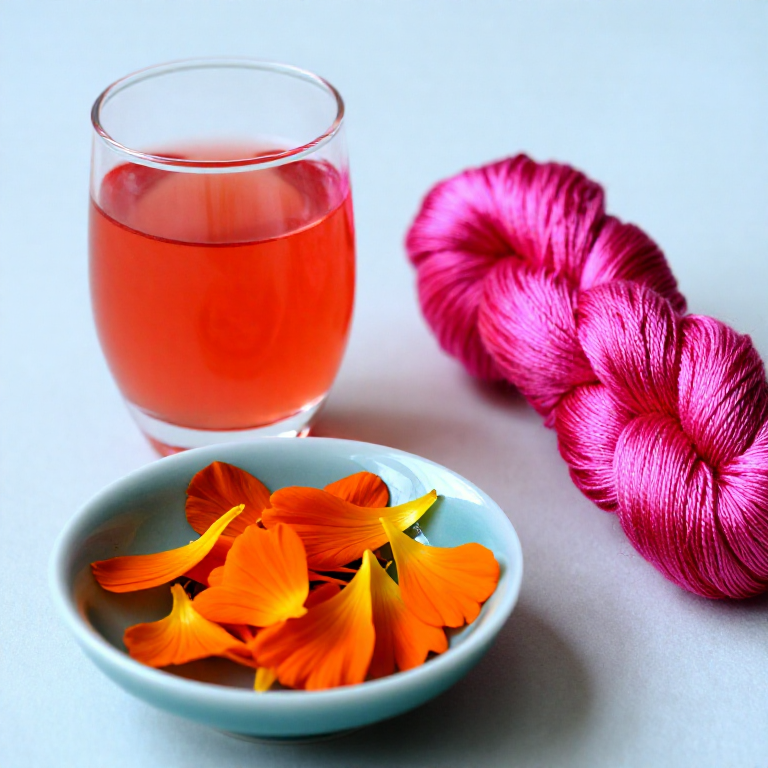


Dyeing with Safflower — Two Colours from One Flower
Safflower (Carthamus tinctorius) is unique among dye plants: a single batch of petals contains two completely different pigments that are separated by their solubility in water. The yellow pigment (safflor yellow) dissolves readily in cold water and washes away. The red pigment (carthamin) is insoluble in water but dissolves in alkaline solution. By first washing out the unwanted yellow in cold water, then extracting the red with an alkali, the dyer obtains a vivid pink-red dye from what appears to be a bright yellow flower.
This dual-pigment property was discovered independently by dyers in ancient Egypt, Persia, India, China, and Japan. Safflower-dyed linen wrappings have been found in Egyptian tombs dating to 3500 BCE. In Japan, safflower dye (benibana, 紅花) was so valued that the annual safflower harvest in Yamagata Prefecture was celebrated as a festival. The extracted red — beni — was used for silk dyeing, cosmetics (traditional Japanese rouge), and the red colour of the Japanese imperial court's ceremonial robes.
Safflower red (carthamin) bonds to silk beautifully without any mordant, producing a luminous coral-pink that no other natural dye replicates. On alum-mordanted wool, it gives a softer rose. The colour is not highly lightfast — it fades in sunlight over months — but its brilliance and the elegance of the extraction process make safflower dyeing one of the most rewarding experiences in textile arts.
Consignes
Weigh the dried safflower petals
Weigh the dried safflower petals
Use 100-200% WOF of dried safflower petals. For 50 g of silk or wool, weigh out 50-100 g of dried petals. Safflower contains only about 0.3-0.6% carthamin by weight — the vast majority of the petal mass is the yellow pigment and plant matter — so high ratios are needed for a meaningful red. The dried petals are bright orange-yellow and very light. Buy food-grade safflower petals (also sold as 'false saffron' in spice markets) or grow your own.
Matériaux pour cette étape :
 Pétales de carthame (séchés)100 g
Outils nécessaires :
 Balance de cuisine numérique
Wash out the yellow pigment in cold water
Wash out the yellow pigment in cold water
Place the petals in a bowl and cover with cold water. Knead and squeeze the petals gently for 5 minutes — the water will turn a deep yellow as the water-soluble safflor yellow dissolves. Drain off the yellow water. Repeat 5-8 times with fresh cold water until the runoff is nearly clear and no more yellow washes out. This may take 30-45 minutes. The yellow wash-water can be saved — it dyes mordanted wool a soft golden yellow, so nothing is wasted. The petals will now be a dull pink-red, having lost their yellow coating.
Extract the red pigment with alkaline water
Extract the red pigment with alkaline water
Dissolve 5 g of washing soda (sodium carbonate) in 1 litre of warm water to make an alkaline solution (about pH 10-11). Add the washed petals and knead gently for 10-15 minutes. The alkaline water dissolves the carthamin — the liquid turns a vivid, deep red-orange. Strain the petals out and squeeze them to extract all the red liquid. Repeat the alkaline extraction 2-3 times with fresh alkaline water until the petals stop yielding red. Combine all the red extracts in a single bowl — this is the safflower dye concentrate.
Outils nécessaires :
 Passoire à maille fine
Acidify the extract to precipitate the red dye
Acidify the extract to precipitate the red dye
Add white vinegar or citric acid to the red alkaline extract, drop by drop, while stirring. As the pH drops below 6 (mildly acidic), the dissolved carthamin becomes insoluble again and precipitates as fine red particles, turning the liquid cloudy and pink-red. This is the same chemistry as cochineal pH shifting — carthamin changes form with pH. For direct dyeing (without precipitating), simply use the alkaline extract at pH 10-11 — the fibre absorbs the dissolved carthamin and when rinsed in slightly acidic water, the dye becomes insoluble inside the fibre.
Matériaux pour cette étape :
 Vinaigre blanc de nettoyage100 ml
Outils nécessaires :
 Cuillère à remuer en bois
Dye the fibre in the alkaline red extract
Dye the fibre in the alkaline red extract
For the simplest method: take the alkaline red extract (before acidifying) and add the pre-wetted wool or silk directly. For silk, no mordant is needed — carthamin bonds directly to silk protein with exceptional affinity. For wool, alum-mordanted fibre gives better results. Submerge the fibre and let it soak at room temperature for 30-60 minutes without heat. Safflower red is best absorbed cool — heat degrades carthamin. Turn the fibre every 10 minutes for even colour. The fibre will turn a vivid pink-red.
Matériaux pour cette étape :
 Écheveau de laine50 g
Rinse in acidified water to set the colour
Rinse in acidified water to set the colour
Remove the dyed fibre and rinse in water with a splash of vinegar (1 tablespoon per litre). The acidic rinse converts the dissolved carthamin inside the fibre to its insoluble form, locking it in place. Rinse until the water runs mostly clear. The final colour is a luminous coral-pink on silk, a softer rose on wool — warm, glowing, and unlike any other natural dye. Safflower pink has moderate washfastness but poor lightfastness — protect dyed items from prolonged sunlight.
Understand safflower's role in dye history
Understand safflower's role in dye history
Safflower's unique chemistry — two pigments separated by solubility — made it one of the most economical dyes in the ancient world. The yellow wash-water dyed cheap cotton and linen. The precious red extract dyed luxury silk. Nothing was wasted. In Japan, safflower beni was not only a textile dye but the primary cosmetic rouge until the 20th century — geisha applied beni to their lips, and the word kurenai (crimson) in Japanese poetry refers specifically to safflower red. In Egypt, safflower was found in Tutankhamun's tomb. One flower, two colours, three thousand years of continuous use across three continents.
Matériaux
3- Espace réservé
- Espace réservé
- Espace réservé
Outils requis
3- Espace réservé
- Espace réservé
- Espace réservé
Matériaux des Blueprints connectés
Blueprints liés
Ces blueprints partagent des connaissances — techniques, matériaux ou principes

CC0 Domaine public
Ce blueprint est publié sous CC0. Vous êtes libre de copier, modifier, distribuer et utiliser ce travail pour tout usage, sans demander la permission.
Soutenez le Maker en achetant des produits via son Blueprint où il perçoit une Commission Maker définie par les Vendeurs, ou créez une nouvelle itération de ce Blueprint et incluez-le comme connexion dans votre propre Blueprint pour partager les revenus.