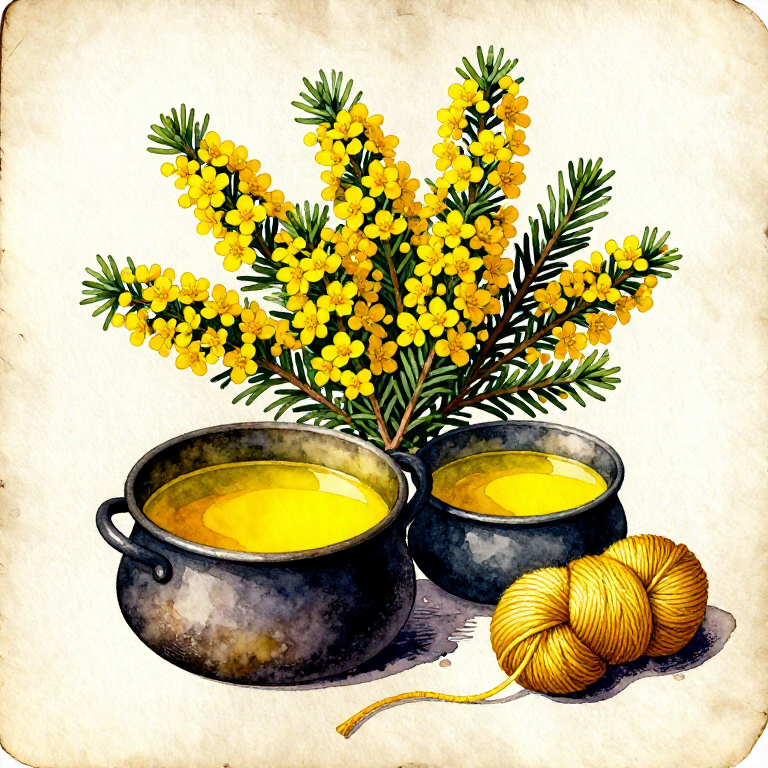


Dyeing Yellow with Dyer's Broom — The Greenweed That Made Lincoln Green
Dyer's broom (Genista tinctoria), also called dyer's greenweed or woodwaxen, is a small shrub native to Europe and Western Asia. Its flowering tops contain the flavonoid pigments genistein and luteolin, producing a clear, warm yellow on alum-mordanted wool. Dyer's broom has been used since at least the Roman period, but its greatest fame came in medieval England where it was one half of the recipe for Lincoln green — the colour of Robin Hood's Merry Men.
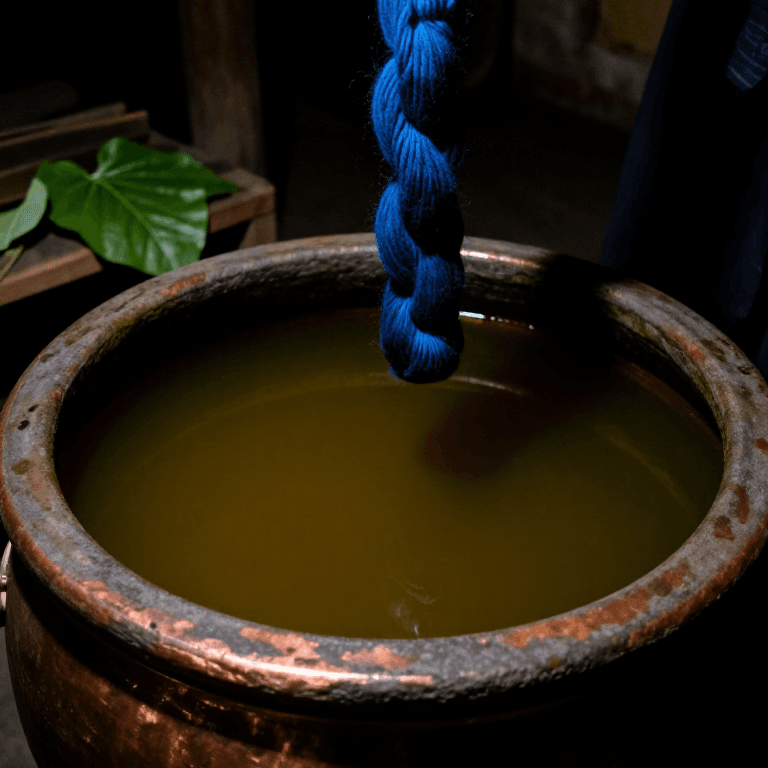
Lincoln green was made by first dyeing wool blue with woad, then over-dyeing with dyer's broom yellow. The combination produced a deep, rich green that became the signature colour of English forest culture. Saxon green used the same principle but with different proportions. The town of Lincoln was a major centre for green cloth production in the 12th-14th centuries, and dyer's broom was cultivated commercially across the English Midlands to supply the trade.
As a standalone yellow dye, dyer's broom produces a warm, clear golden-yellow on alum-mordanted wool. The colour is comparable to weld but slightly warmer in tone. Lightfastness is moderate to good — not quite matching weld but superior to most flower-based yellows. The plant grows readily in poor, sandy soils and self-seeds freely, making it a practical choice for household and commercial dyers.
Consignes
Weigh the dried dyer's broom flowering tops
Weigh the dried dyer's broom flowering tops
Use 100% WOF of dried flowering tops — flowers, leaves, and young stems. For 100 g of wool, weigh out 100 g of dried plant material. Harvest dyer's broom when the small yellow pea-like flowers are fully open, typically in June-July. Cut the top 20-30 cm of stems. Dry loosely bundled in shade for 1-2 weeks until brittle. The dried plant retains a faint green colour and mild herbal scent.
Matériaux pour cette étape :
 Sommités fleuries de genêt des teinturiers (séchées)100 g
Outils nécessaires :
 Balance de cuisine numérique
Soak the plant material in warm water for one hour
Soak the plant material in warm water for one hour
Place the dried dyer's broom in a dye pot with 4 litres of warm water and soak for at least one hour. The water will turn a pale golden-green as the flavonoids begin to dissolve. The woody stems take longer to hydrate than the flowers and leaves. Pressing the material below the surface ensures even extraction.
Outils nécessaires :
 Marmite haute
Simmer at 80°C for 40 minutes
Simmer at 80°C for 40 minutes
Bring the pot to a gentle simmer (75-80°C) and hold for 40 minutes. Do not boil — excessive heat dulls the yellow. Stir occasionally. The liquid will deepen to a warm golden-yellow. The flowers will lose their colour and the stems will darken as the pigment transfers to the water.
Outils nécessaires :
 Thermomètre de cuisson
 Cuillère à remuer en bois
Strain out the plant material
Strain out the plant material
Strain the dye liquor through a fine mesh strainer into a clean pot. Press the spent plant material to extract all remaining yellow liquid. The strained liquor should be a clear, warm golden-yellow.
Outils nécessaires :
 Passoire à maille fine
Dye alum-mordanted wool at 80°C for 45 minutes
Dye alum-mordanted wool at 80°C for 45 minutes
Pre-wet the alum-mordanted wool in lukewarm water for 15 minutes, squeeze gently, and lower it into the dyer's broom bath at room temperature. Slowly raise to 80°C over 15 minutes, then hold for 45 minutes. Turn gently every 10 minutes. The wool will develop a warm, clear golden-yellow — the colour that medieval English dyers over-dyed with woad to create Lincoln green.
Matériaux pour cette étape :
 Écheveau de laine100 g
 Alun (alun de potassium)10 g
Cool, rinse, and dry
Cool, rinse, and dry
Turn off the heat and let the wool cool in the dye bath overnight. Remove, squeeze gently, and rinse in lukewarm water until the runoff is clear. The final colour is a warm golden-yellow, slightly warmer and less green-tinted than weld. Lightfastness is moderate to good. Dry in shade.
Matériaux
3- Espace réservé
- 100 gEspace réservé
- Espace réservé
Outils requis
5- Espace réservé
- Espace réservé
- Espace réservé
- Espace réservé
- Espace réservé
Matériaux des Blueprints connectés
Ce plan fabrique

Blueprints liés
Ces blueprints partagent des connaissances — techniques, matériaux ou principes
CC0 Domaine public
Ce blueprint est publié sous CC0. Vous êtes libre de copier, modifier, distribuer et utiliser ce travail pour tout usage, sans demander la permission.
Soutenez le Maker en achetant des produits via son Blueprint où il perçoit une Commission Maker définie par les Vendeurs, ou créez une nouvelle itération de ce Blueprint et incluez-le comme connexion dans votre propre Blueprint pour partager les revenus.