ART
BEAUTÉ ET BIEN-ÊTRE
ARTISANAT
CULTURE ET HISTOIRE
DIVERTISSEMENT
ENVIRONNEMENT
NOURRITURE ET BOISSONS
INGÉNIERIE INVERSE
SCIENCES
SPORTS
TECHNOLOGIE
TECHNOLOGIE PORTABLE


Grist: Measure a Yarn by Length per Weight, Not by Eye
A yarn's thickness cannot usefully be measured with a caliper, because it squashes and because it is never the same twice along its length.
So the trade measures **grist** — a length per unit weight. Metres per gram, yards per pound, or one of the count systems. It is easy to measure precisely, it does not depend on how hard anything is squeezed, and it is what every other number in a project is calculated from.
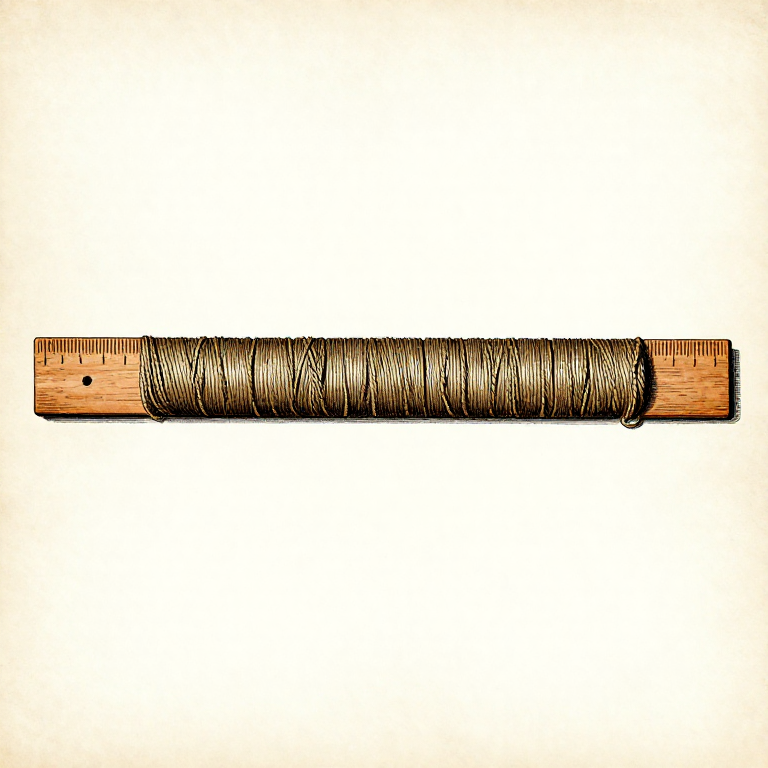
The field version is **wraps per inch**: wind the yarn round a ruler and count. It needs no scale, it takes ten seconds, and it is accurate enough to plan with.
Intermédiaire
2 hours
Consignes
1
1
Measuring grist properly
Measuring grist properly
**Wind a skein of known length**, using a niddy-noddy or a warping board or two chair backs a measured distance apart. Count the wraps and multiply. A niddy-noddy that gives a two-metre circuit makes this trivial.
**Wash and dry the skein before weighing it.** Two reasons, and both matter: yarn takes up moisture from the air, so an unwashed skein's weight depends on the weather; and washing sets the twist and lets the yarn relax to its finished length, which is what you will actually be using.
**Weigh it on a scale reading to a tenth of a gram**, and divide.
**Yarn shrinks in length when it is washed**, sometimes by ten per cent or more for a woollen yarn, because the crimp comes back. A skein measured before washing over-states the length you have.
**Record it with the fibre and the twist.** "Corriedale, worsted prep, 35 degrees, 11 m/g" is a yarn that can be made again. "DK weight" is not.
Matériaux pour cette étape :
 Fil de laine écru1 pièce
Outils nécessaires :
 Balance de précision
 Règle en acier
 Carnet
2
2
The numbers, and how much a project needs
The numbers, and how much a project needs
Chargement du notebook Jupyter…
Outils nécessaires :
 Ordinateur de bureauCarnet
3
3
The count systems, and why they run backwards
The count systems, and why they run backwards
Commercial yarn is sold by **count**, and the systems are a genuine historical mess worth being able to read.
**Indirect systems — a bigger number means a FINER yarn.** They ask "how many hanks of a fixed length make a pound?"
*Worsted count (NeW)*, hanks of 560 yards per pound. *Cotton count (Ne)*, hanks of 840 yards. *Woollen (YSW)*, 256 yards. *Linen lea*, 300 yards.
**Direct systems — a bigger number means a THICKER yarn.** They ask "what does a fixed length weigh?"
*Tex*, grams per 1000 metres. *Denier*, grams per 9000 metres. *Decitex*, grams per 10000 metres.
**Tex is the modern standard** and the only one that is not tied to a particular fibre's history. Tex = 1000 divided by metres per gram, which makes it trivial to convert.
**A plied yarn is written as two numbers** — 2/20 worsted is two singles of 20s plied together, which is thicker than a single 20s, not thinner. Which way round the numbers go varies by country, which is why a sample is worth more than a label.
Matériaux pour cette étape :
Fil de laine écru1 pièce Fil de lin1 pièce
Outils nécessaires :
Balance de précisionCarnetOrdinateur de bureau4
4
Consistency, and the control card
Consistency, and the control card
Spinning a consistent yarn over many hours is harder than spinning a good one for a minute, and there is one technique that solves it.
**Make a control card.** Wind a short length of the yarn you want around a piece of card, and keep it attached to the wheel. Compare the yarn coming off the bobbin against it every few minutes. The eye drifts over an hour and the card does not.
**Keep a sample of the fibre too**, drafted to the width it should be. Most drift is in the drafting, not the twist.
**Fill bobbins to the same level** if the yarn is to be plied, or the plying runs out on one side.
**Spin the whole project's singles before plying any of it**, and ply from bobbins taken from across the whole run rather than in order. That averages the drift out instead of concentrating it at one end of the finished yarn.
**Where consistency truly cannot be achieved**, alternate. A garment knitted alternately from two skeins shows no join at all, and one knitted from skein after skein shows a band at every change. That is the standard answer to variable handspun, and it is worth planning for rather than discovering.
Matériaux pour cette étape :
Fil de laine écru2 piècesOutils nécessaires :
Balance de précisionRègle en acierCarnetMatériaux
2- 4 piècesEspace réservé
- 1 pièceEspace réservé
Blueprints liés
Ces blueprints partagent des connaissances — techniques, matériaux ou principes
CC0 Domaine public
Ce blueprint est publié sous CC0. Vous êtes libre de copier, modifier, distribuer et utiliser ce travail pour tout usage, sans demander la permission.
Soutenez le Maker en achetant des produits via son Blueprint où il perçoit une Commission Maker définie par les Vendeurs, ou créez une nouvelle itération de ce Blueprint et incluez-le comme connexion dans votre propre Blueprint pour partager les revenus.