ART
BEAUTÉ ET BIEN-ÊTRE
ARTISANAT
CULTURE ET HISTOIRE
DIVERTISSEMENT
ENVIRONNEMENT
NOURRITURE ET BOISSONS
INGÉNIERIE INVERSE
SCIENCES
SPORTS
TECHNOLOGIE
TECHNOLOGIE PORTABLE
Youblob · CC0


Hydroxyl-Ended Silicone Oil: D4 Opened with Potash, Then Water (Ceyzeriat 1964)
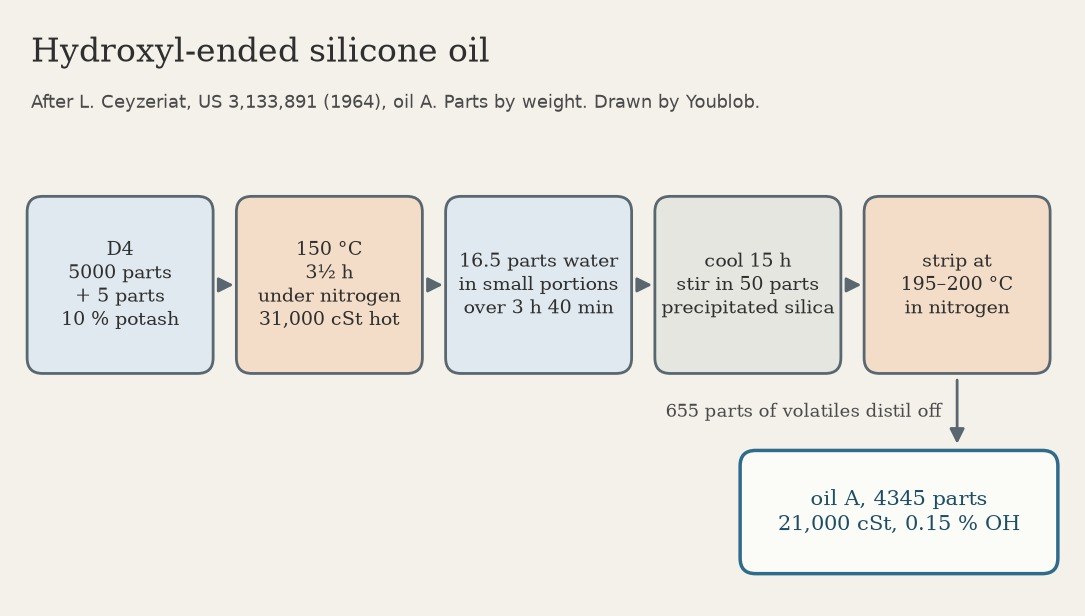
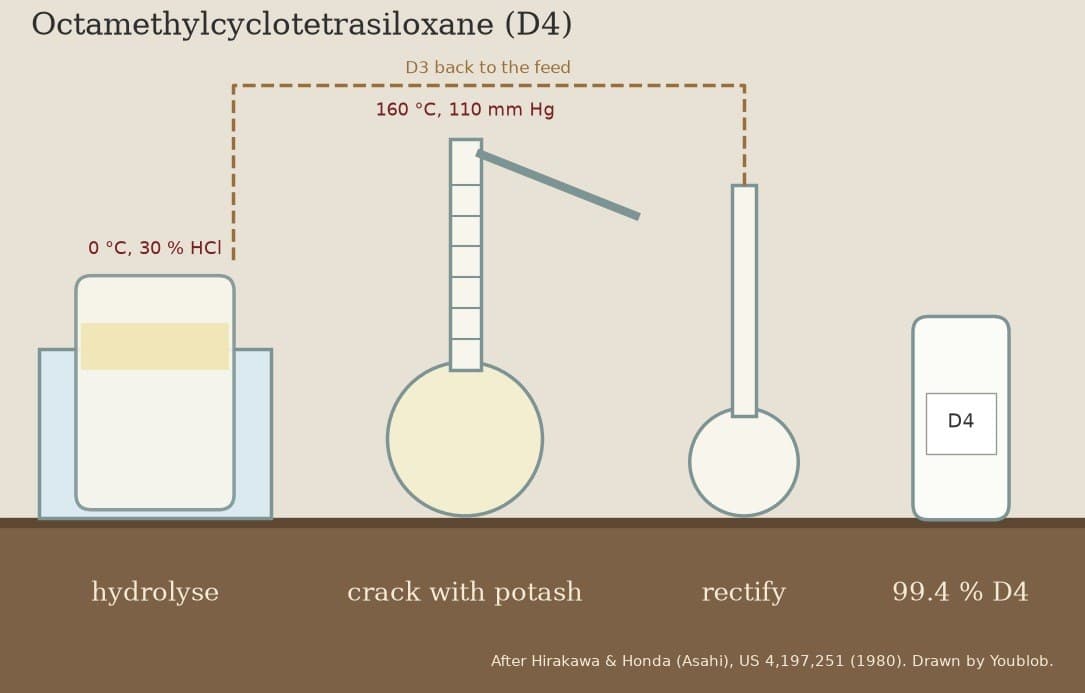
A trace of hot potash opens the ring of D4 and strings it into a long, thick chain. Water added a little at a time then cuts the chains back and leaves hydroxyl groups on their ends, which is what later lets the oil cure into rubber. This is Louis Ceyzeriat's oil A, the base of every sealant in his patent: 21,000 centistokes, 0.15 % hydroxyl.
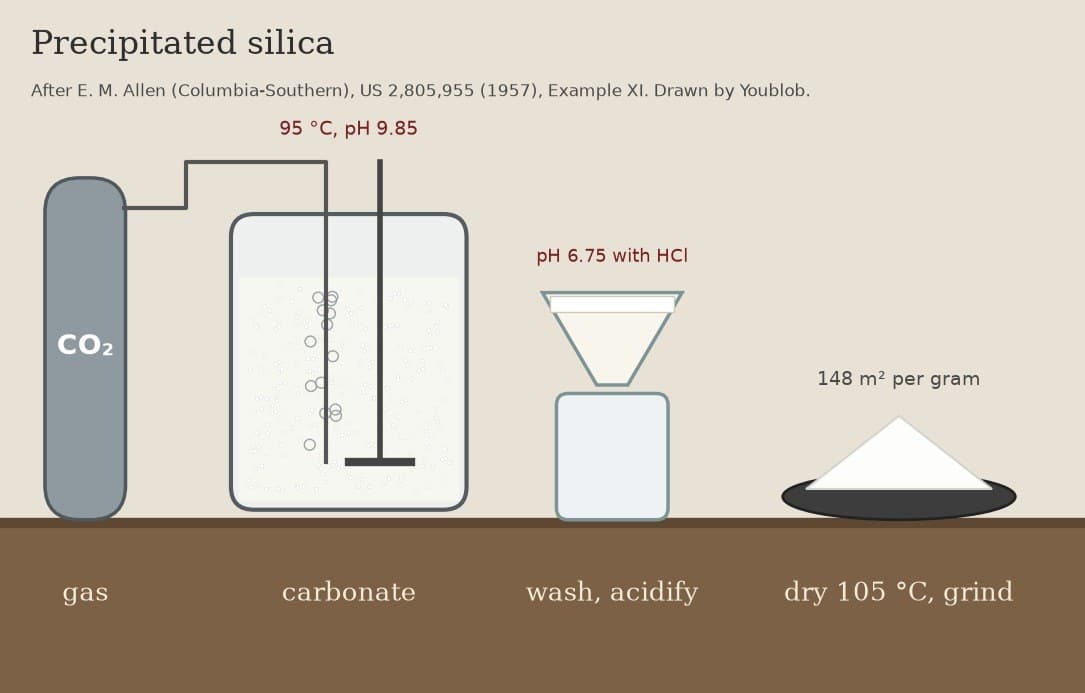
Source: L. Ceyzeriat (Rhône-Poulenc), US 3,133,891 (1964), column 4. His neutraliser was the precipitated silica Hi-Sil X303; we use our precipitated silica in its place. The potash mix and the equipment are ours. Picture drawn by Youblob.
Avancé
2 days
Consignes
1
1
Make the 10 % potash
Make the 10 % potash
Dissolve 0.5 part of potassium hydroxide in 4.5 parts of water (our arithmetic for 5 parts of a 10 % solution). All parts are by weight.
Matériaux pour cette étape :
 Hydroxyde de potassium0.5 parts
 Eau4.5 parts
Outils nécessaires :
 Récipient en verre
 Balance à fléau
2
2
Heat D4 with the potash under nitrogen
Heat D4 with the potash under nitrogen
Heat 5000 parts of octamethylcyclotetrasiloxane (it melts at 17.5 °C) with the 5 parts of 10 % potash at 150 °C for 3½ hours under nitrogen. The oil thickens to 31,000 centistokes while hot.
Matériaux pour cette étape :
 Octaméthylcyclotétrasiloxane (D4)5000 parts
Outils nécessaires :
 Ballon de distillation en verre
 Plaque chauffante
 Thermomètre
 Agitateur
 Bouteille d’azote
3
3
Add water a little at a time
Add water a little at a time
Still hot, add 16.5 parts of water in small portions over 3 hours 40 minutes. The hot oil thins to 1730 centistokes.
Matériaux pour cette étape :
Eau16.5 partsOutils nécessaires :
Ballon de distillation en verrePlaque chauffanteThermomètreAgitateur4
4
Cool, then neutralise with silica
Cool, then neutralise with silica
Let it cool for 15 hours. Then stir in 50 parts of precipitated silica to neutralise the potash. The liquid now measures 13,400 centistokes at 25 °C.
Matériaux pour cette étape :
 Silice précipitée50 parts
Outils nécessaires :
Ballon de distillation en verreAgitateur5
5
Strip the volatiles at 195–200 °C
Strip the volatiles at 195–200 °C
Heat it to about 195–200 °C in a current of nitrogen, with a water condenser on the outlet. 655 parts of liquid distil over; 4345 parts of oil A stay in the boiler, 21,000 centistokes at 25 °C with 0.15 % hydroxyl groups.
Outils nécessaires :
Ballon de distillation en verre Serpentin de condenseurPlaque chauffanteThermomètreBouteille d’azote
 Bocaux en verre avec couvercle
Matériaux
4- 0.5 partsEspace réservé
- 21 partsEspace réservé
- 5000 partsEspace réservé
- 50 partsEspace réservé
Outils requis
9- Espace réservé
- Espace réservé
- Espace réservé
- Espace réservé
- Espace réservé
- Espace réservé
- Espace réservé
- Espace réservé
- Espace réservé
Ce plan fabrique
Blueprints liés
Ces blueprints partagent des connaissances — techniques, matériaux ou principes
CC0 Domaine public
Ce blueprint est publié sous CC0. Vous êtes libre de copier, modifier, distribuer et utiliser ce travail pour tout usage, sans demander la permission.
Soutenez le Maker en achetant des produits via son Blueprint où il perçoit une Commission Maker définie par les Vendeurs, ou créez une nouvelle itération de ce Blueprint et incluez-le comme connexion dans votre propre Blueprint pour partager les revenus.