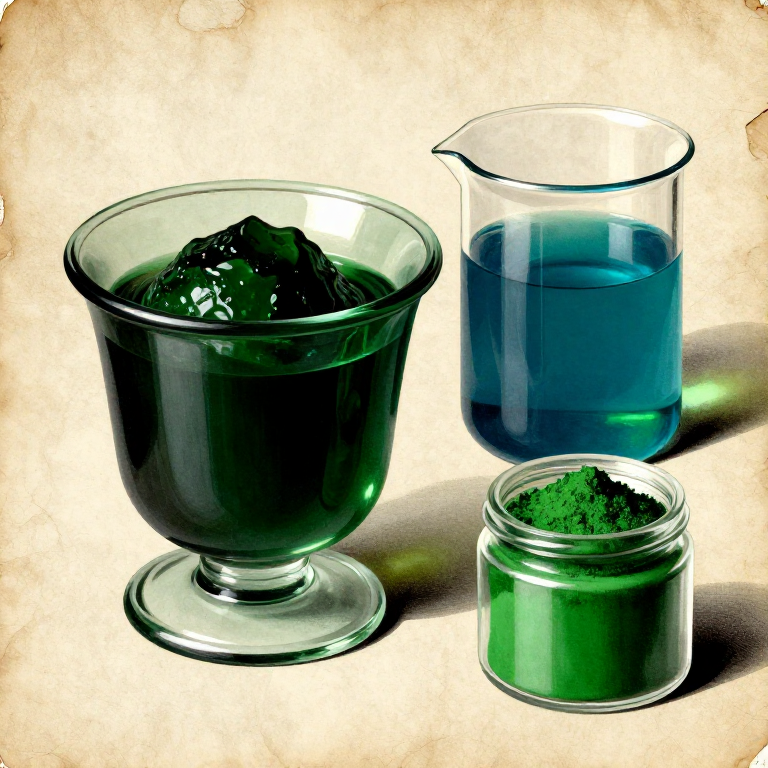

Making Viridian — The Permanent Transparent Chromium Oxide Green
Viridian (hydrated chromium oxide, Cr₂O₃·2H₂O) is a cool, transparent, blue-green pigment first developed by Pannetier and Binet in Paris in 1838. It was the answer to a long-standing problem in painting: how to get a permanent, transparent green that would not darken, fade, or turn brown over time. Copper resinate turned brown; sap green faded; emerald green was lethally toxic; verdigris was unstable. Viridian solved all of these problems — it is completely lightfast, chemically stable, non-toxic as a finished pigment, and has a beautiful cool transparency perfect for glazing.
The pigment is made by heating potassium dichromate with boric acid. The boric acid acts as a reducing flux, converting the hexavalent chromium (Cr⁶⁺, toxic and orange) to trivalent chromium (Cr³⁺, green and stable). The resulting chromium oxide-borate glass is then dissolved in water to remove the borates, leaving pure hydrated chromium oxide — the vivid green pigment. The 'hydrated' form is crucial: anhydrous chromium oxide (Cr₂O₃) is a dull, opaque olive green used as an abrasive; the hydrated form has a completely different crystal structure that produces the vivid, transparent blue-green.
SAFETY WARNING: The starting material — potassium dichromate — is a powerful oxidiser and known human carcinogen (Cr⁶⁺). It is corrosive to skin and mucous membranes. Boric acid is a mild irritant. HOWEVER, the finished pigment (Cr³⁺ oxide) is non-toxic. Full PPE (gloves, goggles, respirator) is mandatory during preparation. Work in a fume hood or well-ventilated area.
Contenu dangereux
Ce blueprint contient des procédures dangereuses. Connectez-vous et activez le contenu dangereux dans les paramètres de votre compte pour voir les instructions étape par étape.
Blueprints liés
Ces blueprints partagent des connaissances — techniques, matériaux ou principes
Making Verdigris — The Copper Acetate Green of Medieval Painters
par Charlie
ART
Making Oil Paint from Raw Pigments — Grinding Pigments in Linseed Oil
par Charlie
ART
Making Watercolour Paint from Raw Pigments — Gum Arabic Binder
par Charlie
ART
Making Egg Tempera Paint — The Medieval Panel Painting Medium
par Charlie
ART
Making Acrylic Paint — Grinding Pigments into Acrylic Polymer Medium
par Charlie
ART
Making Prussian Blue — The First Modern Synthetic Pigment (Berlin, 1704)
par Charlie
ART
Making Azurite Blue Pigment — Grinding the Copper Mineral into the Blue of Medieval Painting
par Charlie
ART
Making Lead White (Flake White) — The Dutch Stack Process for the Most Important Pigment in Oil Painting History
par Charlie
ART
CC0 Domaine public
Ce blueprint est publié sous CC0. Vous êtes libre de copier, modifier, distribuer et utiliser ce travail pour tout usage, sans demander la permission.
Soutenez le Maker en achetant des produits via son Blueprint où il perçoit une Commission Maker définie par les Vendeurs, ou créez une nouvelle itération de ce Blueprint et incluez-le comme connexion dans votre propre Blueprint pour partager les revenus.