ART
BEAUTÉ ET BIEN-ÊTRE
ARTISANAT
CULTURE ET HISTOIRE
DIVERTISSEMENT
ENVIRONNEMENT
NOURRITURE ET BOISSONS
INGÉNIERIE INVERSE
SCIENCES
SPORTS
TECHNOLOGIE
TECHNOLOGIE PORTABLE
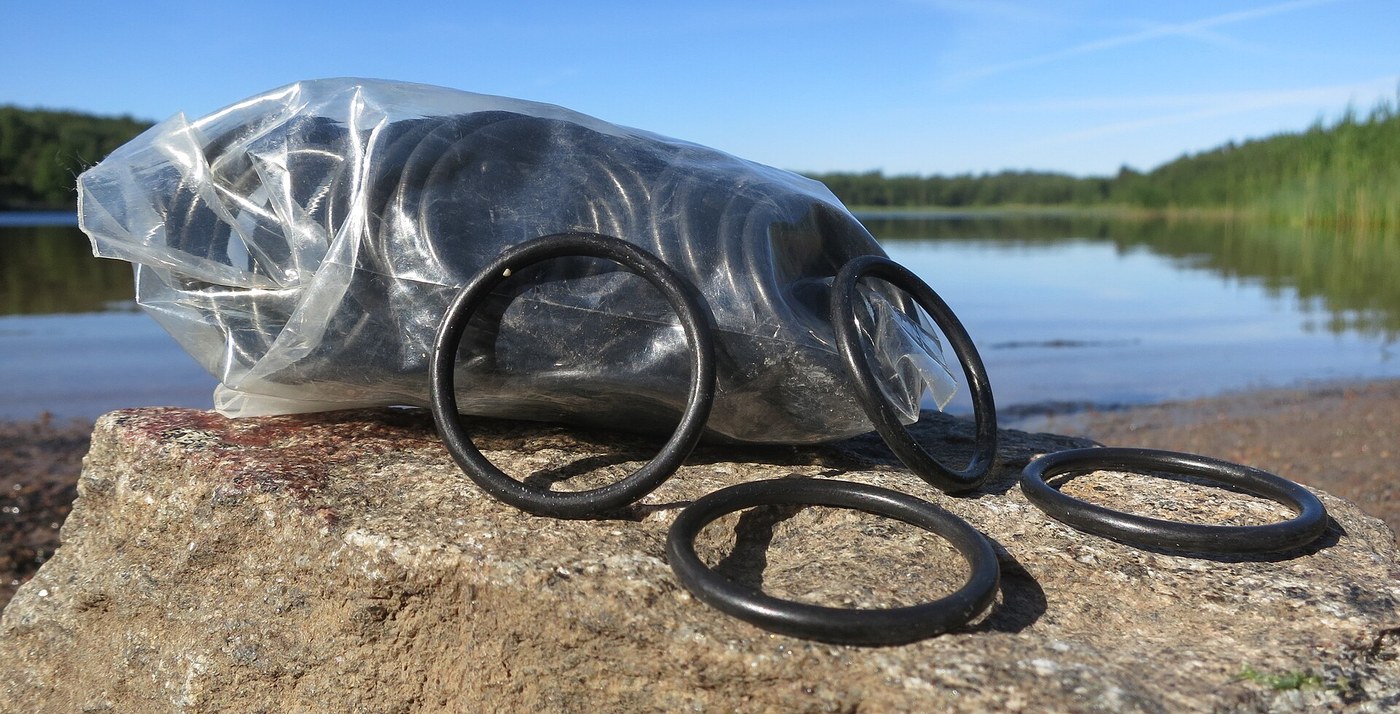


Nitrile Rubber (Buna-N)
At IG Farben in 1930 Erich Konrad and Eduard Tschunkur copolymerised butadiene with acrylonitrile. The nitrile group makes the chain polar, so oil and petrol - which are not - stay out. Sold as Buna N, nitrile rubber became the standard material for oil seals, fuel hoses and, much later, disposable gloves.
**US 1,973,000**, "Rubber like masses from butadiene hydrocarbons and polymerizable nitriles", Konrad and Tschunkur, assigned to IG Farbenindustrie, filed 20. April 1931, granted 11. September 1934. It requires the butadiene to be more than about 60 % by weight of the mix.
**You build the part nitrile made universal: an O-ring seal.** Turn two plugs with sized grooves, close a clear pipe with them, and leave it under water overnight.
Intermédiaire
3 hours plus an overnight soak
Consignes
1
1
The plug
The plug
One turned acetal plug: a flange that stops against the pipe end, a spigot that fits the bore, and a groove carrying the O-ring.
2
2
Measure and choose
Measure and choose
Cut 150 mm of clear PVC pipe and deburr both ends. Measure the bore at three angles and average. Pick a nitrile O-ring about 3 mm thick whose inside diameter is a little under bore minus 5 mm.
Matériaux pour cette étape :
 Tube PVC transparent1 pièce
 Assortiment de joints toriques1 kit
Outils nécessaires :
 Scie à métaux
 Papier abrasif
 Pied à coulisse numérique 6 pouces
3
3
Size the groove
Size the groove
Chargement du notebook Jupyter…
4
4
Turn the spigot
Turn the spigot
Chuck acetal rod. Face it. Turn 12 mm of length to the bore minus 0.1 mm, leaving a 5 mm flange at full pipe outside diameter behind it.
Matériaux pour cette étape :
 Barre de Delrin/acétal1 pièce
Outils nécessaires :
 Tour à métaux
 Jeu d'outils de tournage (HSS)Pied à coulisse numérique 6 pouces
 Lunettes de sécurité transparentes
5
5
Cut the groove
Cut the groove
3 mm from the spigot's end, plunge the parting tool to the root diameter from the notebook, then widen to 4.0 mm. Check the root with the caliper. Break the sharp edges.
Outils nécessaires :
 Bédane de tronçonnageTour à métauxPied à coulisse numérique 6 pouces
6
6
Part off, make the second
Part off, make the second
Part off behind the flange. Make a second identical plug.
Matériaux pour cette étape :
Barre de Delrin/acétal1 pièceOutils nécessaires :
Bédane de tronçonnageTour à métaux7
7
Grease and fit
Grease and fit
Wipe a thin film of petroleum jelly on each O-ring and roll it into its groove without twisting. Put a folded dry paper towel in the pipe and press both plugs home.
Matériaux pour cette étape :
 Vaseline2 g
 Essuie-tout1 feuille
8
8
Overnight under water
Overnight under water
Weigh the capsule down in a bucket of water for 12 hours. Dry it outside, open it, and check the towel. Any damp spot shows which end leaked.
Outils nécessaires :
 Seau
Seau9
9
History & Context
History & Context
**What the patent specifies:** a butadiene hydrocarbon (over about 60 % by weight) polymerised with a polymerisable nitrile, by heating or in emulsion. **Modern build (derived):** commercial NBR O-rings in an acetal gland.
Wartime Germany needed a rubber that fuel could not ruin, and nitrile answered it. More nitrile in the chain means more oil resistance and less flexibility in the cold. Its limits: ozone and sunlight crack it, and it swells in brake fluid and many solvents.
Matériaux
5- 1 pièceEspace réservé
- Espace réservé
- 1 pièceEspace réservé
- 2 gEspace réservé
- 1 feuilleEspace réservé
Outils requis
8- Espace réservé
- Espace réservé
- Espace réservé
- Espace réservé
- Espace réservé
- Espace réservé
- Espace réservé
- Espace réservé
Fichiers de conception
1Blueprints liés
Ces blueprints partagent des connaissances — techniques, matériaux ou principes


CC0 Domaine public
Ce blueprint est publié sous CC0. Vous êtes libre de copier, modifier, distribuer et utiliser ce travail pour tout usage, sans demander la permission.
Soutenez le Maker en achetant des produits via son Blueprint où il perçoit une Commission Maker définie par les Vendeurs, ou créez une nouvelle itération de ce Blueprint et incluez-le comme connexion dans votre propre Blueprint pour partager les revenus.