Collaboration
ART
BEAUTÉ ET BIEN-ÊTRE
ARTISANAT
CULTURE ET HISTOIRE
DIVERTISSEMENT
ENVIRONNEMENT
NOURRITURE ET BOISSONS
INGÉNIERIE INVERSE
SCIENCES
SPORTS
TECHNOLOGIE
TECHNOLOGIE PORTABLE
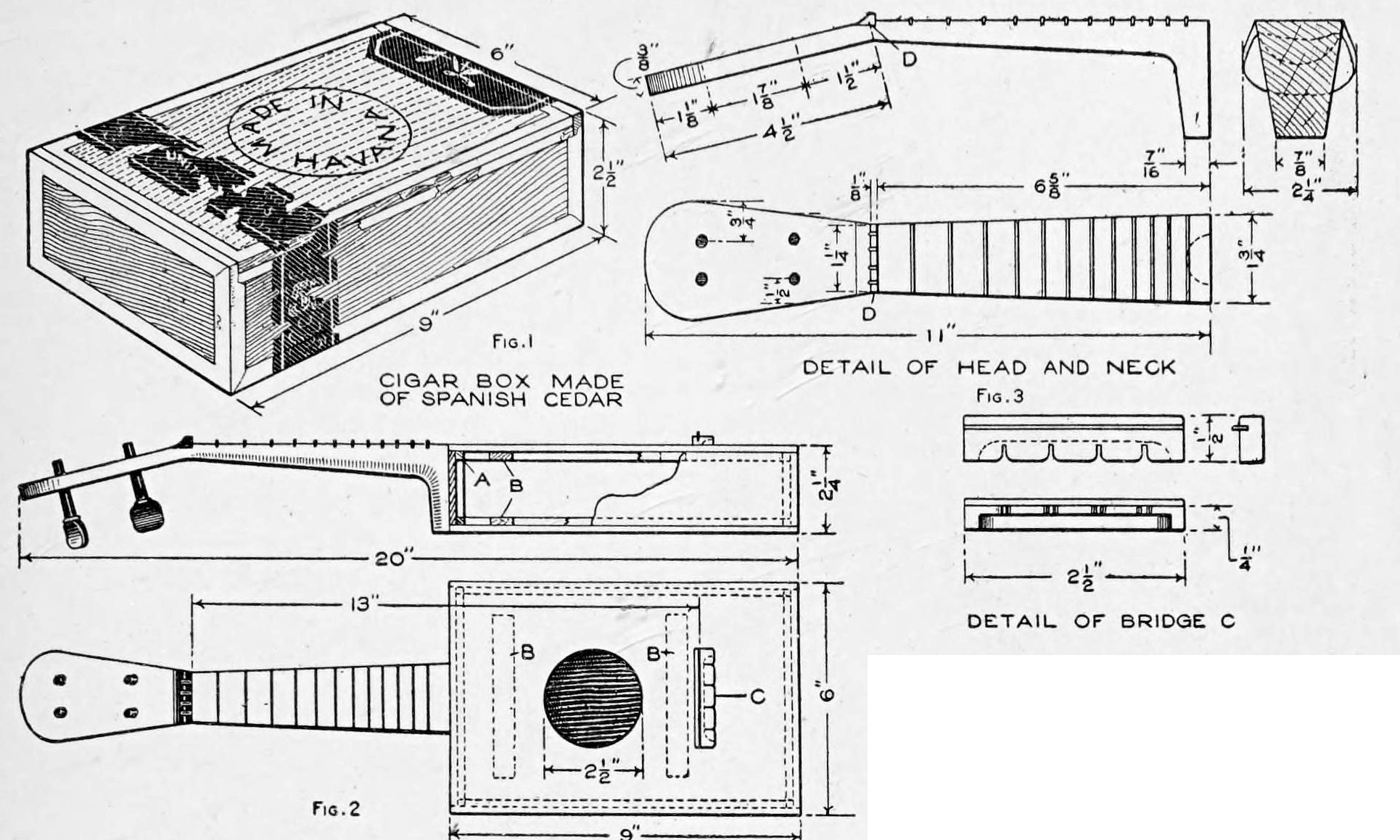


Cigar-Box Hawaiian Ukulele: Spanish-Cedar Body, 11 in Neck and Frets by the Rule of Eighteen (Boy Mechanic, 1919)
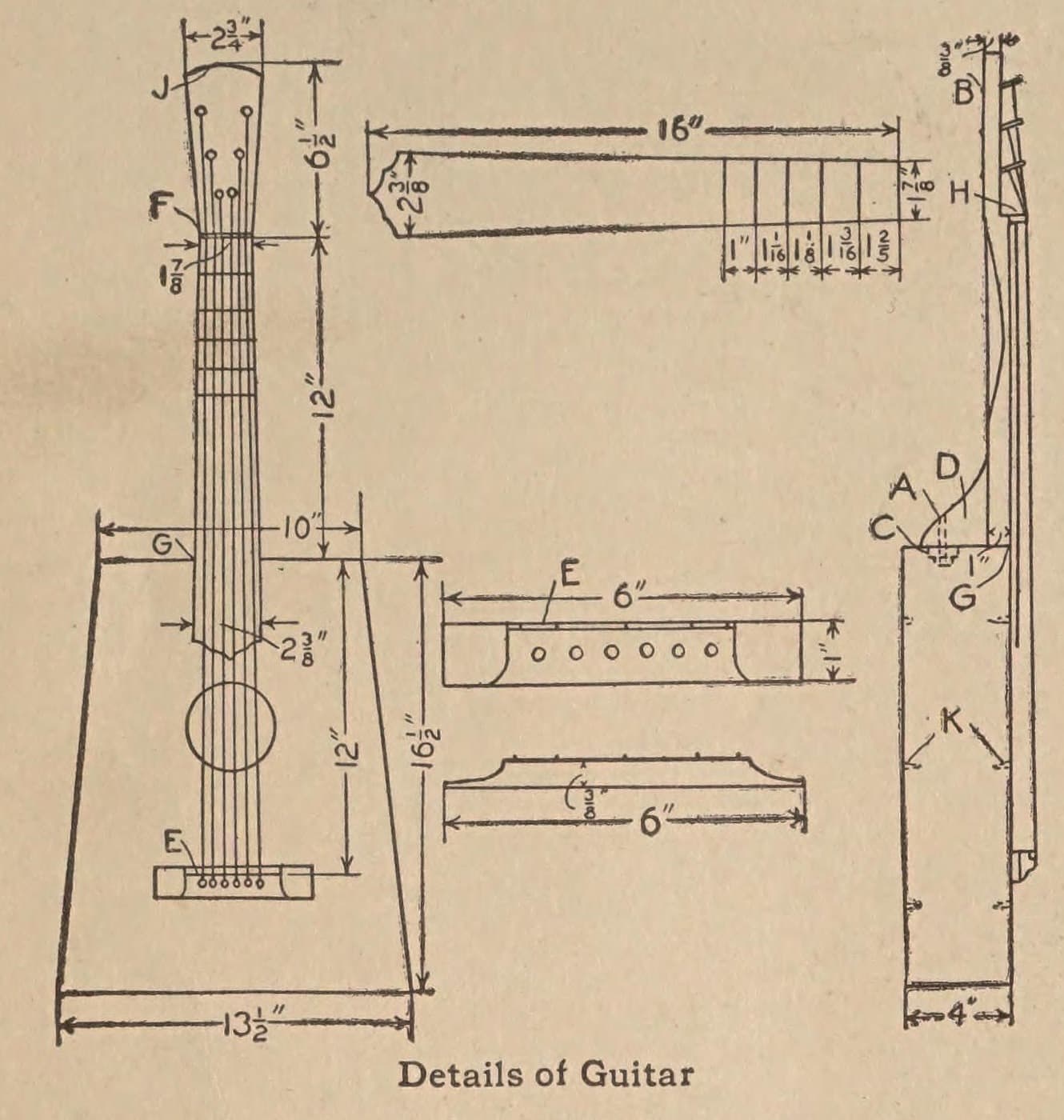
S. H. Samuels's ukulele from The Boy Mechanic, Book 3 (1919), made for 30 cents: a Spanish-cedar cigar box rebuilt as a 9 x 6 in body with a 2-1/2 in sound hole, an 11 in cedar or mahogany neck, a notched hardwood bridge, and aluminium frets set by the old rule of 1/18 on a 13 in string length.
Intermédiaire
About 2 days
Consignes
1
1
Fret table
Fret table
Chargement du notebook Jupyter…
2
2
Read The Boy Mechanic, Book 3
Read The Boy Mechanic, Book 3
"The size of this instrument makes it especially suited to the cigar-box type of body construction."
3
3
Rebuild the box as the body
Rebuild the box as the body
Take a good Spanish-cedar cigar box about 2-1/2 by 6 by 9 in, soak off the paper without marring the wood, take it apart and trim edges with too many or broken nail holes. Fit the parts so top and bottom rest against the sides and ends, the ends between the sides (Fig. 2; drawn 9 by 6 by 2-1/4 in). Cut a 2-1/2 in hole in the top 3-3/4 in from the neck end. Make corner strips A 1/4 in square and strips B 1/4 by 5/8 by 4-1/2 in for under the top and on the bottom.
Matériaux pour cette étape :
 Planche de cèdre1 pièce
Outils nécessaires :
 Scie à chantourner
 Couteau à cuir
 Rabot
 Boussole
 Règle
4
4
Make the neck, nut and bridge
Make the neck, nut and bridge
Cut the neck from Spanish cedar or mahogany, 11 in long, best in one piece (or with the peg extension and the wide body end glued on and doweled): head 4-1/2 in, fingerboard 6-5/8 in from the 1/8 in nut, 1-1/4 in wide at the nut and 1-3/4 in at the body, heel 7/16 in, section 7/8 by 2-1/4 in as drawn (Fig. 3). Make the nut D of mahogany or walnut with the grain lengthwise, notched for the strings as spaced. Make the bridge C of hard wood, 2-1/2 in long and 1/2 in high, hollowed under the notched edge, with a metal string contact.
Matériaux pour cette étape :
 Planche de bois dur1 pièce
 Tourillon en bois1 pièce
 Colle animale1 pièce
 Bande de laiton1 pièce
Outils nécessaires :
 Scie égoïneScie à chantournerCouteau à cuir
 Limes (lime à main)
 Chignole à main
5
5
Fret the fingerboard
Fret the fingerboard
Measure the string length from the bridge contact to the nut (13 in here). Set the first fret 1/18 of that distance from the nut, the second 1/18 of the distance from the first fret to the bridge, and so on (notebook). Cut grooves 1/8 in deep and drive in frets of aluminium (or brass) 1/16 by 3/16 in, tight enough to need no fastening.
Matériaux pour cette étape :
Bande de laiton1 pièceOutils nécessaires :
Scie égoïne Scie à métauxLimes (lime à main)Règle
 Crayon
 Marteau
6
6
Assemble and finish
Assemble and finish
Glue the body's end to the neck with animal glue, reinforced by screws, its upper edge parallel with the fingerboard and the fingerboard flush with the top. Glue the body (without the top) to that end; when dry, glue in the strips, bridge and finally the top. Clean, sandpaper, stain and shellac or varnish. Fit tuning pegs (bought or made) and a set of strings.
Matériaux pour cette étape :
Colle animale1 pièce Vis à bois1 pièce
 Papier abrasif1 pièce
 Vernis à la gomme laque1 pièce
 Chevilles d'accord4 pièces
 Cordes de ukulélé1 pièce
Outils nécessaires :
 Serre-joint à pompe
 Tournevis plat
 Brosse large
7
7
Troubleshooting
Troubleshooting
Ukulele troubleshooting.
Flow
Loading...
8
8
History and honest limits
History and honest limits
From "A Homemade Hawaiian Ukulele" by S. H. Samuels, in **The Boy Mechanic, Book 3**, Popular Mechanics, 1919 (Project Gutenberg 71856; checked on the archive.org scan boymechanic0003unse, pp. 358-359). He gives the box as about 2-1/2 in deep; his drawing shows 2-1/4 in. He names no stain and no string type. The fret table, its equal-temperament comparison and the metric figures are ours.
Matériaux
10- 1 pièceEspace réservé
- 1 pièceEspace réservé
- 1 pièceEspace réservé
- 1 pièceEspace réservé
- 1 pièceEspace réservé
- 1 pièceEspace réservé
- 1 pièceEspace réservé
- 1 pièceEspace réservé
- 4 piècesEspace réservé
- 1 pièceEspace réservé
Outils requis
14- Espace réservé
- Espace réservé
- Espace réservé
- Espace réservé
- Espace réservé
- Espace réservé
- Espace réservé
- Espace réservé
- Espace réservé
- 1 vendor sell this, none ship to you yetEspace réservé
- Espace réservé
- Espace réservé
- Espace réservé
- Espace réservé
Ce plan fabrique

Blueprints liés
Ces blueprints partagent des connaissances — techniques, matériaux ou principes
CC0 Domaine public
Ce blueprint est publié sous CC0. Vous êtes libre de copier, modifier, distribuer et utiliser ce travail pour tout usage, sans demander la permission.
Soutenez le Maker en achetant des produits via son Blueprint où il perçoit une Commission Maker définie par les Vendeurs, ou créez une nouvelle itération de ce Blueprint et incluez-le comme connexion dans votre propre Blueprint pour partager les revenus.