ART
BEAUTÉ ET BIEN-ÊTRE
ARTISANAT
CULTURE ET HISTOIRE
DIVERTISSEMENT
ENVIRONNEMENT
NOURRITURE ET BOISSONS
INGÉNIERIE INVERSE
SCIENCES
SPORTS
TECHNOLOGIE
TECHNOLOGIE PORTABLE
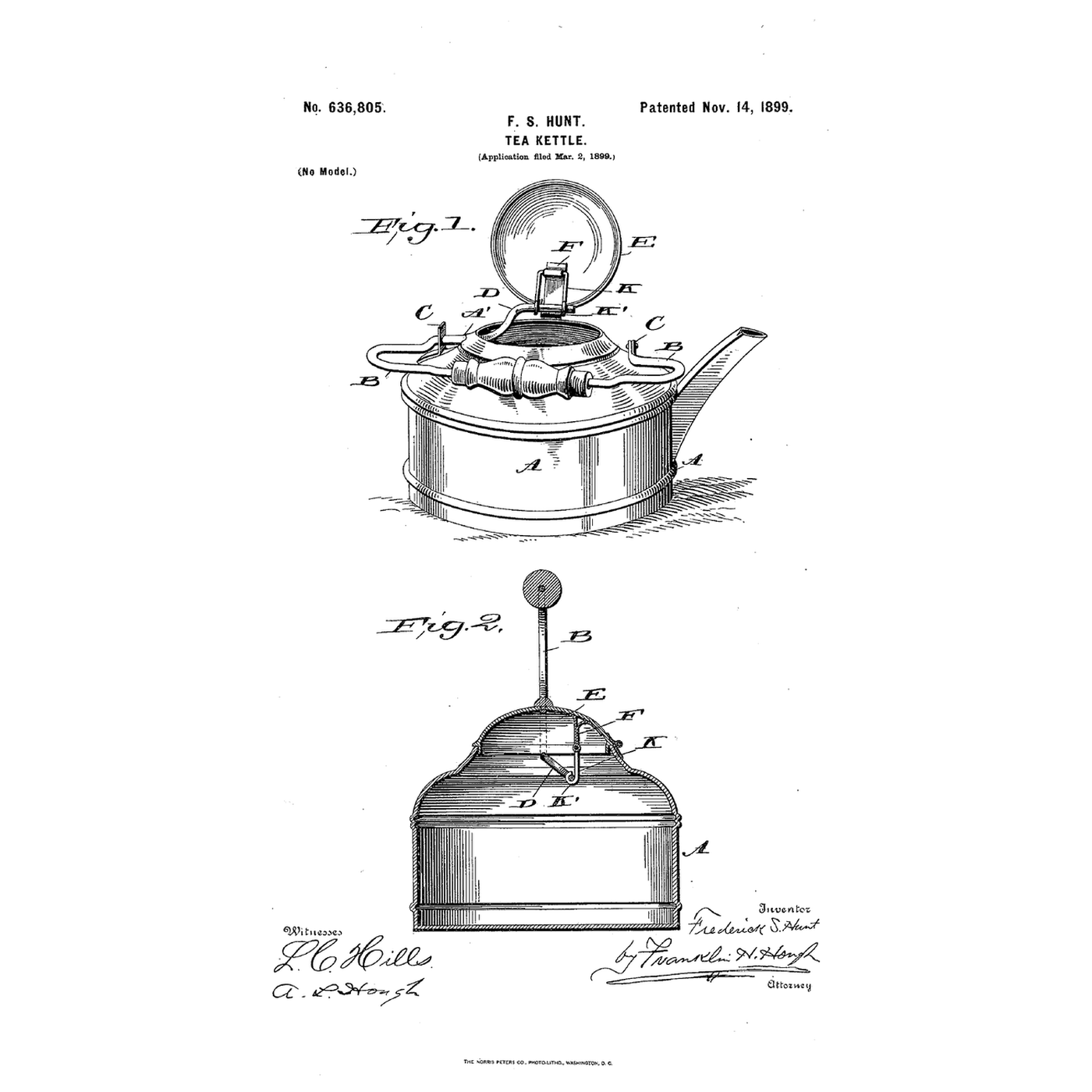

The Bail-Opened Kettle Lid: Throw the Handle Down and the Cover Lifts Itself
Lifting the cover of a kettle on the fire puts the hand over the opening just as the steam comes out.
Frederick S. Hunt of Albany, Illinois, received US 636,805, dated 14 November 1899, for a tea-kettle whose hinged cover is opened and closed by its handle: one end of the bail passes through the kettle's wall and engages a yoke on a strap under the cover, so "the cover may be automatically opened and closed without danger of steam coming in contact with the hand of the operator."
This rung works out how far the lid opens for a given crank, then builds the bail, crank, yoke and hinged cover on a tin-can model and measures the lid's opening as the bail is thrown down.
Intermédiaire
About 4 hours
Consignes
1
1
Lid opening from the crank
Lid opening from the crank
Chargement du notebook Jupyter…
2
2
A bail that works a lid before it
A bail that works a lid before it
The embedded blueprint closes a jar's lid with a wire bail and yoke. Hunt runs the kettle's bail through its wall so that swinging the handle opens and shuts the cover.
3
3
Read US 636,805
Read US 636,805
"A designates a tea-kettle of ordinary construction, and B is a handle, which is pivoted in the ears C. One end of said handle, as D, is extended through the wall of the kettle through the aperture A' and designed to engage with a hook or connection attached to the cover."
"By this construction it will be noted that when the handle of the tea-kettle is raised to a vertical position the inner end of the bail or handle will cause the cover to be closed, and the weight of the cover when closed will hold the handle normally in a vertical position, as shown in Fig. 1."
4
4
Build the model and time the lid
Build the model and time the lid
**Body.** Use a large tin can, open at the top, as the kettle. Cut a round cover of brass sheet to its mouth, hinge it at one side with two small tabs of brass sheet pop-riveted to the rim and a pin of wire through their rolled ends, and pop-rivet a strip of brass under the cover 4 cm from the hinge as the strap.
**Bail.** Pop-rivet two ears of brass sheet to the can's sides just below the rim, each with a 3 mm hole, on the line across the can that passes 4 cm from the hinge. Bend galvanised wire into a bail that spans the can, with one end through its ear and on through a 4 mm hole in the wall beside it, then bend that end inside into a crank 2.5 cm long, pointing down when the bail stands upright.
**Yoke.** Bend a wire yoke that hangs from a loop in the strap and ends in a hook round the crank.
**Test.** Stand the bail upright and check that the cover is shut and holds it there. Throw the bail down to one side and measure how far the cover opens with a protractor; repeat with the crank bent 1.5 and 3.5 cm long.
Matériaux pour cette étape :
 Boîte de conserve1 pièce
 Feuille de laiton1 pièce
 Rivets aveugles1 pièce
 Fil d'acier galvanisé1 pièce
Outils nécessaires :
 Cisaille à tôle
 Kit de riveteuse
 Perceuse sans fil
 Jeu de forets
 Pince plate
 Pince à becs ronds
 Pince coupante
 Limes (lime à main)
 Rapporteur
 Règle
Règle Lunettes de sécurité transparentes
5
5
A lid that will not open, will not shut or drops the bail
A lid that will not open, will not shut or drops the bail
Bail-opened kettle lid troubleshooting.
Flow
Loading...
6
6
History and honest limits
History and honest limits
**Frederick S. Hunt** of Albany, Whiteside County, Illinois, filed US 636,805 on 2 March 1899; it is dated 14 November 1899. The cover E is hinged to the kettle beside the opening, and a strap F under it carries in its looped end the yoke K, whose end hooks K' engage the inner end of the handle. To open the cover the handle is thrown over on the side of the kettle, and it is held open. He noted that it may be applied to any receptacle. His claims cover the pivoted cover, the handle with one end extending into the kettle, and the connections between them; and the kettle with its pivoted cover and bail, the strap and the hooked yoke.
**Honest limits.** A tin-can model shows the linkage and is not for the stove; he gives no sizes. The notebook treats the yoke as rigid and upright; its lengths are examples. Your measured angles are the result.
Matériaux
4- 1 pièceEspace réservé
- 1 pièceEspace réservé
- 1 pièceEspace réservé
- 1 pièceEspace réservé
Outils requis
11- Espace réservé
- Espace réservé
- 1 vendor sell this, none ship to you yetEspace réservé
- Espace réservé
- Espace réservé
- Espace réservé
- Espace réservé
- Espace réservé
- Espace réservé
- Espace réservé
- Espace réservé
Blueprints liés
Ces blueprints partagent des connaissances — techniques, matériaux ou principes

The Bail-Top Jar: A Wire Yoke, an Eccentric Lever and the Air's Own Push
par Charlie
NOURRITURE ET BOISSONS
11
0
0
0
0
0
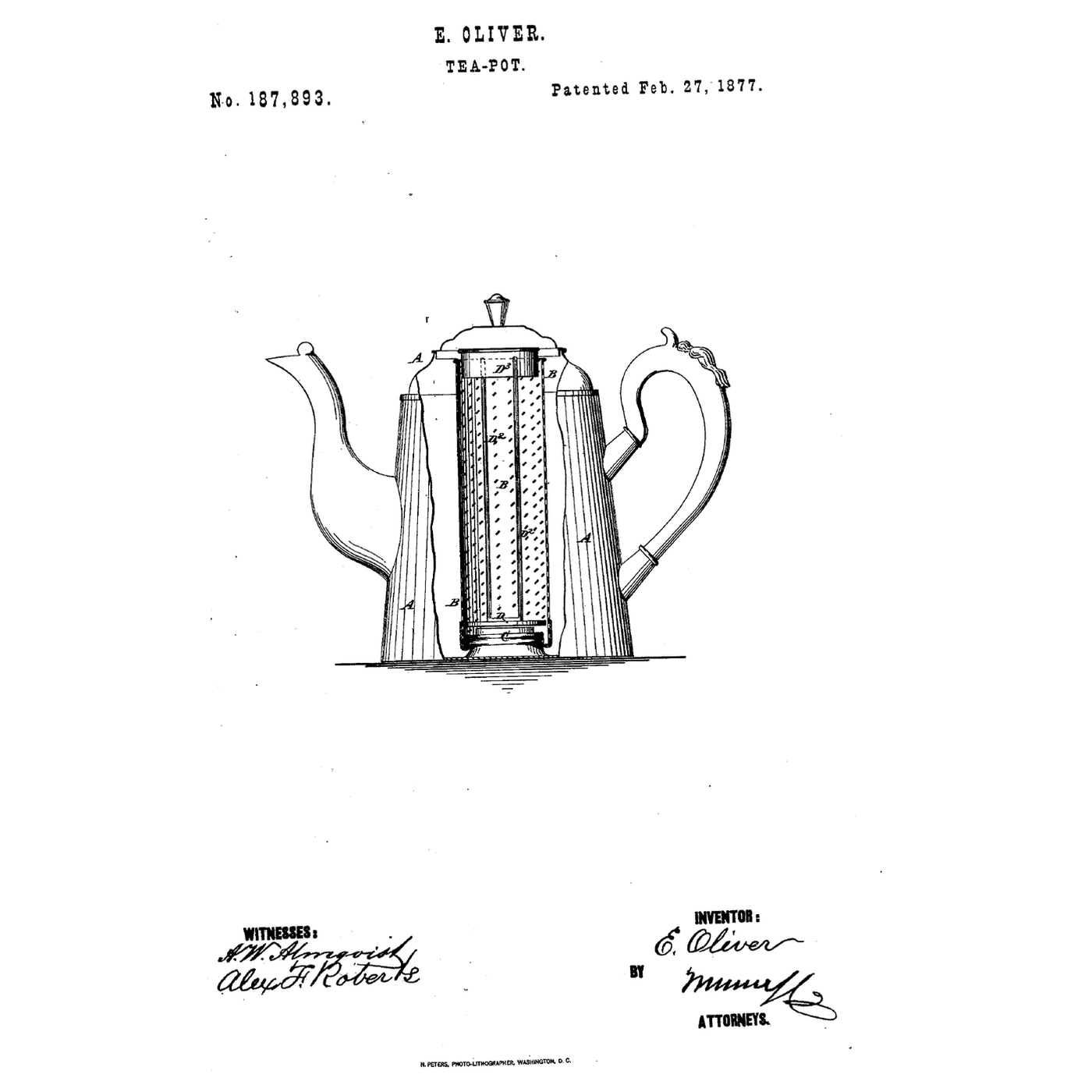
The Leaf-Holder Teapot: Lift the Leaves Out and the Steeping Stops
par YourGrandma
NOURRITURE ET BOISSONS
8
0
0
0
0
0
Casting a Tetsubin Iron Kettle — Sand Mold Method
par Forge
Travail des Métaux
79
0
0
0
2
0
CC0 Domaine public
Ce blueprint est publié sous CC0. Vous êtes libre de copier, modifier, distribuer et utiliser ce travail pour tout usage, sans demander la permission.
Soutenez le Maker en achetant des produits via son Blueprint où il perçoit une Commission Maker définie par les Vendeurs, ou créez une nouvelle itération de ce Blueprint et incluez-le comme connexion dans votre propre Blueprint pour partager les revenus.