ART
BEAUTÉ ET BIEN-ÊTRE
ARTISANAT
CULTURE ET HISTOIRE
DIVERTISSEMENT
ENVIRONNEMENT
NOURRITURE ET BOISSONS
INGÉNIERIE INVERSE
SCIENCES
SPORTS
TECHNOLOGIE
TECHNOLOGIE PORTABLE
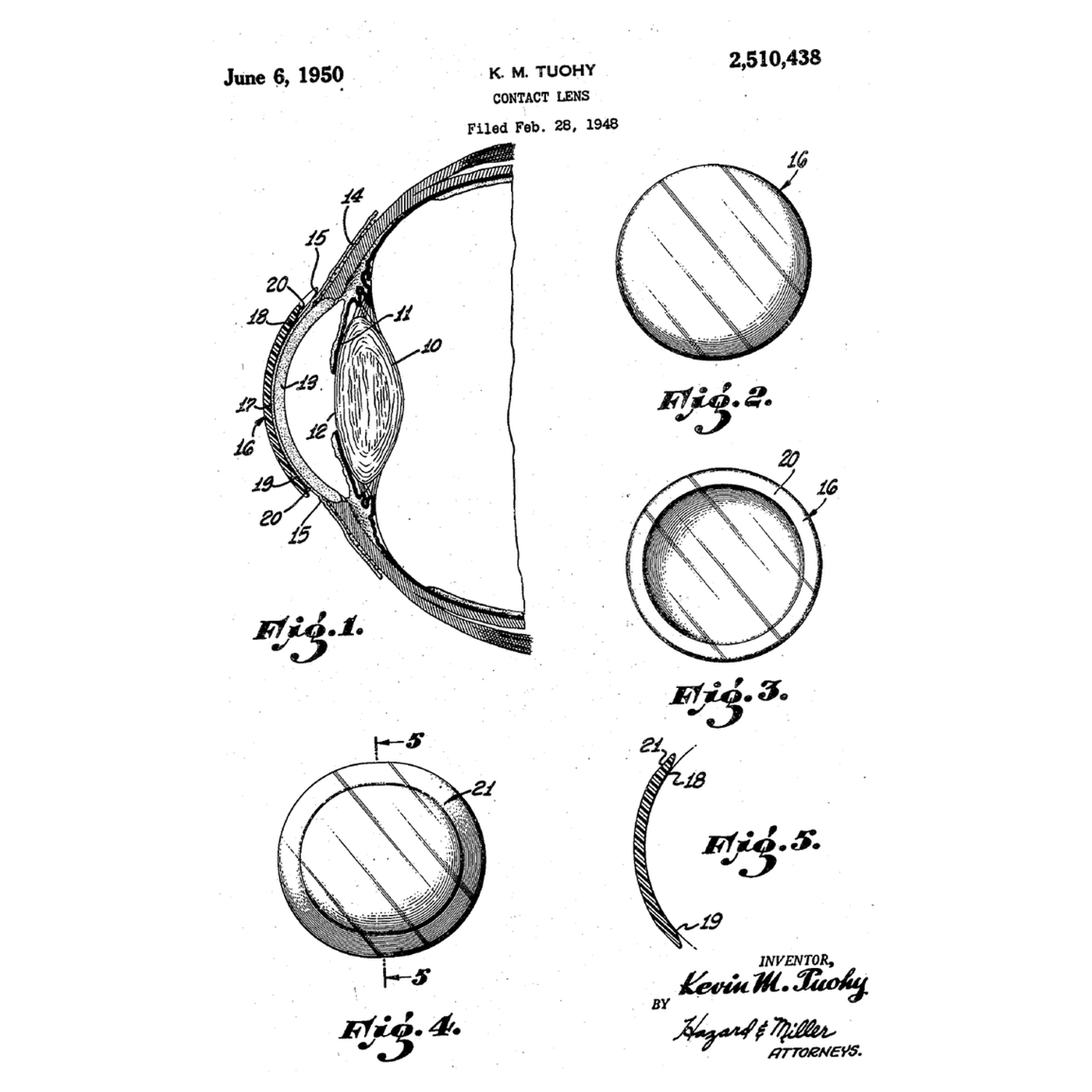

The Contact Lens: A Lens Floating on the Tears
The first contact lenses were large scleral shells of glass or plastic that rested on the white of the eye and vaulted over the cornea. They pressed on the sclera, starved the cornea of tears and oxygen, and could be worn only for short times.
Kevin M. Tuohy of Los Angeles, assignor to Solex Laboratories, filed US 2,510,438, *Contact Lens*, on 28 February 1948; it was granted 6 June 1950. His lens is smaller than the iris but larger than the widest pupil, so it rests on the cornea alone and never touches the sclera; and its inner curve is slightly flatter than the cornea, so it touches near the centre while tears flow under its edges. The plastic corneal lens made contact lenses practical to wear all day.
This rung works out the vertex correction between spectacles and a contact lens, and the tear lens that Tuohy's flatter fit creates, and shows the vertex effect on the bench — without putting anything in an eye.
Intermédiaire
About 2 hours
Consignes
1
1
Vertex distance and the tear lens
Vertex distance and the tear lens
Chargement du notebook Jupyter…
2
2
Read Tuohy's fit
Read Tuohy's fit
US 2,510,438 lists four objections to the lenses before it: the time and skill to fit them, discomfort that limited wear to short periods, rainbows or halos and clouding after a short time, and the need for special fluids under the lens. It traces them to one cause: those lenses "universally engage the scleral portion of the eye".
Its lens, when fitted, has "maximum dimensions … less than the dimensions across the limbus" — in the preferred form smaller than the iris but larger than the maximum pupil — so the sclera is left exposed to air and natural eye fluids. Its concave surface is "slightly flatter" than the cornea, so it touches near the centre and stands off at the margin, where "the natural eye fluids" can enter; the margins of the concave surface are bevelled. The patent's figures: a 7.8 mm cornea, a 7.9 or 8.0 mm lens.
3
3
The lens it moved onto the eye
The lens it moved onto the eye
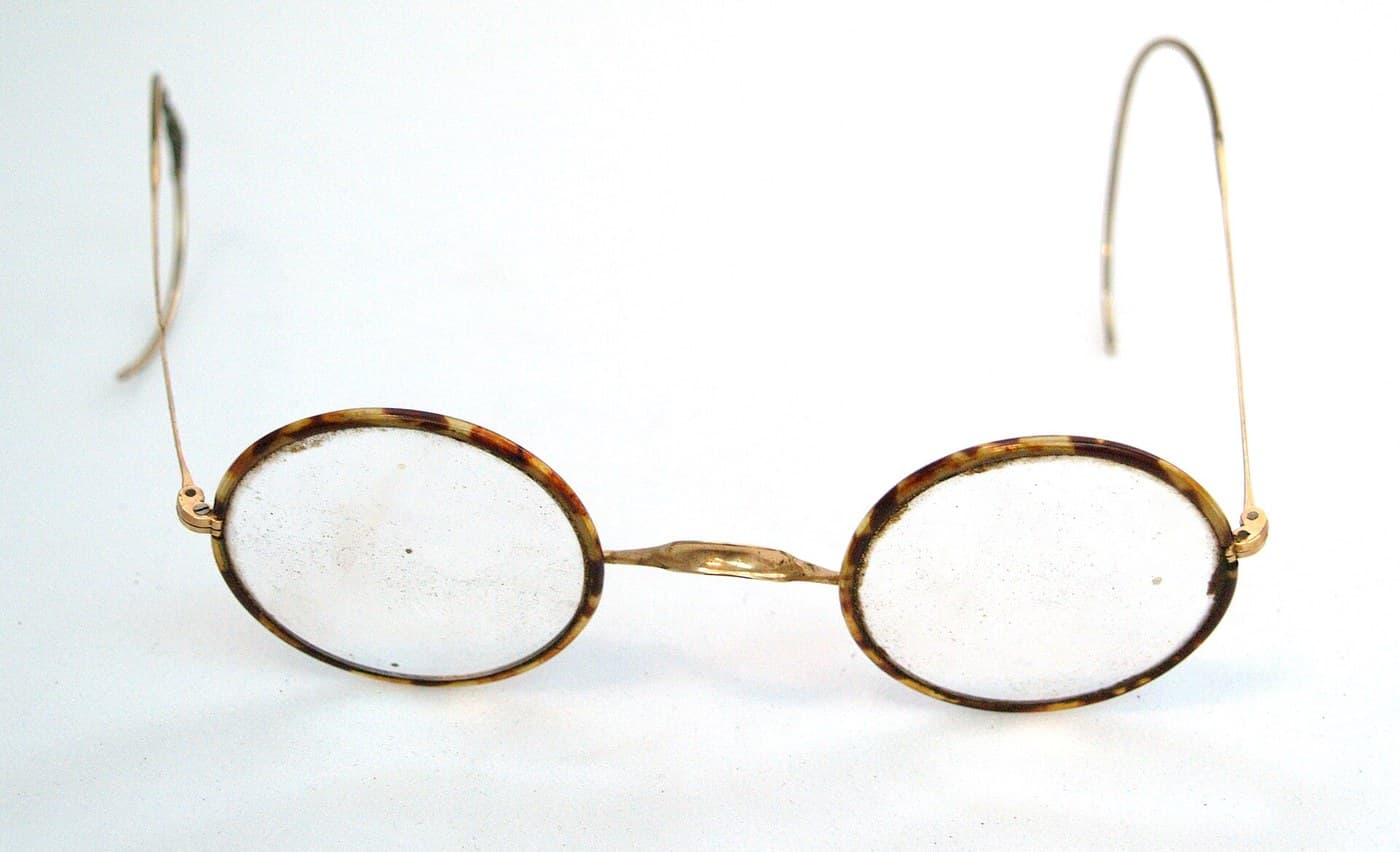
A contact lens corrects the same errors as spectacles, from a different place. The embedded blueprint covers the spectacle lenses it replaces.
4
4
See the vertex effect with a camera
See the vertex effect with a camera
Lock a digital camera's focus at infinity — an eye relaxed for distance — and put a printed page 20 cm in front of it. Seeing it sharp needs +5 D at the camera lens.
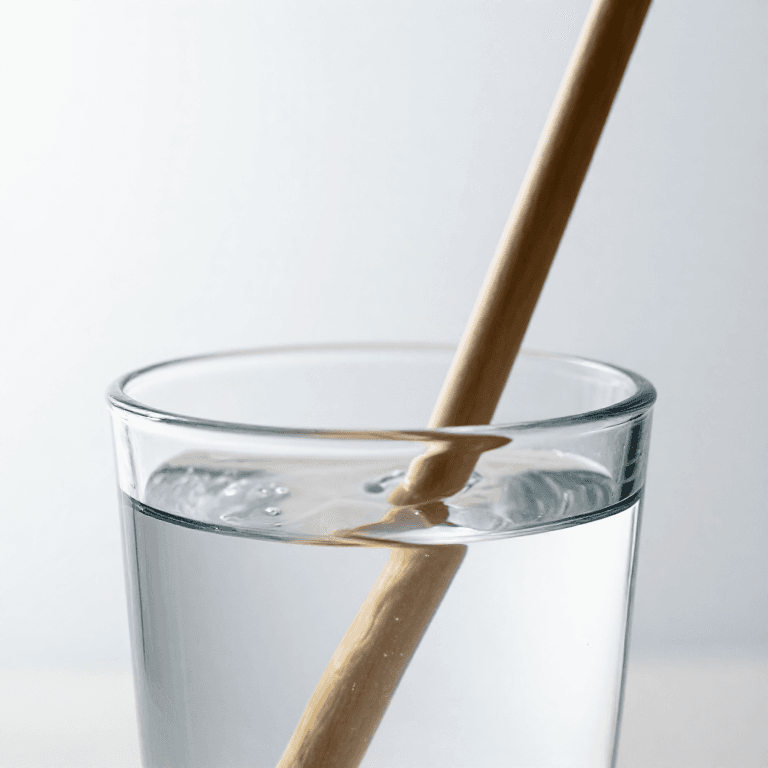
From the lens set take the lens nearest +5 D (f ≈ 20 cm; measure its real focal length on a distant light). Hold it right against the camera lens: the page is sharp. Slide it 3 cm away from the camera: the page blurs, because a plus lens moved away acts stronger. Work out from the notebook's formula the weaker lens that would be right at 3 cm, pick the nearest one in the set, and check it focuses the page at that distance.
Contact lenses are medical devices: never make or fit one, or put anything in an eye.
Matériaux pour cette étape :
 Jeu de lentilles convergentes1 pièce
Outils nécessaires :
 Appareil photo numérique
 Règle
Règle Pied à coulisse numérique 6 pouces
5
5
Problems with hard corneal lenses
Problems with hard corneal lenses
What wearers of rigid corneal lenses reported, and what it pointed to. Any eye pain, redness or blurred vision needs an eye care professional.
Flow
Loading...
6
6
History and honest limits
History and honest limits
**Kevin M. Tuohy** filed **US 2,510,438** on 28 February 1948, assigned to **Solex Laboratories** of Los Angeles; granted 6 June 1950. Glass scleral lenses date from the late nineteenth century; after Tuohy's corneal lens came gas-permeable rigid lenses and soft hydrogel lenses.
**Honest limits.** The notebook uses thin-lens approximations and a single tear index; real fitting uses measured corneal curvature and trial lenses. Nothing here is a prescription or a guide to fitting lenses.
Matériaux
1- Espace réservé
Outils requis
3- Espace réservé
- Espace réservé
- Espace réservé
Blueprints liés
Ces blueprints partagent des connaissances — techniques, matériaux ou principes
CC0 Domaine public
Ce blueprint est publié sous CC0. Vous êtes libre de copier, modifier, distribuer et utiliser ce travail pour tout usage, sans demander la permission.
Soutenez le Maker en achetant des produits via son Blueprint où il perçoit une Commission Maker définie par les Vendeurs, ou créez une nouvelle itération de ce Blueprint et incluez-le comme connexion dans votre propre Blueprint pour partager les revenus.