ART
BEAUTÉ ET BIEN-ÊTRE
ARTISANAT
CULTURE ET HISTOIRE
DIVERTISSEMENT
ENVIRONNEMENT
NOURRITURE ET BOISSONS
INGÉNIERIE INVERSE
SCIENCES
SPORTS
TECHNOLOGIE
TECHNOLOGIE PORTABLE

Snell's Law — Measure How Light Bends (Laser and Protractor)
A hands-on school project: shine a laser pointer into water, a glass prism and an acrylic block, measure the bending with a protractor, and discover Snell's law for yourself — the 400-year-old rule behind lenses, sparkling diamonds and fibre-optic internet. A runnable Python cell lets you check your measurements against the prediction, and a closing compendium answers the tricky questions (why thickness does not bend light more, why stacked layers cancel, and why a prism makes a rainbow).
Débutant
1-2 hours
Consignes
1
1
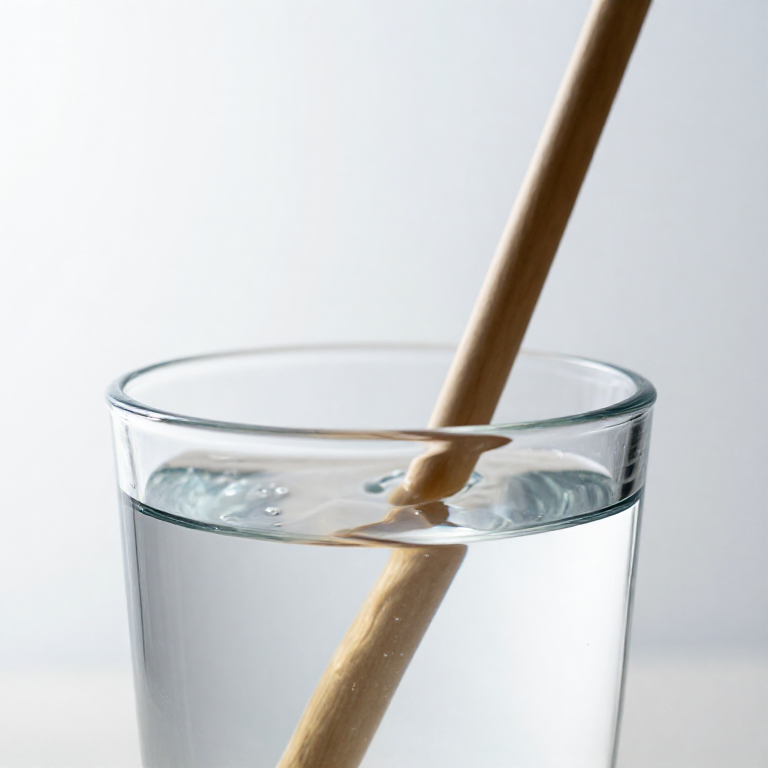
The broken straw
The broken straw
Put a straw in a glass of water and look from the side: it seems to snap at the surface. Light travels more slowly in water or glass than in air, so when it crosses the boundary at an angle it changes direction — it refracts. In this project you will measure that bending yourself with a laser and a protractor, then check your numbers against the 400-year-old law that predicts them.
2
2
The rule you are about to test
The rule you are about to test
Every material has a refractive index n, roughly how much it slows light: air 1.00, water 1.33, ordinary glass about 1.50, diamond 2.42. Snell's law says n1 times the sine of the incoming angle equals n2 times the sine of the outgoing angle, both measured from the 'normal' (the line perpendicular to the surface). The Persian scholar Ibn Sahl wrote it down around 984 AD, and Willebrord Snell rediscovered it in 1621. Keep it in mind — your measurements should obey it.
Matériaux pour cette étape :
 Papier1 feuille
 Jeu de crayons graphite1 pièce
3
3
Build the bench and measure the angle
Build the bench and measure the angle
Lay a protractor flat and stand a shallow container of water (or the glass prism, or the acrylic block) with its flat face on the protractor's centre line. Mark the normal — the line straight out from the surface. Now you need a thin beam of light. Best is a handheld laser pointer aimed at the surface at a measured angle (say 30, 45 and 60 degrees to the normal). No laser? A candle or a small bright lamp placed behind a card with a narrow slit throws a beam you can trace just as well, and even a shaft of sunlight through a gap in the blinds will do. A drop of milk in the water, or a puff of chalk dust in the air, makes the beam glow so you can follow it. Mark where the beam goes inside the water, read the refracted angle off the protractor, and write down each pair of angles. Repeat for the prism and the acrylic block. SAFETY: a Class-2 laser is low power, but never look into the beam or point it at anyone's eyes; keep a candle well clear of the water and anything flammable.
Matériaux pour cette étape :
 Eau1 litre
 Prisme de verre (équilatéral)1 pièce
 Plaque acrylique1 pièce
 Bocaux en verre avec couvercle1 pièce
Outils nécessaires :
 Pointeur laser
 Rapporteur / mesureur d'angle
4
4
Check your measurements against Snell's law
Check your measurements against Snell's law
Chargement du notebook Jupyter…
Outils nécessaires :
 Ordinateur de bureau
5
5
Find the critical angle yourself
Find the critical angle yourself
Chargement du notebook Jupyter…
6
6
Compendium: the variables that trip people up
Compendium: the variables that trip people up
A few subtleties worth understanding once you have the basics. (1) It is the refractive INDEX of a material that sets how much light bends, NOT how thick the material is — a thin drop of water and a deep tank of water bend a given ray by the same angle. (2) With several PARALLEL layers, the ones in the middle cancel out: light going air -> glass -> water comes out at exactly the same angle as air -> water directly, because the glass's term appears on both sides of Snell's law. Only the FIRST and LAST materials fix the final angle. (3) So a thicker pane of glass — like the thick window of a swimming pool — does not bend light any MORE; it only shifts the whole image sideways by a few millimetres. The water beyond still bends light by its own index of 1.33. (4) The index depends slightly on colour, so a prism bends violet a touch more than red and splits white light into a rainbow — that is dispersion. (5) These same ideas explain why a pool looks shallower than it is, why lenses in glasses and cameras form images, why fibre-optic cables carry the internet by trapping light, and why a hot road shimmers with mirages as light bends through warm and cool air.
Matériaux
6- 1 feuilleEspace réservé
- 1 pièceEspace réservé
- 1 litreEspace réservé
- Espace réservé
- 1 pièceEspace réservé
- Espace réservé
Outils requis
5- Espace réservé
- Espace réservé
- Espace réservé
- Espace réservé
- Espace réservé
Blueprints liés
Ces blueprints partagent des connaissances — techniques, matériaux ou principes


CC0 Domaine public
Ce blueprint est publié sous CC0. Vous êtes libre de copier, modifier, distribuer et utiliser ce travail pour tout usage, sans demander la permission.
Soutenez le Maker en achetant des produits via son Blueprint où il perçoit une Commission Maker définie par les Vendeurs, ou créez une nouvelle itération de ce Blueprint et incluez-le comme connexion dans votre propre Blueprint pour partager les revenus.