ART
BEAUTÉ ET BIEN-ÊTRE
ARTISANAT
CULTURE ET HISTOIRE
DIVERTISSEMENT
ENVIRONNEMENT
NOURRITURE ET BOISSONS
INGÉNIERIE INVERSE
SCIENCES
SPORTS
TECHNOLOGIE
TECHNOLOGIE PORTABLE
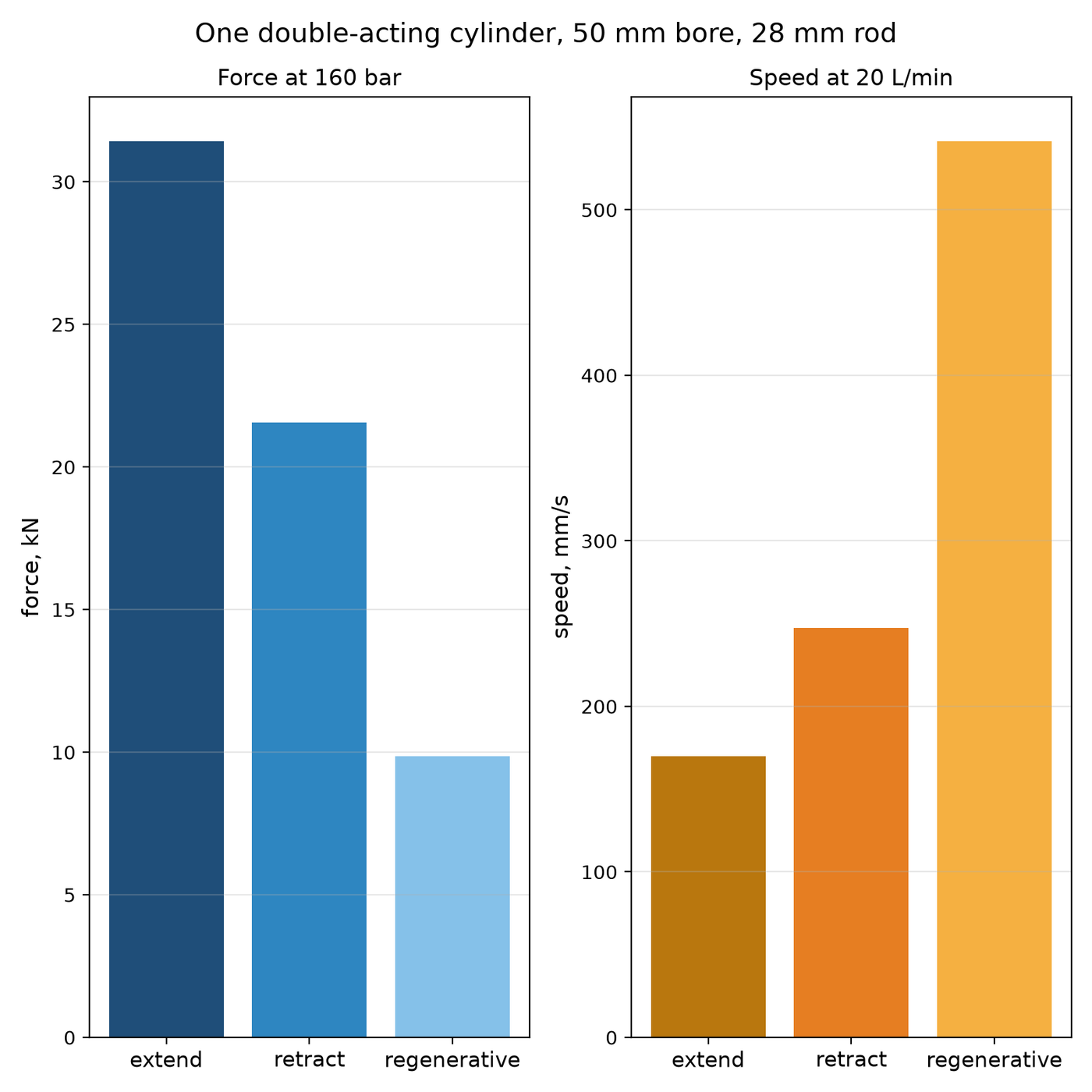
Youblob (generated from this blueprint's notebook) · CC0


The Double-Acting Cylinder: Push With the Bore, Pull With the Ring
Bramah's press and the hydraulic jack push one way and let the load fall back. Most machines need power in both directions: a digger's arm, a tractor's lift, a press that must open as well as close. The double-acting cylinder has a port at each end, so oil drives the piston out and oil drives it back.
The rod makes the two directions unequal. Pushing uses the whole bore; pulling uses only the ring round the rod. That one fact decides a cylinder's forces and speeds, hides a pressure trap that can burst a hose, and — with a long stroke — lets the rod buckle long before the oil runs out of pressure.
This rung works all three out and builds a double-acting cylinder from a syringe to measure the difference.
Débutant
About 3 hours
Consignes
1
1
Force, speed, intensification and buckling
Force, speed, intensification and buckling
Chargement du notebook Jupyter…
2
2
Start from Pascal's principle
Start from Pascal's principle
Every cylinder turns pressure into force by area. The embedded blueprint shows it in its first working form, Bramah's single-acting press.
3
3
Make a syringe double-acting
Make a syringe double-acting
A syringe is single-acting: it has one sealed chamber. Make it double-acting by closing its open end.
Measure the barrel bore and the plunger rod with a caliper. 3D-print an end cap that slides over the barrel's open end, with a central hole for the rod carrying an O-ring in a groove (the gland), and a side port with a hose barb. Seal the cap to the barrel with silicone sealant. Cut the plunger's cross-shaped rod down to a round pushrod: glue a steel dowel pin into it so the O-ring seals on a smooth round rod.
Fill both chambers and two hand syringes with coloured water, bleeding out every bubble. Connect one hand syringe to the tip (cap side) and one to the new side port (rod side).
Matériaux pour cette étape :
 Jeu de seringues1 pièce
 Goupille cylindrique en acier1 pièce
 Assortiment de joints toriques1 pièce
 Tube en silicone1 mètre
 Mastic silicone1 pièce
 Eau1 litre
 Colorant alimentaire (traceur de visualisation d'écoulement)1 pièce
Outils nécessaires :
 Imprimante 3D à filament (FDM)
 Filament PETG
 Pied à coulisse numérique 6 pouces
 Pistolet à colle chaude
4
4
Measure the two directions
Measure the two directions
From your measured bore $D$ and rod $d$, work out the travel that 2 mL should give each way: $2000 / A_{cap}$ mm going out, $2000 / A_{ann}$ mm coming back (areas in mm²).
Push 2 mL into the cap side, with the rod-side hand syringe free to fill, and measure the rod's travel with the caliper. Then push 2 mL into the rod side and measure the travel back. Repeat three times each way. The return stroke is longer for the same volume — exactly the ratio $A_{cap}/A_{ann}$ in the notebook.
Now hold the rod-side hand syringe's plunger firmly and push gently on the cap side: you feel the rod-side plunger pushed back hard. That is intensification. Do not push hard — a syringe is not rated for it.
Outils nécessaires :
Pied à coulisse numérique 6 pouces Règle
Règle Lunettes de sécurité transparentes
5
5
A cylinder that misbehaves
A cylinder that misbehaves
Cylinder faults show up as a handful of symptoms.
Flow
Loading...
6
6
Context and honest limits
Context and honest limits
The double-acting cylinder is not one invention but the working form every hydraulic machine settled on: a honed tube, a piston with seals, a chromed rod through a gland with a wiper, and a port at each end. Its sizes are standardised, so a cylinder of one make fits the mountings of another.
**Honest limits.** A cylinder only turns pressure into force; the valve decides where it goes and the pump how fast. Real cylinders lose a little force to seal friction and need cushions at the ends of stroke, which the notebook leaves out. And hydraulic oil at working pressure can pierce skin from a pinhole leak: never feel for a leak with your hand.
Matériaux
7- 1 pièceEspace réservé
- Espace réservé
- Espace réservé
- 1 mètreEspace réservé
- 1 pièceEspace réservé
- 1 litreEspace réservé
- Espace réservé
Outils requis
6- Espace réservé
- Espace réservé
- Espace réservé
- Espace réservé
- Espace réservé
- Espace réservé
Blueprints liés
Ces blueprints partagent des connaissances — techniques, matériaux ou principes



CC0 Domaine public
Ce blueprint est publié sous CC0. Vous êtes libre de copier, modifier, distribuer et utiliser ce travail pour tout usage, sans demander la permission.
Soutenez le Maker en achetant des produits via son Blueprint où il perçoit une Commission Maker définie par les Vendeurs, ou créez une nouvelle itération de ce Blueprint et incluez-le comme connexion dans votre propre Blueprint pour partager les revenus.