ART
BEAUTÉ ET BIEN-ÊTRE
ARTISANAT
CULTURE ET HISTOIRE
DIVERTISSEMENT
ENVIRONNEMENT
NOURRITURE ET BOISSONS
INGÉNIERIE INVERSE
SCIENCES
SPORTS
TECHNOLOGIE
TECHNOLOGIE PORTABLE
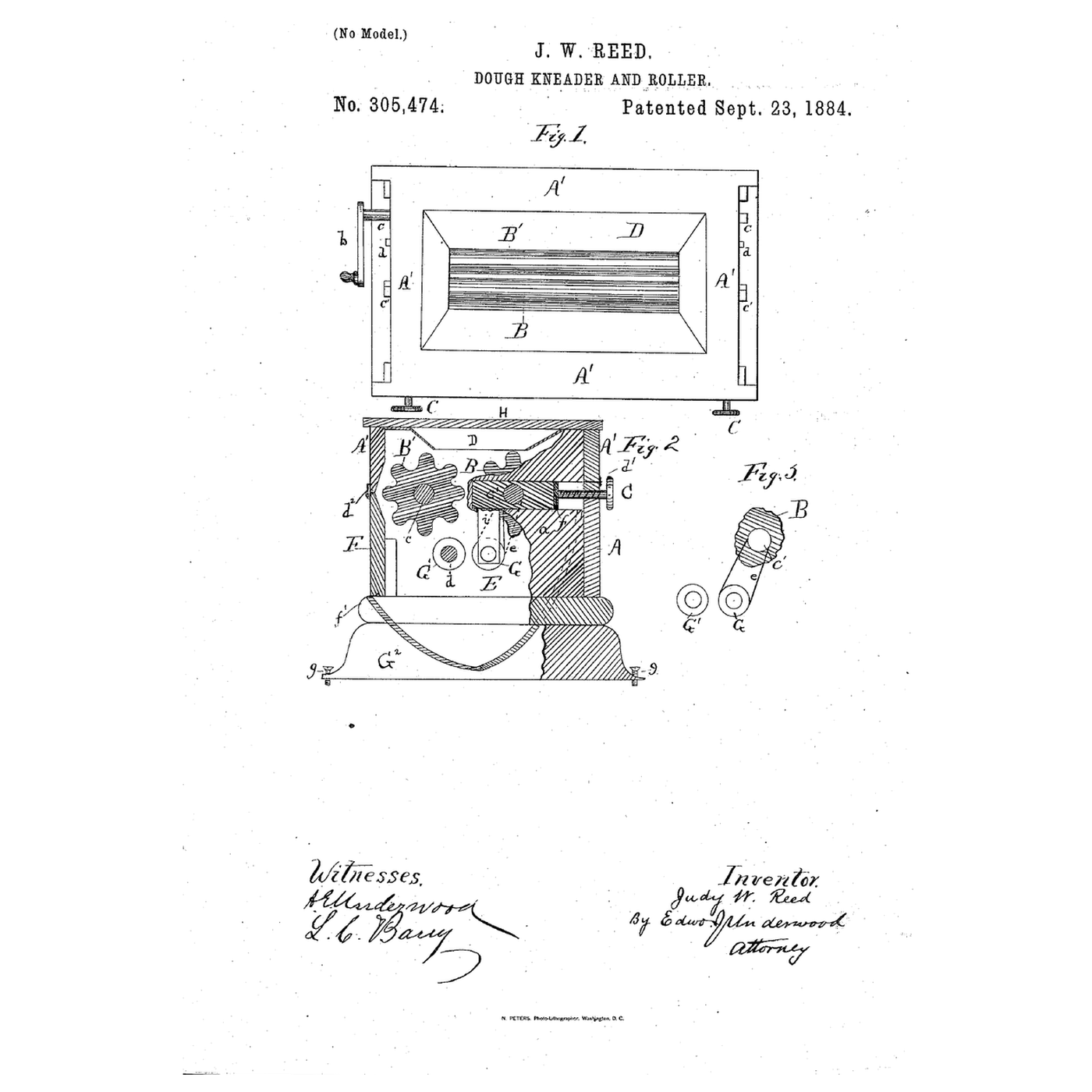

The Dough Kneader and Roller: Corrugated Rolls, Then Plain Ones
Kneading dough by hand is hard, slow work, and the dough on an open table collects whatever is in the air.
Judy W. Reed of Washington, D.C., filed US 305,474 on 21 January 1884; it is dated 23 September 1884, and its drawing sheet is titled "Dough Kneader and Roller". A closed box holds a pair of intermeshing corrugated metal rolls, one set by screws pressing on rubber plates so the squeeze can be increased or reduced, and below them a pair of plain rollers driven by a belt. Dough is put into a covered hopper, cranked through both pairs, and drops into a closed receptacle with a door — kneaded, rolled, and kept from dust throughout.
This rung works out when rollers grip the dough and how much sheet a crank turn makes, and builds a two-roller model.
Intermédiaire
About 3 hours
Consignes
1
1
The nip condition and the sheet
The nip condition and the sheet
Chargement du notebook Jupyter…
2
2
Two rollers and a spring
Two rollers and a spring
A wringer squeezes cloth between rollers pressed together by a spring. The embedded blueprint shows the same arrangement Reed used for dough.
3
3
Read US 305,474
Read US 305,474
Reed's objects are, first, "to subject the mass of dough to a thorough and equable mixing and working by causing it to pass between a pair of intermeshing corrugated rollers or cylinders", which approach or recede by regulating-screws "according as the pressure on the dough is desired to be increased or diminished, and then passing it between a pair of plain rollers to roll the dough"; second, a covered receiver and a receptacle for the dough; and third, "to protect the mass of dough from dust or impurities in the atmosphere throughout its working".
In the case A A′ are corrugated metallic rolls B B′ and plain rollers G G′; B′ carries a crank. Roll B runs in movable bearings c′ pressed by screws C that bear on rubber plates f, keeping it against B′. The plain roller G hangs from B's bearings and is driven by a belt from B's axle. The upper part A′ has a hopper-shaped receiver D, "preferably lined with tin or other thin metal to prevent any taste of the wood", hinged so it can be swung back to remove the rolls for cleaning; below is a receptacle E with a door F.
4
4
Build a two-roller model
Build a two-roller model
Mount two hardwood dowels about 30 mm thick in a plywood frame, one in fixed holes and one in slots, with wing nuts or screws to set the gap. Wrap one dowel's surface with evenly spaced ribs of more dowel glued lengthwise, to stand for corrugations, and fit a crank to the fixed one.
Mix a simple bread dough with flour and water. Feed a lump through with the ribbed roll, then with both rolls smooth, starting with a wide gap and narrowing it pass by pass. Note the thickest lump each set-up will draw in and compare with the notebook. Finish the sheet with a rolling pin and measure its thickness with the caliper.
Matériaux pour cette étape :
 Farine tout usage1 pièce
 Goujons de bois dur1 pièce
 Panneau de contreplaqué1 pièce
 Vis à bois8 pièces
Outils nécessaires :
 Rouleau à pâtisserie
 Perceuse sans fil
 Jeu de forets
 Pied à coulisse numérique 6 pouces
 Balance de cuisine numérique
 Pistolet à colle chaude
5
5
Rollers that will not take the dough
Rollers that will not take the dough
Dough roller troubleshooting.
Flow
Loading...
6
6
History and honest limits
History and honest limits
**Judy W. Reed** of Washington, D.C., filed US 305,474 on 21 January 1884; it is dated 23 September 1884. It claims the case with its corrugated rolls, one movable and one cranked, the belt-driven plain rollers, and the hopper above and receptacle below.
**Honest limits.** The friction coefficients in the notebook are assumptions; dough's grip varies with its water, flour and rest.
Matériaux
4- 1 pièceEspace réservé
- 1 pièceEspace réservé
- 1 pièceEspace réservé
- Vis à bois10 % de commission8 piècesEspace réservé
Outils requis
6- Espace réservé
- 1 vendor sell this, none ship to you yetEspace réservé
- Espace réservé
- Espace réservé
- Espace réservé
- Espace réservé
Blueprints liés
Ces blueprints partagent des connaissances — techniques, matériaux ou principes
Egyptian Emmer Bread — Baking Emmer Wheat Flatbread in a Clay Oven
par TheChef
Nourriture
74
0
0
0
0
0
Cultivating a Sourdough Starter from Wild Yeast — The Living Culture Behind the World's Oldest Bread
par Bob
Biologie
54
0
0
0
6
0

The Clothes Wringer: Two Rollers and a Spring
par YourGrandma
Outils Textiles
0
0
0
0
0
0
Gear Trains: Idlers, Compounding and Hitting a Given Ratio
par Martin
Mécanique
22
0
0
0
0
0
CC0 Domaine public
Ce blueprint est publié sous CC0. Vous êtes libre de copier, modifier, distribuer et utiliser ce travail pour tout usage, sans demander la permission.
Soutenez le Maker en achetant des produits via son Blueprint où il perçoit une Commission Maker définie par les Vendeurs, ou créez une nouvelle itération de ce Blueprint et incluez-le comme connexion dans votre propre Blueprint pour partager les revenus.