ART
BEAUTÉ ET BIEN-ÊTRE
ARTISANAT
CULTURE ET HISTOIRE
DIVERTISSEMENT
ENVIRONNEMENT
NOURRITURE ET BOISSONS
INGÉNIERIE INVERSE
SCIENCES
SPORTS
TECHNOLOGIE
TECHNOLOGIE PORTABLE
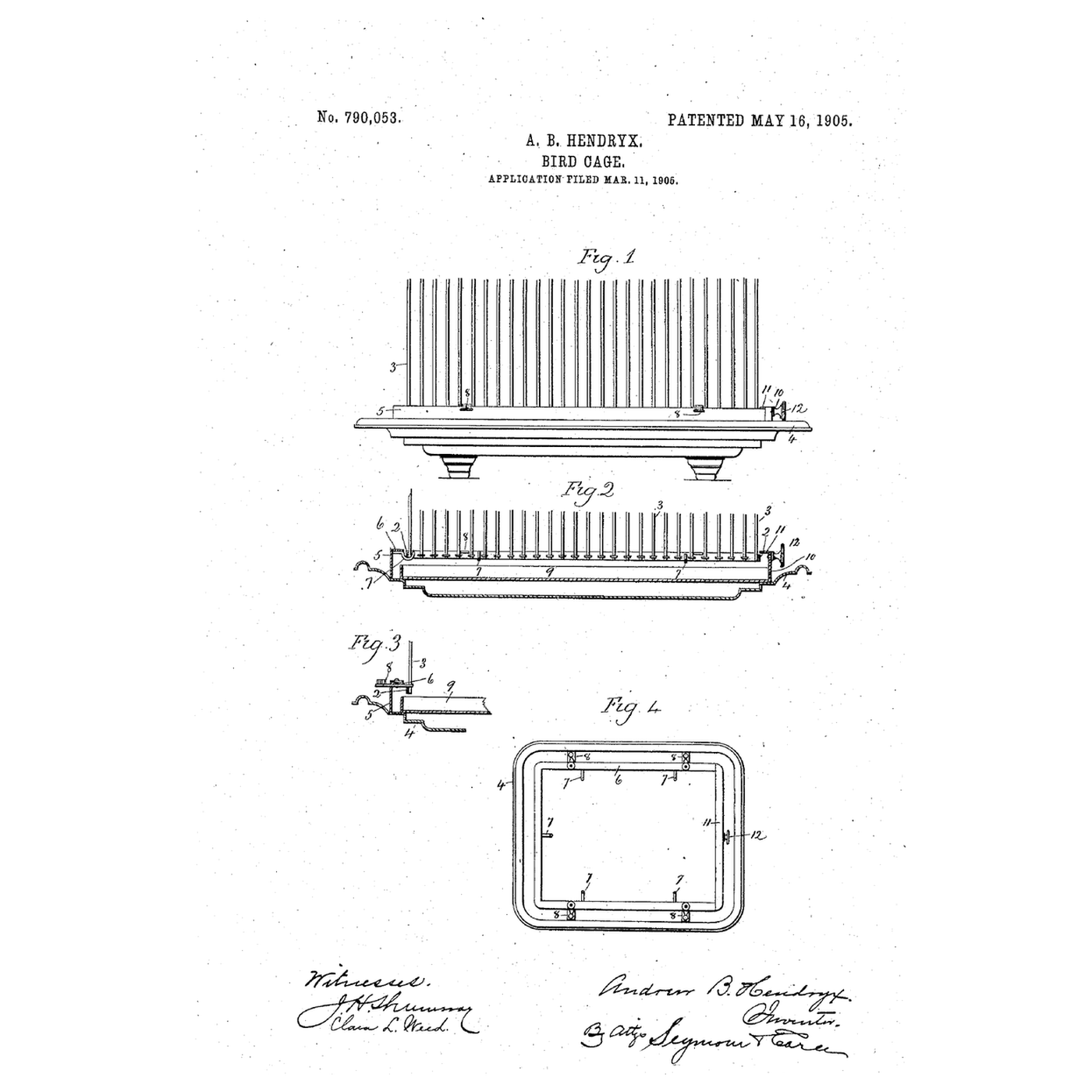


The Flanged-Base Cage Pan: A Pan Larger Than the Cage, Drawn Out From Under a Flange
A bird cage whose pan slides in under the base is cleaned without lifting the cage off; but the pan is smaller than the cage, so seeds and refuse collect beyond its edge and the cage must come off after all.
Andrew B. Hendryx of New Haven, Connecticut, received US 790,053, dated 16 May 1905, for a bird cage whose base has an upward rim on three sides, turned inward as a flange; the cage sets within the flange, and a pan slides in over the base beneath the flange, its front completing the rim, so that "the pan extending beneath the flange catches all refuse and may be readily withdrawn for cleaning".
This rung works out how much a smaller pan misses, then builds a flanged base for a bought cage with a pan that reaches under the flange, and counts the lentils each pan catches.
Intermédiaire
About 4 hours
Consignes
1
1
What a small pan misses
What a small pan misses
Chargement du notebook Jupyter…
2
2
A cage floor cleaned without lifting the cage
A cage floor cleaned without lifting the cage
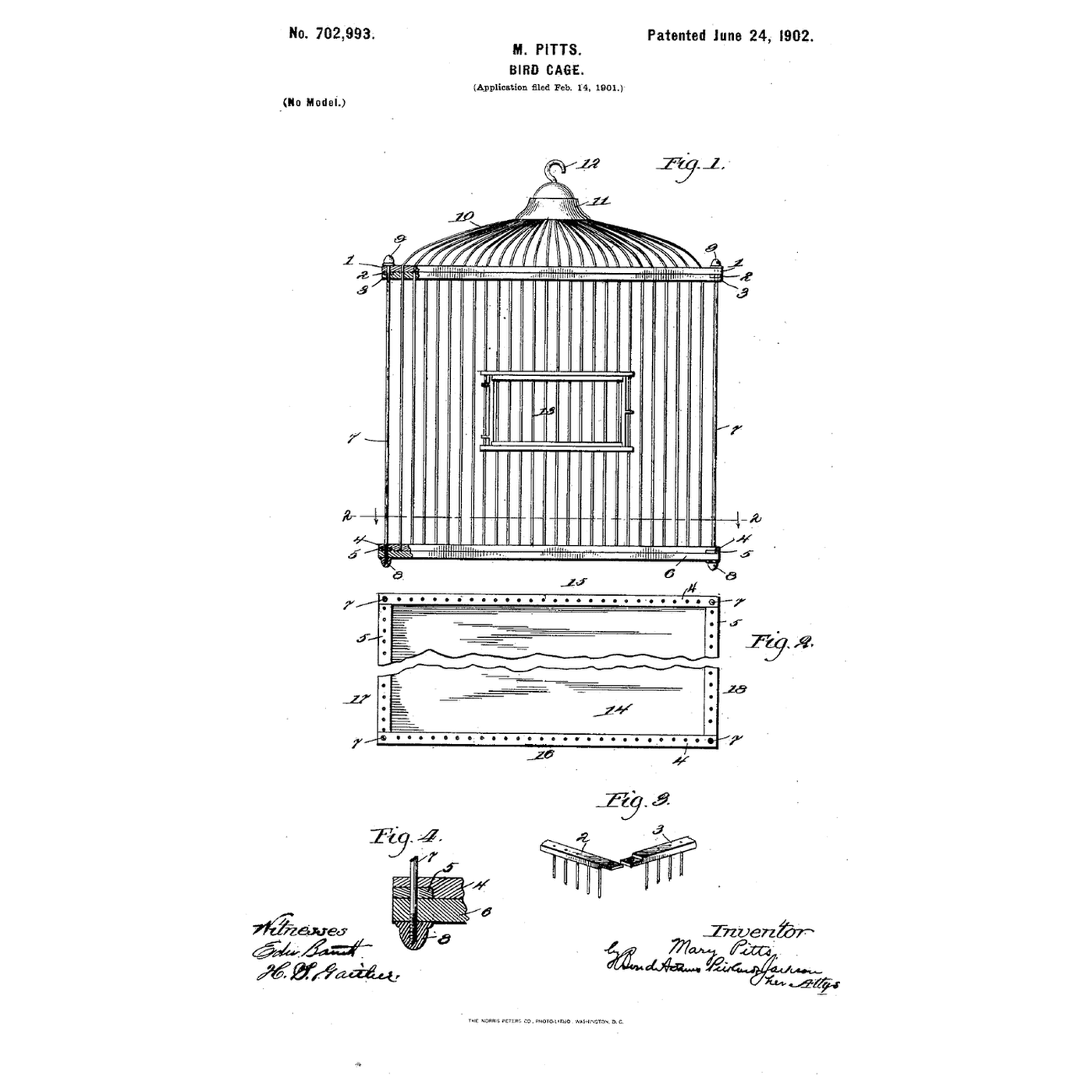
The embedded blueprint renews a cage's floor by pulling paper through from a roll. Hendryx instead slides a pan larger than the cage in under a flange, so everything that falls lands in it.
3
3
Read US 790,053
Read US 790,053
"The base 4 is of substantially usual form, and near its outer edge I attach an upright rim 5, which extends on two sides and across one end. At the upper edge this rim is turned inward, forming a flange 6."
"As the edge of the drawer extends beneath the flange 6 and as the cage sets within the flange, it follows that the drawer is of greater dimensions than the dimensions of the cage, so that all refuse falling within the cage must necessarily fall within the pan, and this pan and its contents may be readily withdrawn without disengaging the body of the cage from the base."
4
4
Build the base and pan
Build the base and pan
**Base.** Measure the bought cage's bottom rim. Saw a hardwood board 6 cm longer and wider than it.
**Rim and flange.** Cut a strip of aluminium sheet 4.5 cm wide and long enough for two sides and one end. Fold 1.5 cm of one edge out flat as a foot, 2 cm up as the rim, and the last 1 cm inward as the flange. Screw the feet to the board 1.5 cm in from its edge along those three sides, so the flange's inner edge stands 5 mm outside the cage's rim all round.
**Pan.** Fold a tray from aluminium sheet that slides in over the board under the flange and fills the rim, with sides 1.5 cm high, so it is 1.5 cm larger than the cage all round. At its open end fold a front as tall as the rim, turned in at the top like the flange, and screw a small dowel knob to it.
**Cage.** Drill four holes in the flange and pass a hook bent from galvanised wire down through each, so the cage's bottom rim rests on the hooks just below the flange's top, clear of the pan. Twist a wire clip over the rim at each hook to lock the cage to the base.
**Test.** Scatter a counted cupful of lentils over the cage floor and count those in the pan and outside it; repeat with a tray cut 2 cm smaller than the cage all round.
Matériaux pour cette étape :
 Cage à oiseaux1 pièce
 Planche de bois dur1 pièce
 Tôle d'aluminium1 pièce
 Vis à bois12 pièces
 Goujons de bois dur1 pièce
 Fil d'acier galvanisé1 pièce
 Lentilles sèches1 pièce
Outils nécessaires :
 Scie égoïne
 Cisaille à tôle
 Étau d'établi
 Pince plate
 Marteau
 Perceuse sans fil
 Jeu de forets
 Jeu de tournevis
 Limes (lime à main)
 Règle
Règle Marqueur permanent
 Lunettes de sécurité transparentes
5
5
A pan that sticks, spills or leaves refuse behind
A pan that sticks, spills or leaves refuse behind
Flanged-base cage pan troubleshooting.
Flow
Loading...
6
6
History and honest limits
History and honest limits
**Andrew B. Hendryx** of New Haven, Connecticut, filed US 790,053 on 11 March 1905; it is dated 16 May 1905. The cage has a lower rim or bar 2 carrying the upright wires 3; hooks 7 on the flange receive the rim, and slides 8 on the flange pass over it to interlock cage and base. The pan 9 has a front 10 with an inward upper edge 11 and a knob 12. He noted that the rim and flange also give a finished look and allow a flat base, where cages with a drawer in the base must be deep. His claims cover the base with its rim and flange, the cage set within it, and the pan extending beneath the flange, with its front completing the fourth side.
**Honest limits.** A screwed aluminium rim on a board and a bought cage stand in for his; wire hooks replace his hooks and slides. The notebook assumes refuse falls evenly; its sizes are examples. Your lentil counts are the result.
Matériaux
7- 1 pièceEspace réservé
- 1 pièceEspace réservé
- 1 pièceEspace réservé
- 12 piècesEspace réservé
- 1 pièceEspace réservé
- 1 pièceEspace réservé
- 1 pièceEspace réservé
Outils requis
12- Espace réservé
- Espace réservé
- Espace réservé
- Espace réservé
- Espace réservé
- 1 vendor sell this, none ship to you yetEspace réservé
- Espace réservé
- Espace réservé
- Espace réservé
- Espace réservé
- Espace réservé
- Espace réservé
Blueprints liés
Ces blueprints partagent des connaissances — techniques, matériaux ou principes


CC0 Domaine public
Ce blueprint est publié sous CC0. Vous êtes libre de copier, modifier, distribuer et utiliser ce travail pour tout usage, sans demander la permission.
Soutenez le Maker en achetant des produits via son Blueprint où il perçoit une Commission Maker définie par les Vendeurs, ou créez une nouvelle itération de ce Blueprint et incluez-le comme connexion dans votre propre Blueprint pour partager les revenus.