ART
BEAUTÉ ET BIEN-ÊTRE
ARTISANAT
CULTURE ET HISTOIRE
DIVERTISSEMENT
ENVIRONNEMENT
NOURRITURE ET BOISSONS
INGÉNIERIE INVERSE
SCIENCES
SPORTS
TECHNOLOGIE
TECHNOLOGIE PORTABLE
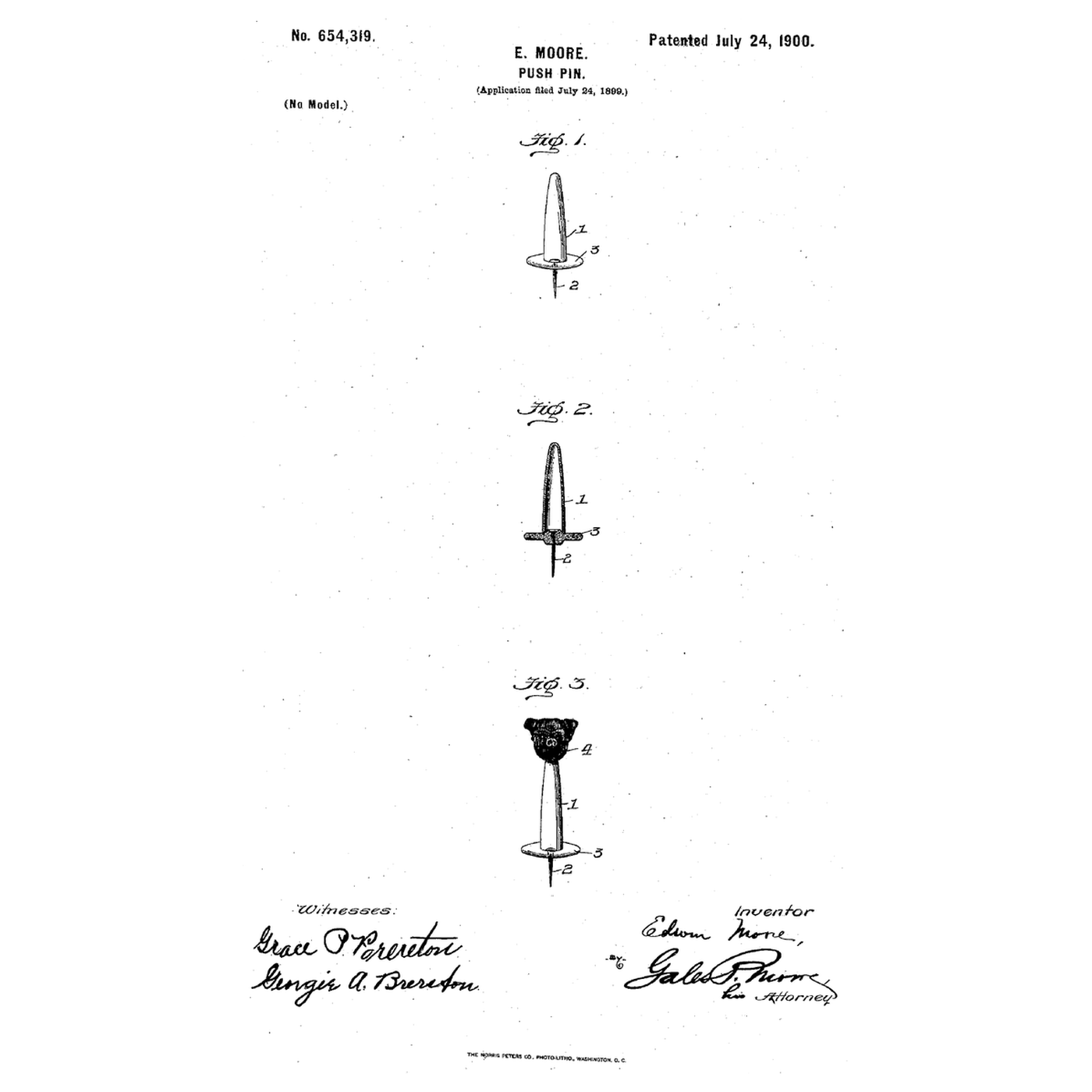

The Push Pin: A Glass Handle Sealed Round a Steel Point
Photographers developing roll film hung the wet strips on boards to dry, pinned at the corners. Wet fingers slipped on a pin's small head, tore the film, and rusty pins stained it.
Edwin Moore of Newark, New Jersey, patented the push-pin: US 654,319, filed 24 July 1899 and dated 24 July 1900. Its handle is glass, porcelain or another non-corroding vitreous material, tapered so the fingers can grip it, with a collar at the pin end to stop them slipping onto the film. The pin is embedded in the glass and should expand with temperature as the glass does, so the handle does not crack.
This rung works out why the pin and glass must match, and compares push pins with drawing pins in use.
Débutant
About 2 hours
Consignes
1
1
Sealing steel into glass
Sealing steel into glass
Chargement du notebook Jupyter…
2
2
The film the pins were made to hold
The film the pins were made to hold
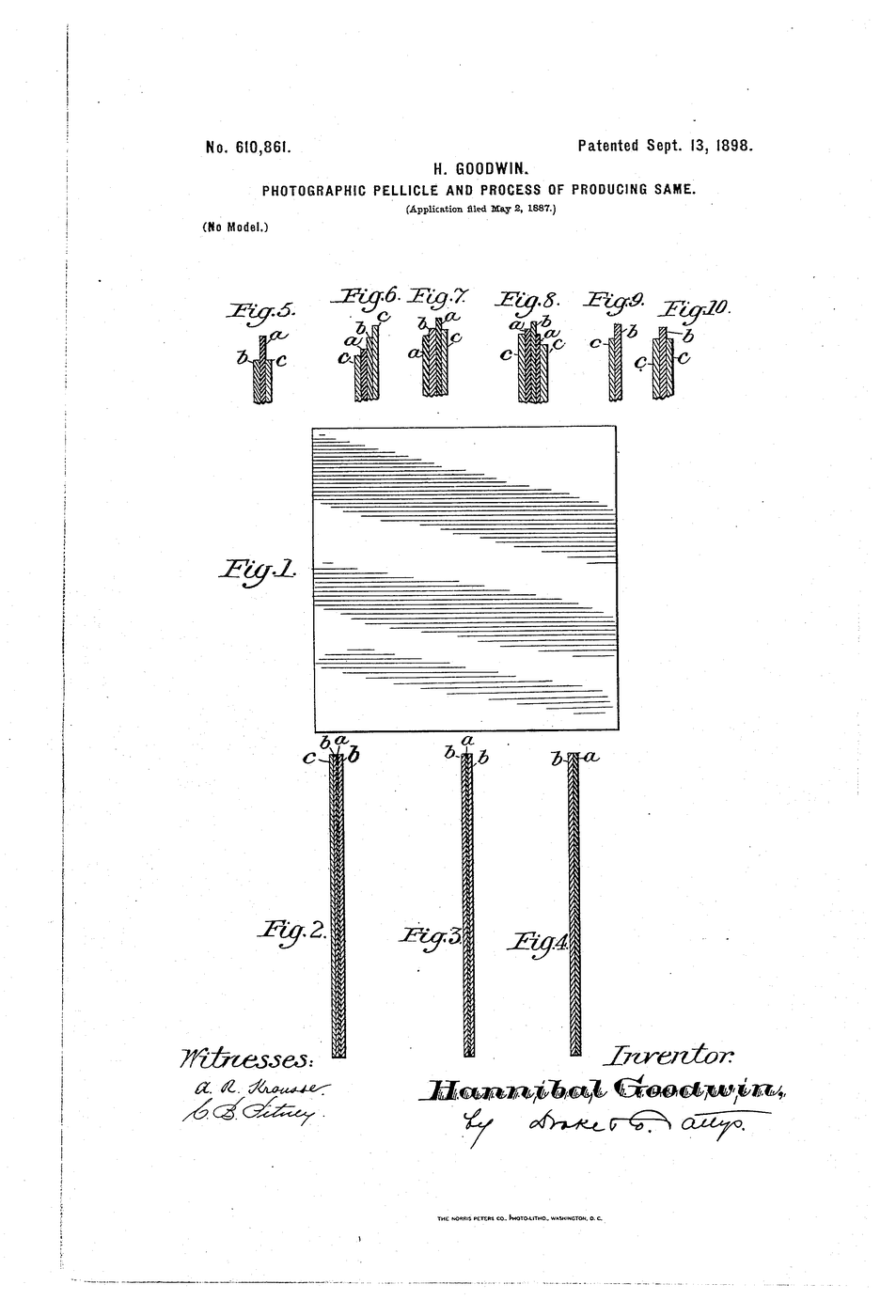
Moore designed the push-pin for drying film. The embedded blueprint explains the flexible film that needed pinning.
3
3
Read US 654,319
Read US 654,319
Moore's push-pins are "adapted to support one article upon another and being particularly employed for holding photographic films stretched upon a surface, such as a board, for drying and the like." The earlier kind had a wooden body with the pin clamped by a metal collar; with it "the fingers slip and tear or blotch the film", and "the water employed upon the film corrodes the pin and the metallic cap, thus causing stains upon the film."
His handle 1 "is constructed of glass, porcelain, or other vitreous substantially non-corrosive substance", preferably "formed from glass tubing", and tapers so it can be "firmly grasped by the fingers". An annular flange or collar 3 at the pin end is "an additional safeguard to prevent slipping of the fingers against the film." The pin 2 is embedded and should have a coefficient of expansion substantially that of the handle, "whereby cracking of the handle due to expansion of the pin is avoided". The projecting pin may be coated against rust, and Fig. 3 adds an enlarged end to pull the pin out by.
4
4
Pin up a wet print
Pin up a wet print
Glue a cork sheet to a board. Wet a sheet of paper as a stand-in for film and pin its corners, once with drawing pins and once with push pins, with wet fingers each time. Count slips and note any tears.
Push one of each into the cork and hook the spring scale under the head to pull it straight out; compare the holding force. Leave one of each in a damp dish for a week and look for rust marks on the paper under it.
Matériaux pour cette étape :
 Épingle-punaise10 pièces
 Punaises (boîte de 50)1 pièce
 Plaque de liège1 pièce
 Papier1 pièce
 Panneau de contreplaqué1 pièce
Outils nécessaires :
 Dynamomètre (peson à ressort)
 Loupe de poche 10x
5
5
A push pin that will not hold
A push pin that will not hold
Push pin troubleshooting.
Flow
Loading...
6
6
History and honest limits
History and honest limits
**Edwin Moore** of Newark, New Jersey, filed US 654,319 on 24 July 1899, and it is dated 24 July 1900. He describes the handle, its taper and flange, and the matched pin.
**Honest limits.** Moore names no pin metal. The expansion coefficients in the notebook are typical values, and the stress formula is a first estimate that ignores the seal's geometry and annealing.
Matériaux
5- 10 piècesEspace réservé
- 1 pièceEspace réservé
- 1 pièceEspace réservé
- 1 pièceEspace réservé
- 1 pièceEspace réservé
Outils requis
2- Espace réservé
- Espace réservé
Blueprints liés
Ces blueprints partagent des connaissances — techniques, matériaux ou principes
Photographic Film
par Mary
Papeterie Créative
50
0
0
0
2
0

Dangereux
Making a Daguerreotype — The First Practical Photograph, Drawn in Silver and Mercury
par Legolas
Photographie
45
0
0
0
0
0
Drawing Wire Through a Drawplate — Reducing Iron Rod to Fine Wire
par Forge
Travail des Métaux
48
0
0
0
3
0
Quench Hardening and Tempering a Steel Blade — Heat Treatment Fundamentals
par Forge
Travail des Métaux
73
0
0
0
4
0
CC0 Domaine public
Ce blueprint est publié sous CC0. Vous êtes libre de copier, modifier, distribuer et utiliser ce travail pour tout usage, sans demander la permission.
Soutenez le Maker en achetant des produits via son Blueprint où il perçoit une Commission Maker définie par les Vendeurs, ou créez une nouvelle itération de ce Blueprint et incluez-le comme connexion dans votre propre Blueprint pour partager les revenus.