ART
BEAUTÉ ET BIEN-ÊTRE
ARTISANAT
CULTURE ET HISTOIRE
DIVERTISSEMENT
ENVIRONNEMENT
NOURRITURE ET BOISSONS
INGÉNIERIE INVERSE
SCIENCES
SPORTS
TECHNOLOGIE
TECHNOLOGIE PORTABLE
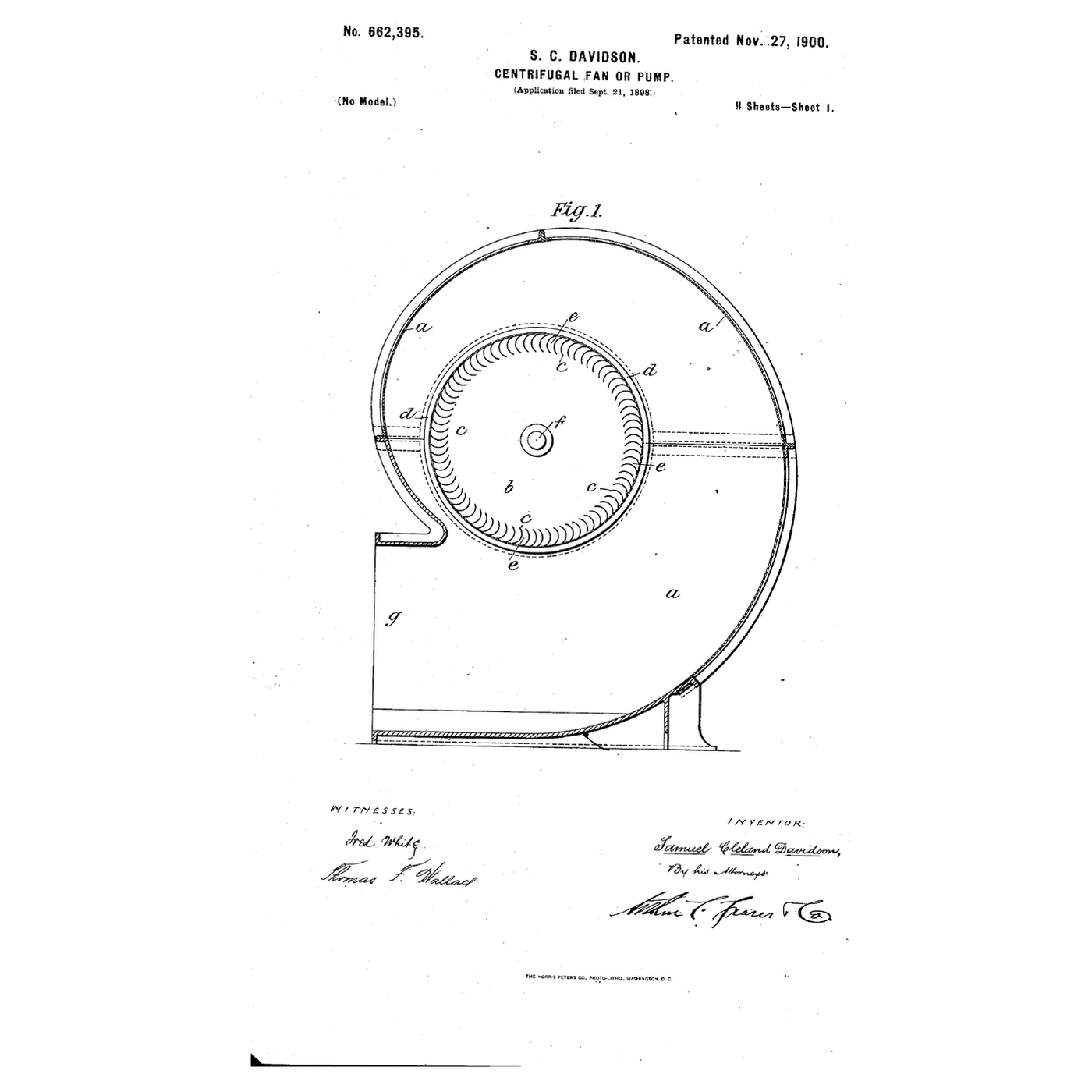


The Sirocco Fan: Many Shallow Forward-Curved Blades
Look inside a cooker hood, a car's heater or a furnace blower and you find a squirrel cage: a drum of many narrow blades, each curved forward, spinning in a spiral casing. Samuel Cleland Davidson of Belfast patented it in 1898–1900 as the 'Sirocco' fan, and his own specification gives its proportions.
Forward-curved blades throw the air off the rim faster than the rim itself moves, so a small, slow wheel moves a lot of air quietly. The price is a power curve that keeps rising with flow: a Sirocco blower with its duct removed can overload its own motor.
This rung prints a Sirocco wheel to Davidson's proportions and a backward-curved wheel of the same size, and measures the difference.
Intermédiaire
About 5 hours
Consignes
1
1
Read Davidson's proportions
Read Davidson's proportions
US 662,395, 'Centrifugal Fan or Pump', filed 21 September 1898. The rotor is *"constructed with numerous thin elongated blades arranged in substantially drum form"*, enclosing *"a relatively large and practically unobstructed intake-chamber"*.
The numbers are in the text: each blade's length should be *"at the least three times their depth"* and *"preferably as much as nine or more times"*; in the preferred form the intake chamber's diameter is *"ten times the depth of the individual blades"*. Curved blades are mounted so that *"their concave faces are toward the direction of rotation"* with the outer edges *"tilted forward slightly"*.
Those three ratios are the design brief for step 3.
2
2
Why forward curving, and what it costs
Why forward curving, and what it costs
Chargement du notebook Jupyter…
3
3
Print two wheels and a scroll
Print two wheels and a scroll
**Sirocco wheel:** 100 mm outside diameter, 36 shallow blades each 8 mm deep radially (an intake about ten times that across, per Davidson), 75 mm long (over nine times the depth), each blade curved with its concave face forward. A solid back disc carries the hub; the front is an open ring.
**Backward-curved wheel:** same diameter and width, 8 thicker blades curving the other way.
**Scroll casing:** a spiral whose gap to the wheel grows round to a rectangular outlet, with a round inlet on the axis. Mount the hobby motor behind it, wheel on its shaft.
Matériaux pour cette étape :
 Filament PETG120 g
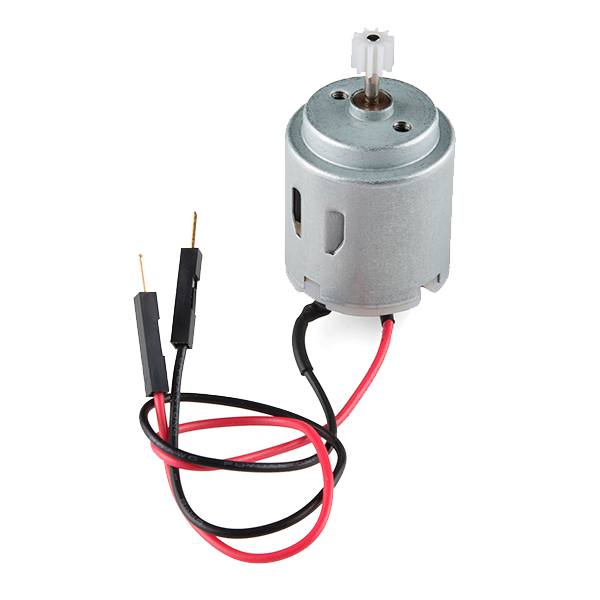 Hobby Motor - Gear1 pièce
 Vis à métaux6 pièces
Outils nécessaires :
 Imprimante 3D à filament (FDM)
 Pied à coulisse numérique 6 pouces
 Jeu de clés Allen
4
4
Measure flow and motor current, open and throttled
Measure flow and motor current, open and throttled
Run each wheel from the bench supply at the same voltage. Hold the anemometer across the outlet and read the air speed; flow is air speed × outlet area. Read the motor current on the supply.
Then throttle the outlet with a card, in steps from open to nearly closed, and read both again at each step.
The Sirocco wheel moves more air at the same speed. Watch its current: it is highest with the outlet wide open and falls as you close it — the notebook's rising power curve, measured. The backward-curved wheel's current changes far less. That is why a Sirocco blower must never be run without the duct it was sized for.
Outils nécessaires :
 Alimentation en courant continu
 Anémomètre portatif
 Tachymètre numérique
 Règle
Règle5
5
History and context
History and context
**US 662,395, 'Centrifugal Fan or Pump', Samuel Cleland Davidson of Belfast, Ireland; filed 21 September 1898, patented 27 November 1900.** Davidson's Sirocco Engineering Works had begun with tea-drying machinery — hot air blown through leaves — and the fan grew out of the need to move large volumes of warm air. It became standard for ventilation, mine and ship fans, and it is still the small blower in countless appliances.
**Honest limits.** Forward-curved fans are less efficient than good backward-curved ones, and their rising power curve can overload the motor when the system resistance falls. Their many small blades collect dust and grease. They suit low pressures and large flows, not high pressures.
Matériaux
3- 120 gEspace réservé
- Hobby Motor - Gear10 % de commission1 pièce€2.21
- 6 piècesEspace réservé
Outils requis
7- Espace réservé
- Espace réservé
- Espace réservé
- Espace réservé
- Espace réservé
- Espace réservé
- Espace réservé
Total estimé
Ce que le maker a acheté. Les matériaux sans prix se trouvent là où vous les achetez.
Blueprints liés
Ces blueprints partagent des connaissances — techniques, matériaux ou principes

CC0 Domaine public
Ce blueprint est publié sous CC0. Vous êtes libre de copier, modifier, distribuer et utiliser ce travail pour tout usage, sans demander la permission.
Soutenez le Maker en achetant des produits via son Blueprint où il perçoit une Commission Maker définie par les Vendeurs, ou créez une nouvelle itération de ce Blueprint et incluez-le comme connexion dans votre propre Blueprint pour partager les revenus.