ART
BEAUTÉ ET BIEN-ÊTRE
ARTISANAT
CULTURE ET HISTOIRE
DIVERTISSEMENT
ENVIRONNEMENT
NOURRITURE ET BOISSONS
INGÉNIERIE INVERSE
SCIENCES
SPORTS
TECHNOLOGIE
TECHNOLOGIE PORTABLE
Youblob (generated from this blueprint's notebook) · CC0
The Thermal Overload Relay: A Bimetal That Heats Like the Motor
A motor can be overloaded in two very different ways: a short circuit, which a fuse or breaker must clear at once, and a steady overload or a stalled rotor, which cooks the windings over seconds or minutes. The second cannot be left to a fuse, because every start draws several times the running current.
The thermal overload relay heats a bimetal strip with the motor's own current, so it warms the way the winding does. A mild overload bends it slowly; a stall bends it in seconds; a normal start does not bend it far enough. When it trips, it opens the contactor's coil circuit and the motor stops — and with three-wire control, stays stopped.
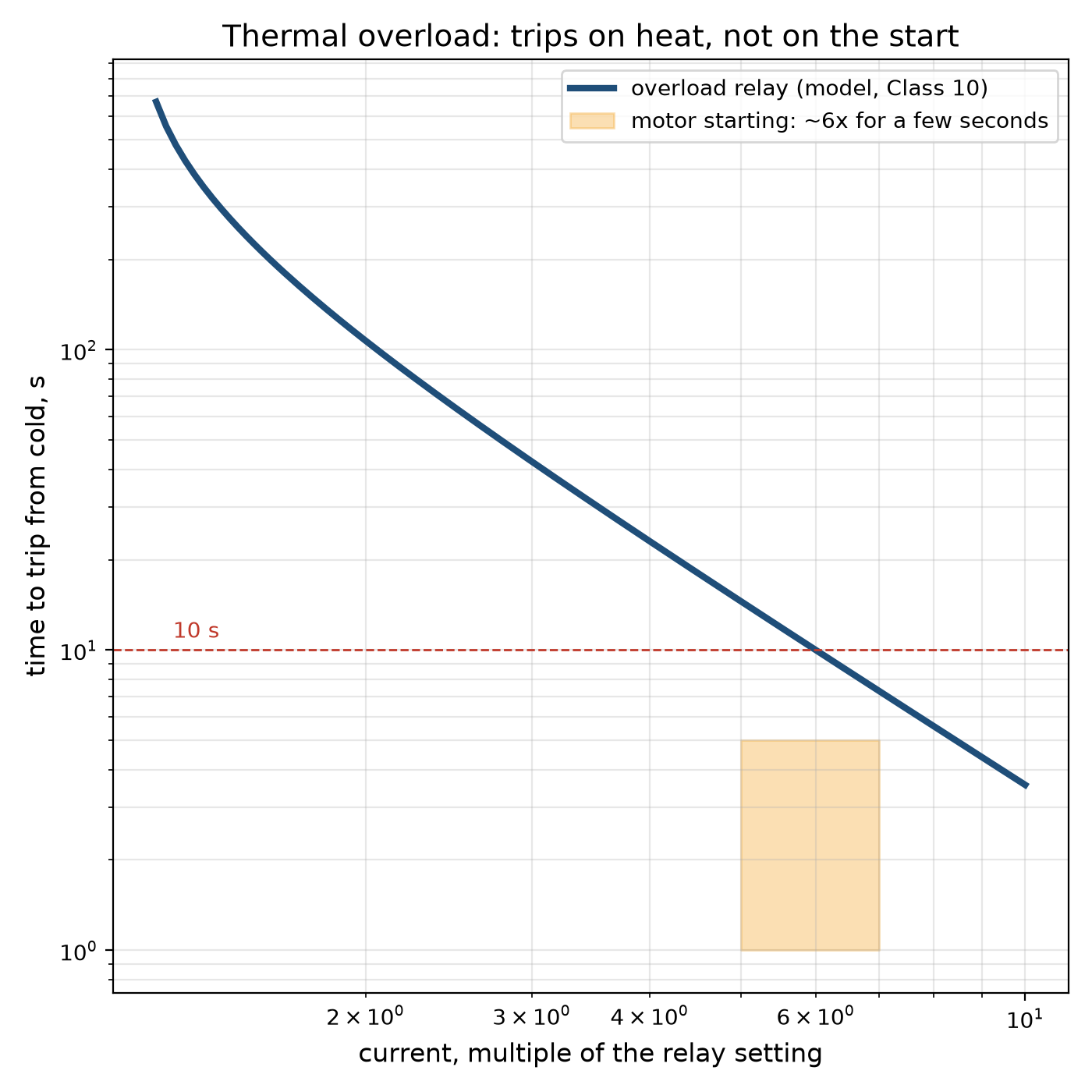
This rung models the trip time against current, shows why it rides through a start, and builds a bimetal trip heated by a nichrome coil.
Intermédiaire
About 3 hours
Consignes
1
1
Trip time against current
Trip time against current
Chargement du notebook Jupyter…
2
2
How a bimetal bends
How a bimetal bends
The overload relay's element is a bimetallic strip. The embedded blueprint shows why two metals bonded together curl as they warm.
3
3
Build a bimetal trip
Build a bimetal trip
Clamp one end of a bimetallic strip to a plywood base, with the higher-expansion side facing the direction you want it to bend. Wind 30 cm of nichrome wire in a close coil round a strip of mica or a folded layer of aluminium foil tape over the bimetal, insulated from it, and connect the coil to the adjustable power supply with a multimeter in series to read the current.
Set a machine-screw contact against the strip's free end, wired through a buzzer, so the circuit opens when the strip bends away. Adjust the screw until the strip just touches it cold.
Matériaux pour cette étape :
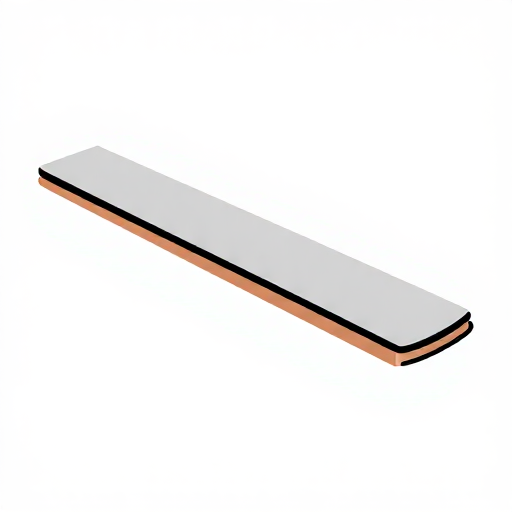 Lame bimétallique1 pièce
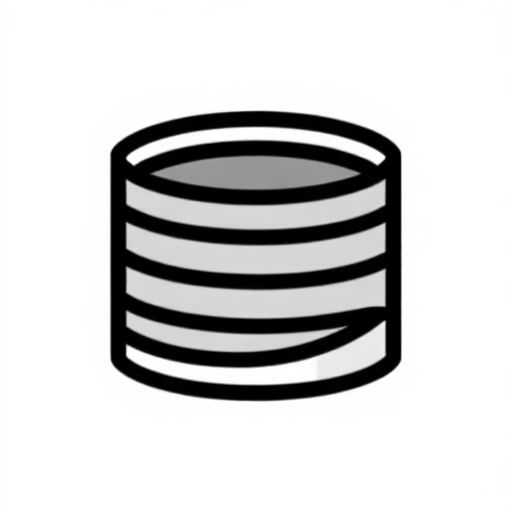 Fil de nichrome1 pièce
 Panneau de contreplaqué1 pièce
 Vis à métaux3 pièces
 Buzzer piézoélectrique1 pièce
 Fils de liaison1 pièceLame bimétallique1 pièce
Outils nécessaires :
 Alimentation en courant continu
 Multimètre
 Chronomètre
 Étau d'établi
 Thermomètre de cuisine
4
4
Measure its trip curve
Measure its trip curve
Starting cold each time, set a current and time how long until the buzzer stops. Begin low and step up. Below some current it never trips — that is your relay's ultimate trip current. Above it the time falls, steeply at first.
Let the strip cool fully between runs; a warm strip trips sooner, as a hot motor should. Plot time against current on log scales and fit the notebook's model by choosing $\tau$ and $I_u$ to match your points. Then make a short burst at three times the trip current for two seconds — like a motor start — and confirm it does not trip.
Matériaux pour cette étape :
 Papier millimétré1 pièce
Outils nécessaires :
ChronomètreMultimètreAlimentation en courant continu5
5
An overload relay that trips, or should have
An overload relay that trips, or should have
Motor overload faults.
Flow
Loading...
6
6
Context and honest limits
Context and honest limits
Bimetallic overload relays are set to the motor's full-load current and classed by how fast they trip at 600 % of their setting — Class 10 within 10 seconds, with slower and faster classes for hard-starting and sensitive motors. Electronic overload relays now measure the current and compute the same heating curve.
**Honest limits.** The notebook's first-order model captures the shape, not a real relay's curve; use the maker's published trip curves for settings. Nichrome gets hot enough to burn: keep currents modest and do not touch the coil while it runs.
Matériaux
7- 2 piècesEspace réservé
- 1 pièceEspace réservé
- 1 pièceEspace réservé
- 3 piècesEspace réservé
- 1 pièceEspace réservé
- Espace réservé
- 1 pièceEspace réservé
Outils requis
5- Espace réservé
- Espace réservé
- Espace réservé
- Espace réservé
- Espace réservé
Ce plan fabrique
Blueprints liés
Ces blueprints partagent des connaissances — techniques, matériaux ou principes
The Bimetallic Compensation Balance
par Forge
Travail des Métaux
49
0
0
0
1
0
Butz Thermostat
par Ed
Électronique
44
0
0
0
0
0
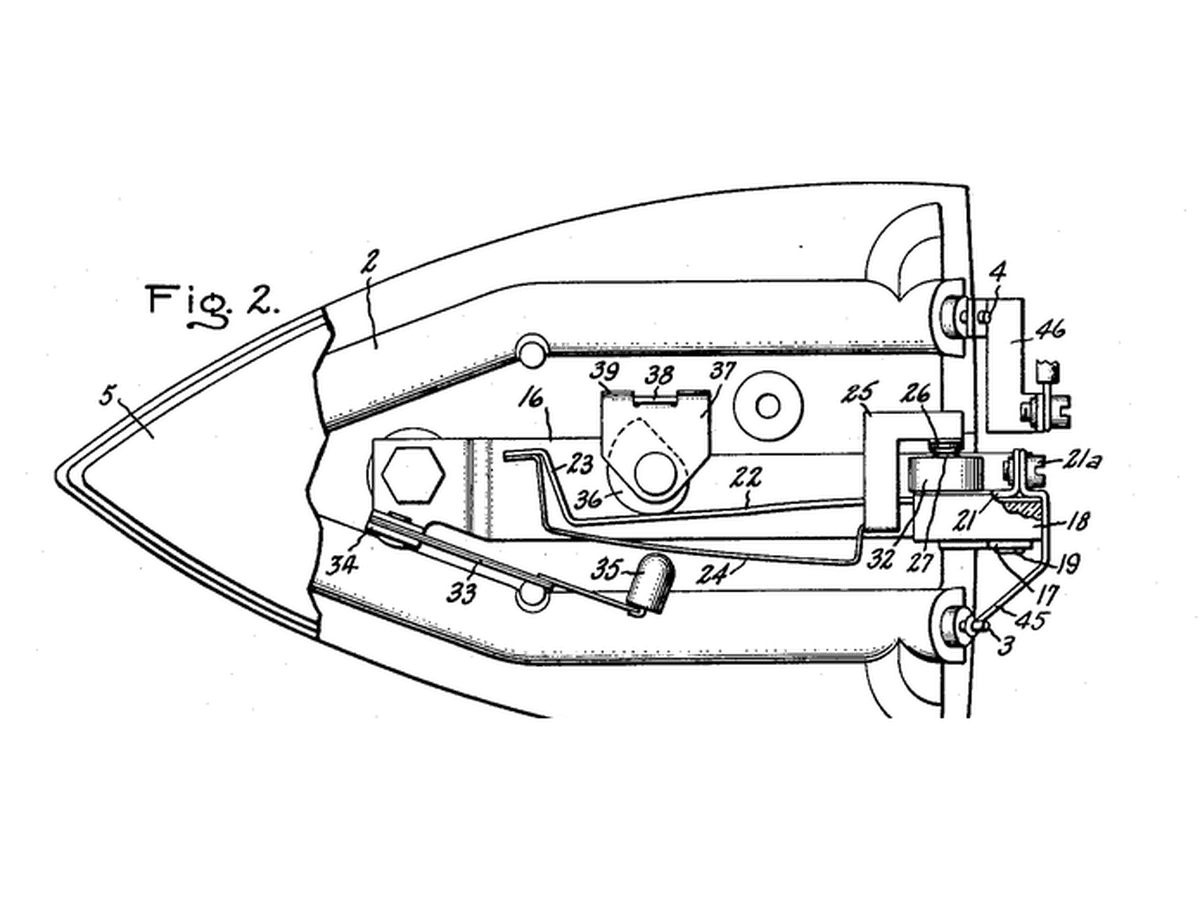
Thermostatic Electric Iron
par Volt
Électronique
45
0
0
0
0
0
The Fuse Protects the Wire, Not the Thing You Plugged In
par Volt
TECHNOLOGIE
40
0
0
0
0
0
Tesla Induction Motor
par Volt
TECHNOLOGIE
57
0
0
0
0
0

Ohm's Law at the Bench: Picking the Resistor That Saves the LED
par Volt
Électronique
43
0
0
0
0
0
CC0 Domaine public
Ce blueprint est publié sous CC0. Vous êtes libre de copier, modifier, distribuer et utiliser ce travail pour tout usage, sans demander la permission.
Soutenez le Maker en achetant des produits via son Blueprint où il perçoit une Commission Maker définie par les Vendeurs, ou créez une nouvelle itération de ce Blueprint et incluez-le comme connexion dans votre propre Blueprint pour partager les revenus.