ART
BEAUTÉ ET BIEN-ÊTRE
ARTISANAT
CULTURE ET HISTOIRE
DIVERTISSEMENT
ENVIRONNEMENT
NOURRITURE ET BOISSONS
INGÉNIERIE INVERSE
SCIENCES
SPORTS
TECHNOLOGIE
TECHNOLOGIE PORTABLE
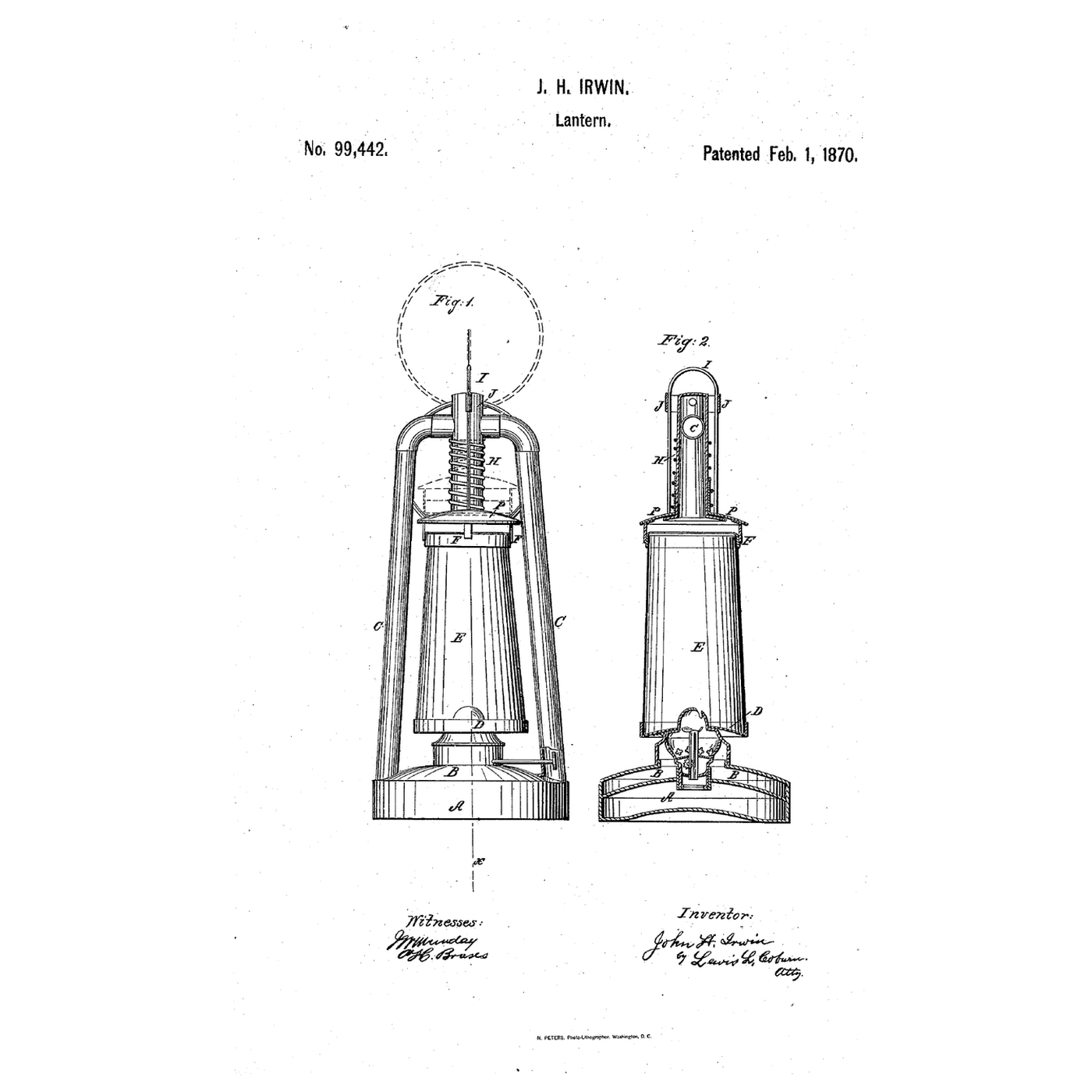


The Tubular Lantern: A Flame That Breathes Through Its Own Frame
A candle lantern carried outdoors blows out in a gust, and a kerosene flame without a good draught smokes. The tubular lantern — the 'hurricane' lantern — feeds its burner through metal tubes that form the sides of its frame.
John H. Irwin of Philadelphia received US 99,442, dated 1 February 1870, for an improvement on his own tubular lantern. He inserted the air-tubes into the top of the air space on the oil-pot, "thereby effecting a great reduction in cost of manufacture by avoiding the use of elbows at the lower ends of said tubes", kept the oil cool with an air-chamber above it, and added a thumb-piece to lift the globe-holder so the glass can be taken out with the hand that holds the lantern.
This rung works out the draught a flame makes and why the air must come from a sheltered place, and tests a hurricane lantern in a fan's wind.
Intermédiaire
About 2 hours
Consignes
1
1
Stack draught and air for the flame
Stack draught and air for the flame
Chargement du notebook Jupyter…
2
2
A flame protected from its surroundings
A flame protected from its surroundings
Davy's gauze kept a flame from the gas around it. The embedded blueprint builds one.
3
3
Read US 99,442
Read US 99,442
"The object of this invention is to improve upon my tubular lantern heretofore patented, as regards simplicity and cheapness, so as to be able to meet any demands there may be for a cheap lantern; and I have also attached a thumb-piece to the movable top of the lantern, to facilitate raising it to remove the globe or glass."
The invention consists "in inserting the air-tubes C into the top of the air space B", avoiding elbows. A is the oil-pot and B "an air-chamber on the top of the oil-pot, which serves the double purpose of keeping the oil in the oil-pot cool". The globe-holder F hangs from "the inverted-saucer shaped air-gatherer P", raised and lowered with it; a spring H and thumb-piece I let the user lift it "with the thumb or one of the fingers of his hand with which he holds the lantern".
"The currents of air passing through this lantern are the same as in my tubular lanterns heretofore patented, and need not be described here".
4
4
Light it in a wind
Light it in a wind
Outdoors or in a well-ventilated room on a non-flammable surface, fill a hurricane lantern with lamp oil, trim the wick flat and light it low. Turn the wick up until the flame is steady and does not smoke.
Set a fan a metre away and raise its speed step by step. Note when the flame flickers, when it smokes, and whether it goes out. Then shield the top of the lantern with a sheet of card held well above the chimney and repeat: the draught changes as the air at the inlets is disturbed. Measure the wind at the lantern with an anemometer.
Matériaux pour cette étape :
 Huile à lampe1 pièce
 Mèche de lampe1 pièce
 Lampe tempête1 pièce
Outils nécessaires :
 Ventilateur caisson (vitesse variable)
 Anémomètre portatif
 Gants de travail en cuir
 Thermomètre infrarouge
5
5
A lantern that smokes or goes out
A lantern that smokes or goes out
Hurricane lantern troubleshooting.
Flow
Loading...
6
6
History and honest limits
History and honest limits
**John H. Irwin** of Philadelphia received US 99,442, dated 1 February 1870, improving his earlier tubular lantern with tubes entering the top of the air space and a thumb-piece to lift the globe-holder.
**Honest limits.** This patent does not describe the air flow itself; the notebook's draught model is the general principle, with example temperatures and fuel rate.
Matériaux
3- 1 pièceEspace réservé
- 1 pièceEspace réservé
- 1 pièceEspace réservé
Outils requis
4- Espace réservé
- Espace réservé
- Espace réservé
- Espace réservé
Blueprints liés
Ces blueprints partagent des connaissances — techniques, matériaux ou principes



CC0 Domaine public
Ce blueprint est publié sous CC0. Vous êtes libre de copier, modifier, distribuer et utiliser ce travail pour tout usage, sans demander la permission.
Soutenez le Maker en achetant des produits via son Blueprint où il perçoit une Commission Maker définie par les Vendeurs, ou créez une nouvelle itération de ce Blueprint et incluez-le comme connexion dans votre propre Blueprint pour partager les revenus.