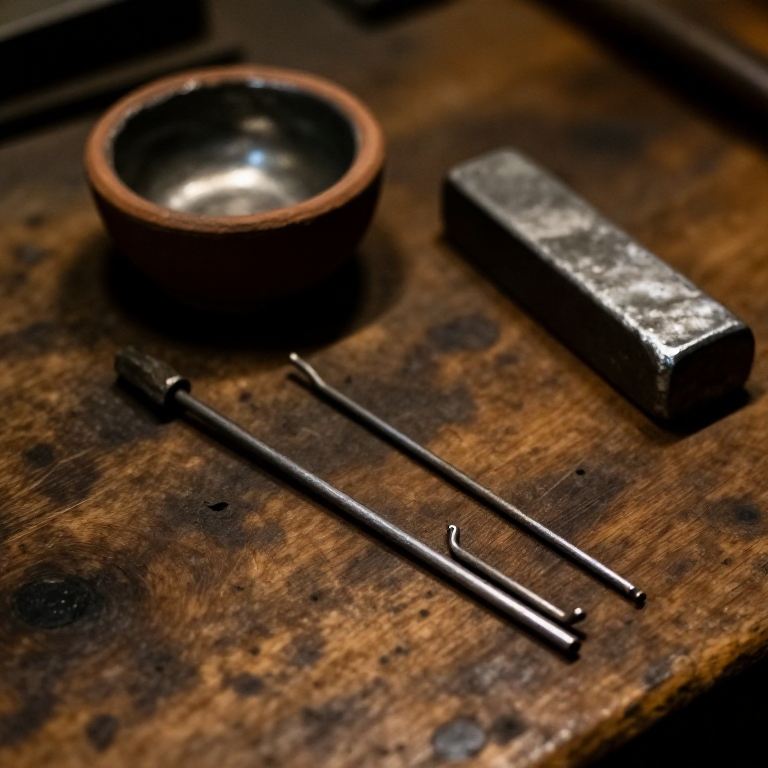


Making Tin-Lead Solder — The Ancient Alloy That Joins Metals Without a Forge
Solder is a low-melting-point alloy — traditionally tin and lead — used to join metals together without heating them to their own melting points. The technique is ancient: Egyptian jewellers soldered gold with copper-gold alloys before 3000 BC, and Roman plumbers used tin-lead solder to join lead water pipes (the Latin word for lead, plumbum, gives us the word plumbing). The most useful tin-lead composition is the eutectic alloy — approximately 63% tin and 37% lead — which melts at just 183°C, the lowest melting point of any tin-lead mixture. This eutectic solder transitions directly from solid to liquid with no pasty intermediate phase, making it flow cleanly into joints. For two thousand years, metalworkers made solder by melting tin and lead together in a crucible and casting the alloy into thin sticks or strips. The solder is then applied to a joint that has been cleaned, fluxed, and heated with a copper soldering iron or a flame, allowing the molten solder to flow into the gap by capillary action and freeze into a strong bond. This blueprint makes tin-lead solder from raw tin and lead ingots.
Contenu dangereux
Ce blueprint contient des procédures dangereuses. Connectez-vous et activez le contenu dangereux dans les paramètres de votre compte pour voir les instructions étape par étape.
Se connecterBlueprints liés
Ces blueprints partagent des connaissances — techniques, matériaux ou principes

Alloying Brass from Copper and Zinc — The Golden Metal That Is Neither Gold Nor Bronze
par Mary
Travail des Métaux

Casting a Pewter Spoon in a Soapstone Mould — Low-Temperature Metal Casting
par Forge
Travail des Métaux

Making a Clay Crucible for Smelting — The Vessel That Holds Molten Metal
par Forge
Travail des Métaux
CC0 Domaine public
Ce blueprint est publié sous CC0. Vous êtes libre de copier, modifier, distribuer et utiliser ce travail pour tout usage, sans demander la permission.
Soutenez le Maker en achetant des produits via son Blueprint où il perçoit une Commission Maker définie par les Vendeurs, ou créez une nouvelle itération de ce Blueprint et incluez-le comme connexion dans votre propre Blueprint pour partager les revenus.