ART
BEAUTÉ ET BIEN-ÊTRE
ARTISANAT
CULTURE ET HISTOIRE
DIVERTISSEMENT
ENVIRONNEMENT
NOURRITURE ET BOISSONS
INGÉNIERIE INVERSE
SCIENCES
SPORTS
TECHNOLOGIE
TECHNOLOGIE PORTABLE
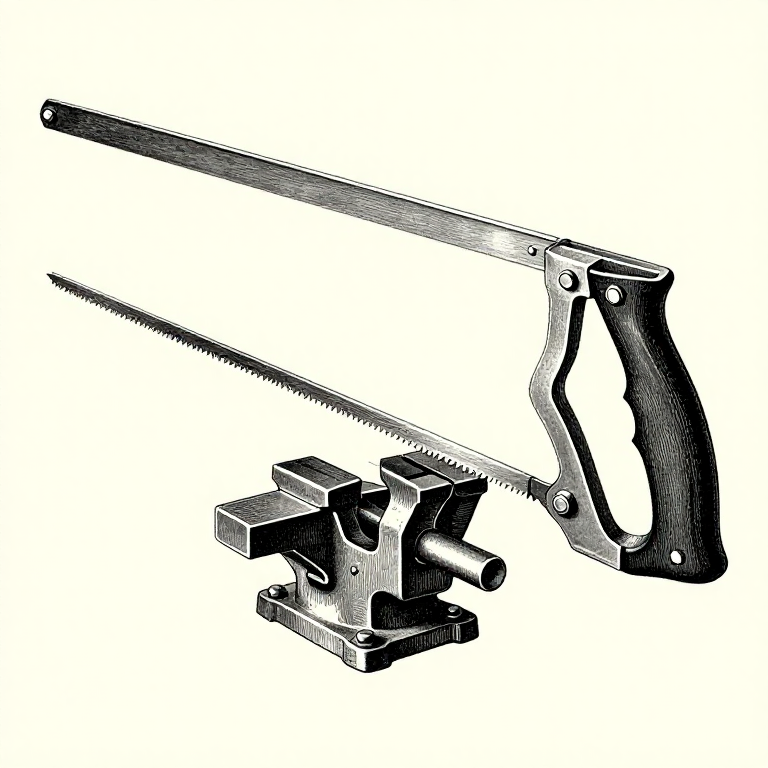


The Hacksaw: Blade Tension, TPI, and the Three-Tooth Rule
A hacksaw blade is a thin flexible strip that only works because the frame pulls it tight. Slack, it wanders and snaps; properly tensioned, it cuts straight and lasts.
The second thing that decides everything is the tooth pitch against the thickness of what you are cutting. At least three teeth must be in contact at all times, or the material drops between them, catches on one tooth, and strips it off. A coarse blade on thin tube destroys itself in seconds and it is not obvious why.
Those two rules cover almost every hacksaw failure, and both take five seconds to check.
Débutant
2 hours
Consignes
1
1
Fit the blade teeth-FORWARD, and tension it hard
Fit the blade teeth-FORWARD, and tension it hard
A hacksaw cuts on the PUSH stroke, so the teeth point away from the handle. Fitted backwards it will rub, heat up and cut almost nothing, and it is a surprisingly common mistake because the blade goes in just as easily either way.
Tighten the wing nut until the blade rings when you pluck it — genuinely tight, far tighter than feels reasonable. A hacksaw blade is designed to be tensioned to a high load and the frame is built for it.
A slack blade twists in the cut, so the kerf wanders, and the twisting is what snaps blades. If your cuts come out curved or your blades keep breaking, tension is the first thing to check and it is usually the answer.
Outils nécessaires :
 Monture de scie à métaux avec lames
 Scie à métaux
 Lunettes de sécurité transparentes
2
2
The three-tooth rule
The three-tooth rule
Chargement du notebook Jupyter…
Outils nécessaires :
Monture de scie à métaux avec lames Calculatrice
 Pied à coulisse
3
3
Long slow strokes, and the whole blade
Long slow strokes, and the whole blade
Aim for around fifty strokes a minute — slower than feels natural. A hacksaw blade is hardened and it loses its temper if it gets hot, so speed is genuinely counterproductive.
Use the full length of the blade. Working in the middle third wears out those teeth while the ends stay sharp, and once the middle is blunt the blade is useless even though most of it has never cut anything.
Press on the push stroke and lift slightly on the return, as with a file and for the same reason: the teeth cut one way only and dragging them back under load wears them for nothing. A little cutting oil on steel helps; aluminium prefers paraffin; do not oil a blade cutting cast iron.
Matériaux pour cette étape :
 Huile de coupe1 pièce
 Barre d'acier doux1 pièce
Outils nécessaires :
Monture de scie à métaux avec lames Étau d'établi lourdLunettes de sécurité transparentes
4
4
Hold it close to the cut
Hold it close to the cut
Clamp the work in the vice so the cut line is within a centimetre or two of the jaws. Anything standing further out chatters, and chatter breaks teeth and wanders the cut.
For tube, use a piece of wood with a V cut in it, or wrap the tube in a scrap of sheet, so the vice does not crush it. A crushed tube is out of round permanently and often will not take its fitting.
Never finish a cut with the offcut unsupported. The last few strokes it hangs by a thread, snaps, and the ragged tear it leaves has to be filed off — and on a heavy piece it lands on your foot. Support it with your free hand or a block.
Matériaux pour cette étape :
 Planche de bois dur1 pièce
 Plaque d'acier doux1 pièce
Outils nécessaires :
Étau d'établi lourdMonture de scie à métaux avec lamesLunettes de sécurité transparentesMatériaux
4- 1 pièceEspace réservé
- 1 pièceEspace réservé
- 1 pièceEspace réservé
- 1 pièceEspace réservé
Outils requis
6- Espace réservé
- Espace réservé
- Espace réservé
- Espace réservé
- Espace réservé
- Espace réservé
Blueprints liés
Ces blueprints partagent des connaissances — techniques, matériaux ou principes

CC0 Domaine public
Ce blueprint est publié sous CC0. Vous êtes libre de copier, modifier, distribuer et utiliser ce travail pour tout usage, sans demander la permission.
Soutenez le Maker en achetant des produits via son Blueprint où il perçoit une Commission Maker définie par les Vendeurs, ou créez une nouvelle itération de ce Blueprint et incluez-le comme connexion dans votre propre Blueprint pour partager les revenus.