ART
BEAUTÉ ET BIEN-ÊTRE
ARTISANAT
CULTURE ET HISTOIRE
DIVERTISSEMENT
ENVIRONNEMENT
NOURRITURE ET BOISSONS
INGÉNIERIE INVERSE
SCIENCES
SPORTS
TECHNOLOGIE
TECHNOLOGIE PORTABLE
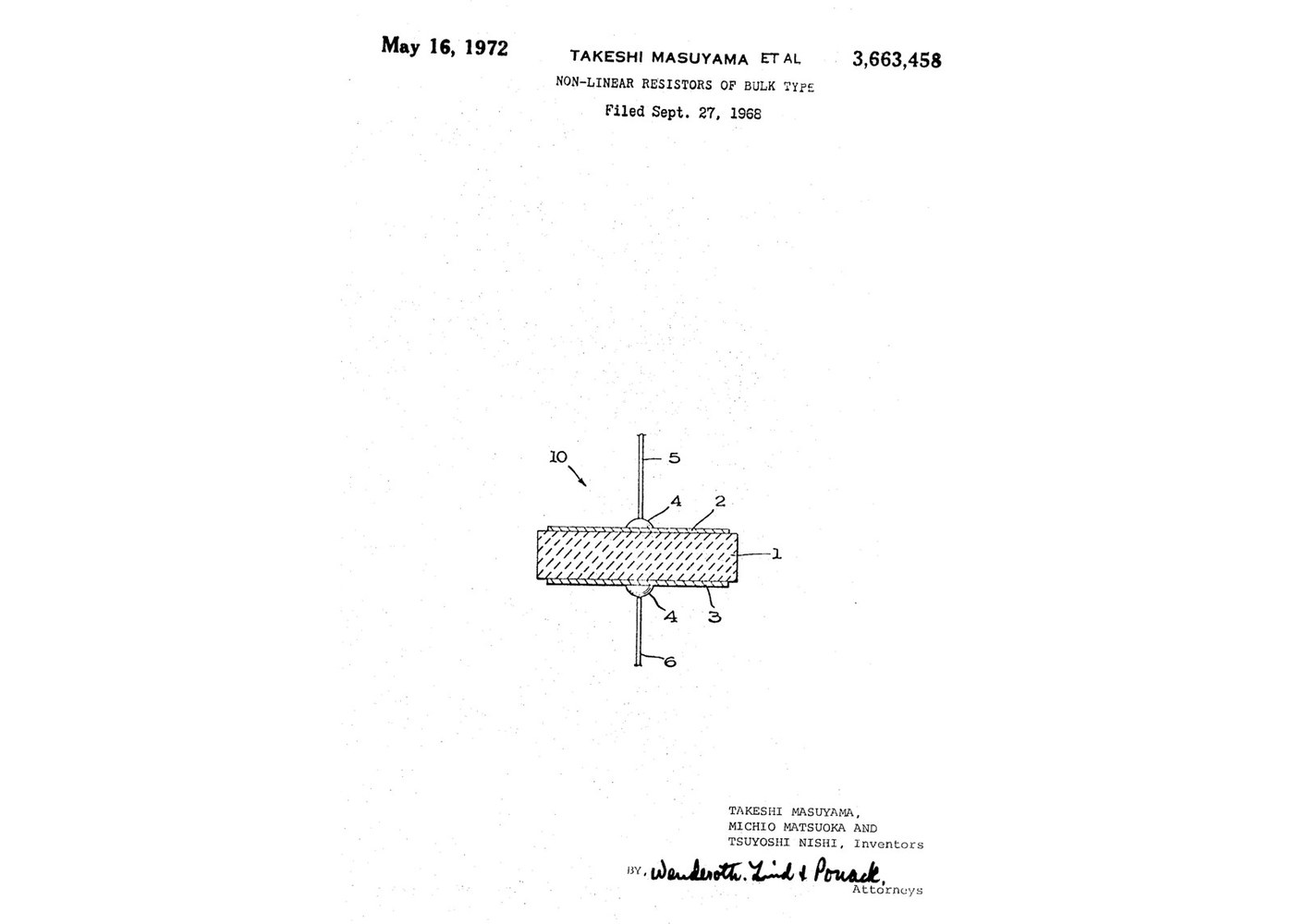


Metal Oxide Varistor: Zinc Oxide with 0.1 % Bismuth Oxide, 1100 °C, 1.0 mm (Masuyama 1972)
A non-linear resistor: the current through it rises far faster than the voltage across it. Masuyama, Matsuoka and Nishi made one from zinc oxide with a little bismuth oxide: pressed into a disc, sintered, lapped, and given metal electrodes. With 0.1 mole % bismuth oxide, sintered at 1100 °C and lapped to 1.0 mm, the disc measured a C-value of 40 at 1 mA and a nonlinearity exponent n of 4.0.
Source: T. Masuyama, M. Matsuoka and T. Nishi (Matsushita), US 3,663,458 (1972), Example 1. Unknown: how the aluminium is sprayed on and what the silver paint is. The patent calls both well known, so they are linked to unknown heads. The 10 g batch is our arithmetic. Picture: the patent's drawing.
Avancé
1 day
Consignes
1
1
Weigh 99.9 ZnO to 0.1 Bi2O3 and wet-mill 5 hours
Weigh 99.9 ZnO to 0.1 Bi2O3 and wet-mill 5 hours
Mix zinc oxide and bismuth oxide 99.9 : 0.1 by moles. Ours, for 10 g: 9.943 g zinc oxide and 0.057 g bismuth oxide (our arithmetic). Mill wet for 5 hours, then dry. Unknown: the milling liquid.
Matériaux pour cette étape :
 Poudre d'oxyde de zinc9.943 g
 Oxyde de bismuth0.057 g
Outils nécessaires :
 Balance à fléau
 Broyeur à boulets de fer
 Étuve de séchage
2
2
Press discs 13 mm by 2.5 mm
Press discs 13 mm by 2.5 mm
Press the powder in a mould into discs 13 mm across and 2.5 mm thick at 340 kg/cm².
Outils nécessaires :
 Presse hydraulique
 Matrice de pressage de disques
 Pied à coulisse
3
3
Sinter 1 hour at 1100 °C and furnace-cool
Sinter 1 hour at 1100 °C and furnace-cool
Sinter the discs in air for 1 hour at 1100 °C, then let them cool in the furnace to room temperature (about 15-30 °C). Above 1200 °C the disc loses its nonlinearity.
Outils nécessaires :
 Four à moufle
4
4
Lap both faces to 1.0 mm
Lap both faces to 1.0 mm
Lap both faces with 600-mesh silicon carbide until the disc is 1.0 mm thick.
Outils nécessaires :
 Grains de carbure de siliciumPied à coulisse
5
5
Spray aluminium electrodes and attach leads
Spray aluminium electrodes and attach leads
Spray a metallised film of aluminium on both faces. Attach a lead wire to each with conductive silver paint. Unknown: the spraying method and the paint.
Matériaux pour cette étape :
 Lingot d'aluminium1 as required
 Peinture conductrice à l'argent1 as required
 Fil de cuivre2 pièces
Outils nécessaires :
 Méthode de projection de métal inconnuePied à coulisse
Matériaux
5- 9.943 gEspace réservé
- 0.057 gEspace réservé
- 1 as requiredEspace réservé
- 1 as requiredEspace réservé
- 2 piècesEspace réservé
Outils requis
9- Espace réservé
- Espace réservé
- Espace réservé
- Espace réservé
- Espace réservé
- Espace réservé
- Espace réservé
- Espace réservé
- Espace réservé

Blueprints liés
Ces blueprints partagent des connaissances — techniques, matériaux ou principes

CC0 Domaine public
Ce blueprint est publié sous CC0. Vous êtes libre de copier, modifier, distribuer et utiliser ce travail pour tout usage, sans demander la permission.
Soutenez le Maker en achetant des produits via son Blueprint où il perçoit une Commission Maker définie par les Vendeurs, ou créez une nouvelle itération de ce Blueprint et incluez-le comme connexion dans votre propre Blueprint pour partager les revenus.