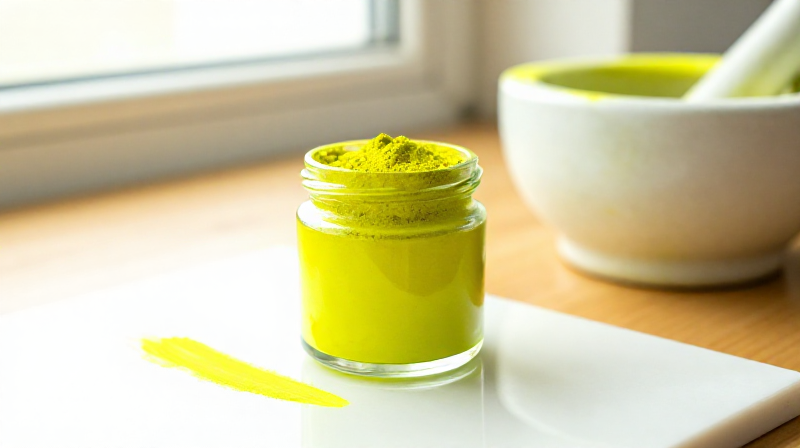


Making Isoindoline Yellow — The High-Performance Pigment That Outlasts Cadmium
Isoindoline Yellow (Pigment Yellow 109, CI 56284) is a synthetic organic pigment developed in the 1960s by Ciba-Geigy in Switzerland. It belongs to a class of pigments built from the isoindoline ring system — a five-membered nitrogen-containing ring fused to a benzene ring. These pigments offer a combination of brilliant colour, excellent lightfastness (ASTM I–II), and good heat stability that no earlier yellow pigment could match without using toxic heavy metals.
The synthesis involves two stages. First, phthalonitrile (1,2-dicyanobenzene) is reacted with ammonia to form 1,3-diiminoisoindoline — a reactive intermediate where both nitrile groups have been converted to imino groups, with one incorporated into a five-membered ring. Second, two molecules of this diiminoisoindoline are condensed with one molecule of barbituric acid. The active methylene group of barbituric acid (position 5) bridges the two isoindoline units, creating an extended conjugated system that absorbs blue-violet light and appears bright yellow.
The closely related PY110 (CI 56280) uses tetrachlorophthalonitrile as the starting material instead, giving a warmer, more reddish yellow with even greater weather resistance — preferred for automotive paints. Together, these isoindoline yellows replaced cadmium yellow and chrome yellow for applications demanding permanence without toxicity.
SAFETY WARNING: Phthalonitrile is a skin and respiratory irritant. Ammonia solution causes chemical burns and produces choking fumes. Barbituric acid is harmful if ingested (it is the parent compound of barbiturate drugs, though it has no sedative activity itself). Work under ventilation with full PPE.
相关蓝图
这些蓝图共享知识——技术、材料或原理
CC0 公共领域
此蓝图以 CC0 协议发布。你可以自由复制、修改、分发和使用此作品,无需征得许可。
通过购买蓝图中的产品支持创客,他们将获得 创客佣金 (由供应商设定),或创建此蓝图的新版本并将其作为连接包含在你自己的蓝图中以分享收入。