SENI
KECANTIKAN & KESEHATAN
KERAJINAN
BUDAYA & SEJARAH
HIBURAN
LINGKUNGAN
MAKANAN & MINUMAN
REKAYASA BALIK
ILMU PENGETAHUAN
OLAHRAGA
TEKNOLOGI
PERANGKAT PAKAI
Berbahaya


Jungner Nickel-Cadmium Accumulator
The lead-acid cell keeps part of its charge in the acid. Discharge one and the sulphuric acid is genuinely spent - the solution thins, the specific gravity drops, and a hydrometer tells you exactly how much is left. It is a wonderfully honest instrument, and it exists because the electrolyte is a participant.
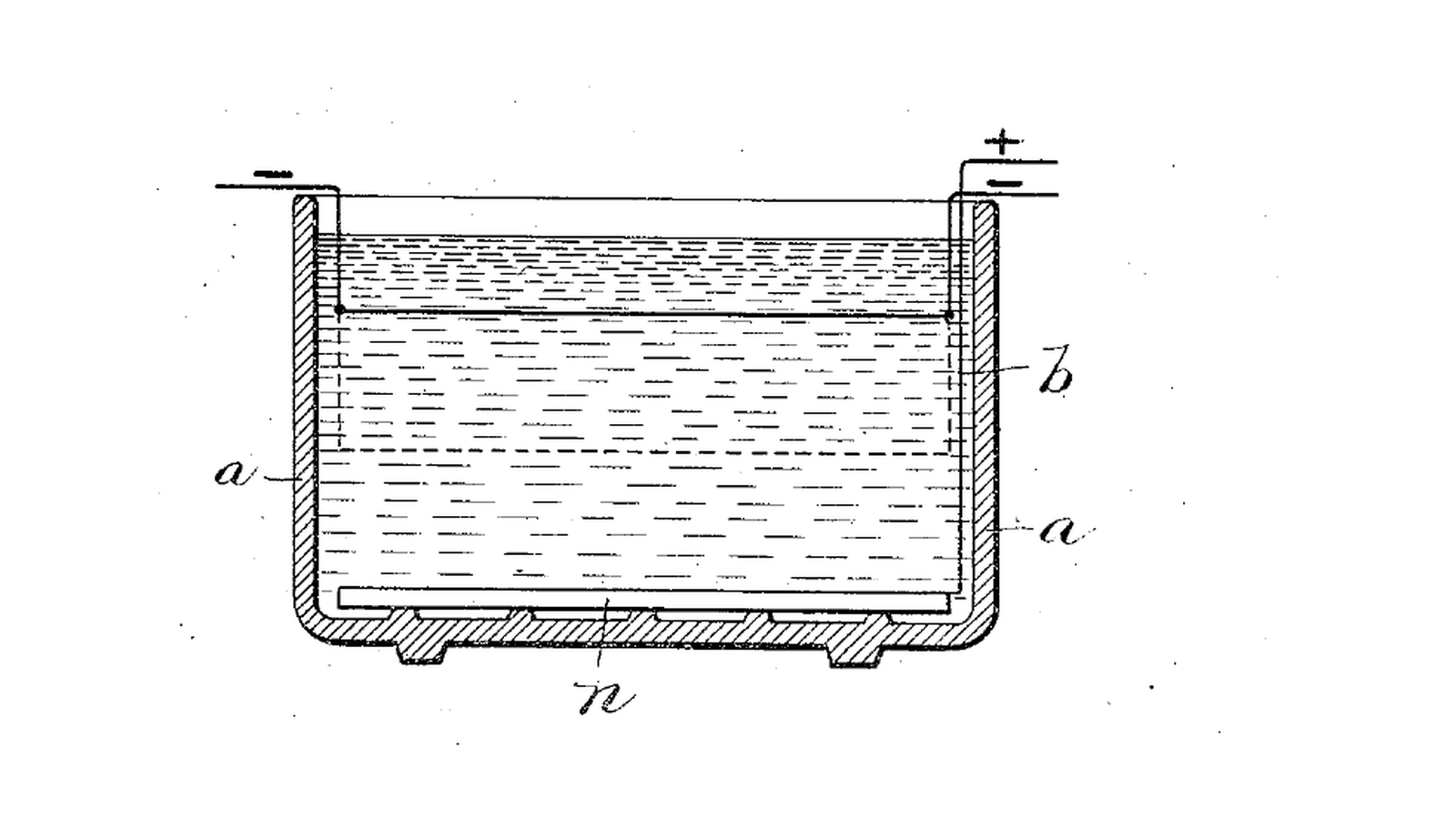
Ernst Waldemar Jungner built the opposite. In his cell the potassium hydroxide takes no part at all: hydroxide is released at one plate and taken up at the other, so the solution ends a discharge exactly as concentrated as it began. Everything is stored in the plates - nickel oxyhydroxide on one side, cadmium on the other - and the electrolyte is only the road between them.
That single decision is why the cell survives treatment that destroys a lead plate. Leave it flat for a year and there is no acid to sulphate it. Freeze it and there is no dilute acid to burst the case. Cycle it thousands of times and the plates are still the same compounds they started as. It also takes the hydrometer away from you, permanently, and the discharge curve is so flat that voltage is a poor substitute - a trade that ships in every alkaline cell since.
**On the patents, because the citation matters.** Jungner invented the nickel-cadmium cell in Sweden in the late 1890s, and his Swedish priority is where the invention lives; this blueprint does not cite a number for it that could not be checked. What CAN be checked are his two US patents, and both are in the build. **US 738,110** "Reversible galvanic battery" is a DIVISION of an application filed 17. April 1899 - which is where the 1899 date comes from, on the face of the patent itself - refiled 23. June 1902 and granted 1. September 1903. It claims the principle rather than the couple: an alkaline electrolyte with "active masses of metallic oxygen compounds" that are "insoluble in the electrolyte under all conditions", so that "the electrolyte remains throughout the same both in quality and quantity". **US 884,930** "Electrode for reversible galvanic batteries", filed 20. September 1904 and granted 14. April 1908, fixes the practical flaw in that idea: the active mass barely conducts, so it is mixed with flake graphite whose particles carry "a thin coating of nickel". Step 2 is that patent.
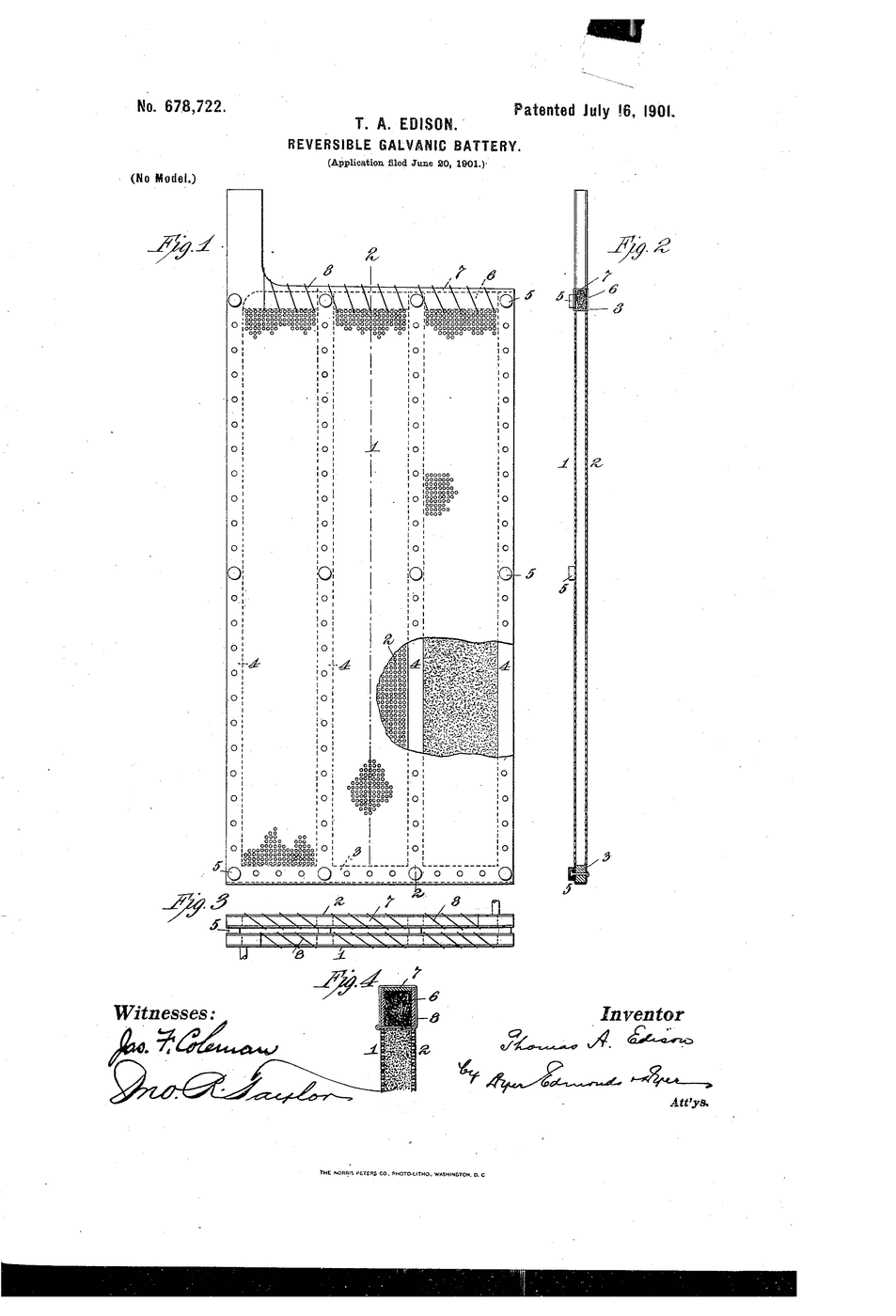
Edison filed his own "Reversible Galvanic Battery", US 678,722, in June 1901 - the same title, a year before Jungner's. He used iron where Jungner used cadmium, and he won the patent dispute that followed, having deeper pockets. Both cells are still made.
Cadmium is a toxic heavy metal and potassium hydroxide is severely caustic. This is gated for the first reason, and the last step tells you what the European Union has since decided about selling cells like this one.
Lanjutan
5 hours over two days
Konten berbahaya
Blueprint ini mengandung prosedur berbahaya. Masuk dan aktifkan konten berbahaya di pengaturan akun Anda untuk melihat petunjuk langkah demi langkah.
Blueprint terkait
Blueprint ini berbagi pengetahuan — teknik, bahan, atau prinsip

CC0 Domain Publik
Cetak biru ini dirilis di bawah CC0. Anda bebas untuk menyalin, memodifikasi, mendistribusikan, dan menggunakan karya ini untuk tujuan apa pun, termasuk komersial, tanpa meminta izin.
Dukung Maker dengan membeli produk melalui Cetak Biru mereka di mana mereka mendapatkan Komisi Pembuat yang ditetapkan oleh Penjual, atau buat iterasi baru dari Cetak Biru ini dan masukkan sebagai koneksi di milik Anda sendiri.