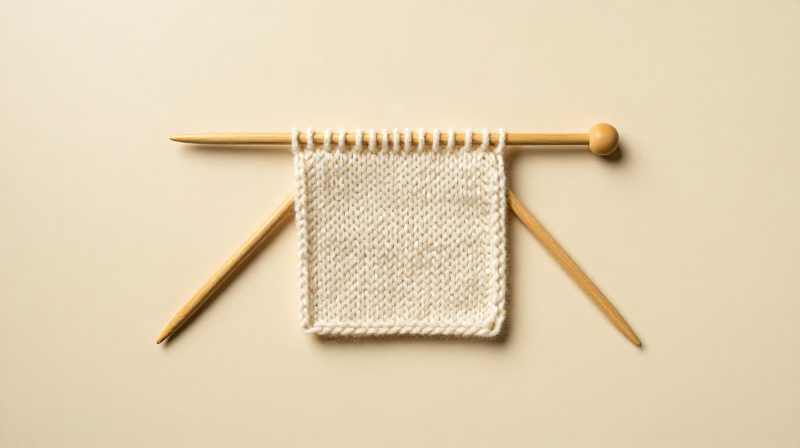

Knitting a Flat Swatch on Two Needles — The Knit Stitch and Garter Stitch
Knitting — the interlocking of continuous yarn into rows of loops using two or more pointed needles — first appears in the archaeological record around the 11th century CE in Egypt. The earliest confirmed knitted textiles are Coptic cotton socks from Egyptian tombs, worked in a technique called 'nalbinding-to-knitting transition' that shows the shift from single-needle looping to the two-needle method. By the 13th century, knitting had spread across the Islamic world and into Europe, where knitting guilds formed in cities like Paris and Florence.
Unlike nålbinding, which uses short yarn lengths and cannot unravel, knitting uses a continuous yarn and forms interlocking loops that can be pulled out row by row. This makes knitting faster but also more fragile — a dropped stitch can 'run' and unravel the fabric. The simplest knitted fabric is garter stitch: every row worked as knit stitches, producing a bumpy, elastic, reversible fabric that lies flat without curling.
This blueprint teaches the three foundational skills of two-needle knitting: casting on (creating the first row of stitches), the knit stitch (the single movement that builds every row), and casting off (securing the final row). Mastering these three actions is sufficient to knit scarves, washcloths, and blanket squares.
Instruksi
Select yarn and matching needles
Select yarn and matching needles
Choose a medium-weight (worsted or aran) wool yarn in a light color — light yarn makes it easier to see individual stitches while learning. Select straight knitting needles sized to match the yarn; for worsted weight, 4.5–5.5 mm needles are standard. Wooden or bamboo needles grip the yarn better than metal, which helps prevent dropped stitches for beginners.
Material untuk langkah ini:
 Gulungan Benang Wol50 g
Alat yang dibutuhkan:
 Jarum rajut
Make a slip knot for the first stitch
Make a slip knot for the first stitch
Pull about 60 cm of yarn from the ball (this tail feeds the cast-on stitches). Make a loop near the tail end, reach through the loop and pull the working yarn through to form a slip knot. Slide the slip knot onto one needle and tighten gently. This counts as your first stitch.
Cast on using the long-tail method
Cast on using the long-tail method
Hold the needle with the slip knot in your right hand. Drape the tail yarn over your left thumb and the working yarn over your left index finger, holding both strands in your left palm. Insert the needle tip upward through the thumb loop, catch the index finger strand, and pull it back through the thumb loop. Release the thumb loop and tighten. This creates one cast-on stitch. Repeat until you have 20 stitches on the needle.
Check the cast-on row
Check the cast-on row
Hold the needle up and examine the 20 stitches. Each should sit evenly on the needle without twisting. The bottom edge should form a neat chain of interlocking loops. If stitches are uneven (some tight, some loose), pull them off and re-cast at consistent tension. The cast-on row sets the tension for the entire swatch.
Hold the needles and yarn for knitting
Hold the needles and yarn for knitting
Transfer the needle with stitches to your left hand. Hold the empty needle in your right hand like a pencil or knife (both grips work — use whichever feels natural). Wrap the working yarn around the fingers of your right hand to maintain tension: over the index finger, under the middle finger, and over the ring finger. The yarn should feed smoothly without pulling too tight or hanging slack.
Insert the right needle into the first stitch
Insert the right needle into the first stitch
Push the tip of the right needle into the first stitch on the left needle, entering from left to right (front to back). The right needle passes behind the left needle, forming an X shape with the right needle underneath. The stitch should open slightly around both needles.
Wrap the yarn around the right needle
Wrap the yarn around the right needle
With the right needle still inserted through the stitch, wrap the working yarn counterclockwise around the right needle tip — bring the yarn behind the right needle, over the top, and back toward you between the two needle tips. This wrap creates the new loop that will become the next stitch.
Pull the new loop through the old stitch
Pull the new loop through the old stitch
Use the right needle tip to catch the wrapped yarn and draw it forward through the old stitch on the left needle. The new loop now sits on the right needle. This motion — insert, wrap, pull through — is the complete knit stitch. It takes practice to coordinate smoothly.
Slide the old stitch off the left needle
Slide the old stitch off the left needle
Once the new loop is secure on the right needle, slide the old stitch off the tip of the left needle. One stitch has moved from the left needle to the right needle. The old stitch now hangs below the new loop, forming the interlocking structure of knitted fabric.
Knit across the entire row
Knit across the entire row
Repeat the knit stitch (insert, wrap, pull through, slide off) into each stitch on the left needle. When all 20 stitches have been transferred to the right needle, the left needle is empty and one row is complete. Count your stitches — you should still have exactly 20. A missing stitch means you accidentally dropped one; an extra stitch means you split a stitch or added a yarn-over.
Turn the work and begin the next row
Turn the work and begin the next row
Swap the needles between hands: the full needle (now your working needle) goes to the left hand, the empty needle goes to the right hand. The fabric hangs below the left needle with the working yarn trailing from the last stitch on the right side. You are now ready to knit the next row from right to left — knitting always works from the left needle to the right.
Continue knitting rows to build garter stitch
Continue knitting rows to build garter stitch
Knit every stitch of every row. After 4–5 rows, the fabric begins to take shape: horizontal ridges appear on both sides, and the fabric feels bumpy and elastic. This is garter stitch — the simplest and oldest knitted fabric pattern. It lies flat, does not curl at the edges, and stretches equally in all directions. Continue until you have completed 30 rows.
Maintain even tension throughout
Maintain even tension throughout
Consistency matters more than tightness. Each stitch should slide freely on the needle without bunching or gapping. If your stitches are so tight they barely move on the needle, relax your grip. If they slide off on their own, tighten slightly. Tension improves naturally with practice — most beginners knit too tightly at first.
Count stitches periodically
Count stitches periodically
Every 5–10 rows, pause and count the stitches on your needle. You should always have 20. If the count has changed, examine the most recent rows for mistakes. Common errors: accidentally knitting into the yarn between stitches (adds a stitch), or letting a stitch slide off the needle unworked (loses a stitch). Catching mistakes early is easier than fixing them later.
Begin casting off on the final row
Begin casting off on the final row
When the swatch reaches your desired length (approximately 15 cm after 30 rows), begin the cast-off row. Knit the first two stitches normally onto the right needle. Then use the left needle tip to lift the first stitch on the right needle over the second stitch and off the needle. One stitch has been cast off.
Continue casting off across the row
Continue casting off across the row
Knit one more stitch (two stitches on right needle again), then lift the first over the second and off. Repeat this sequence — knit one, lift one over — across the entire row. Keep tension relaxed during cast-off; a tight cast-off edge will pucker. When one stitch remains on the right needle, cut the yarn leaving a 15 cm tail and pull it through the final loop to secure.
Alat yang dibutuhkan:
 Gunting
Weave in the yarn tails
Weave in the yarn tails
Thread each loose tail onto a blunt tapestry needle. Weave the tail through the backs of 5–6 stitches along the edge of the fabric, following the path of existing yarn so the weaving is invisible from the front. Trim the excess close to the fabric surface. Both the cast-on tail and the cast-off tail must be secured this way.
Alat yang dibutuhkan:
 Jarum nålbinding
Block the finished swatch
Block the finished swatch
Soak the swatch in lukewarm water for 10 minutes, gently squeeze out excess water (do not wring), and lay flat on a towel. Pin the corners to the desired dimensions and let it dry completely. Blocking evens out the stitches and sets the final shape. Wool yarn responds dramatically to blocking — uneven beginner stitches smooth out considerably after a good soak.
Bahan
1- Placeholder
Alat yang Diperlukan
3- Placeholder
- Placeholder
- Placeholder
Bahan cetak biru terhubung
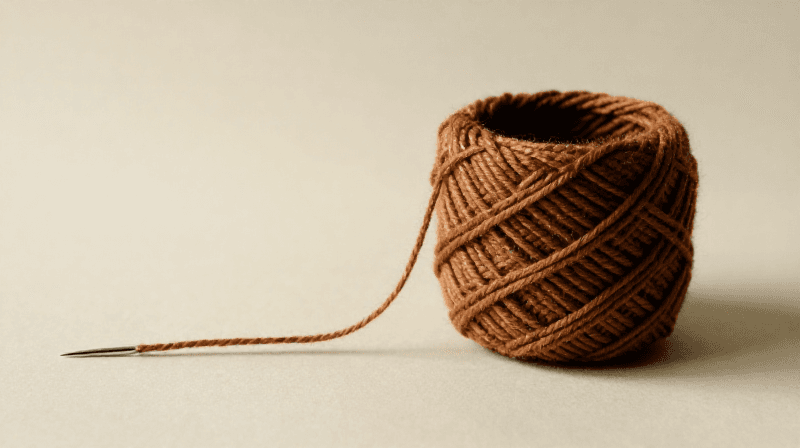
Nålbinding with the Oslo Stitch — Looped Fabric from a Single Needle
oleh Tex
Tekstil & Kulit
Using a Drop Spindle to Spin Wool — Hand Spinning Yarn
oleh Tex
Tekstil & Kulit
Carding and Combing Raw Wool for Spinning — Preparing Fleece for the Drop Spindle
oleh Tex
Kuno
Blueprint terkait
Blueprint ini berbagi pengetahuan — teknik, bahan, atau prinsip
CC0 Domain Publik
Cetak biru ini dirilis di bawah CC0. Anda bebas untuk menyalin, memodifikasi, mendistribusikan, dan menggunakan karya ini untuk tujuan apa pun, termasuk komersial, tanpa meminta izin.
Dukung Maker dengan membeli produk melalui Cetak Biru mereka di mana mereka mendapatkan Komisi Pembuat yang ditetapkan oleh Penjual, atau buat iterasi baru dari Cetak Biru ini dan masukkan sebagai koneksi di milik Anda sendiri.