Kolaborasi
SENI
KECANTIKAN & KESEHATAN
KERAJINAN
BUDAYA & SEJARAH
HIBURAN
LINGKUNGAN
MAKANAN & MINUMAN
REKAYASA BALIK
ILMU PENGETAHUAN
OLAHRAGA
TEKNOLOGI
PERANGKAT PAKAI
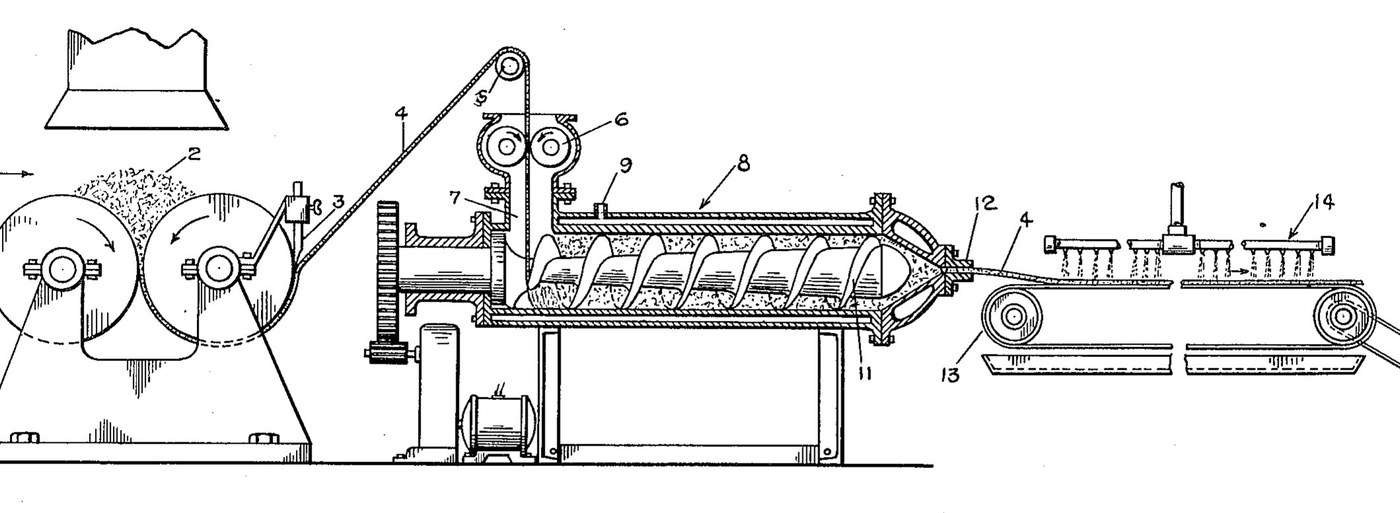


Plastic Extruder: Steam-Jacketed Screw Stuffer with a Heated Nozzle (Andersen & Strasdin, US 2,384,521, 1945)
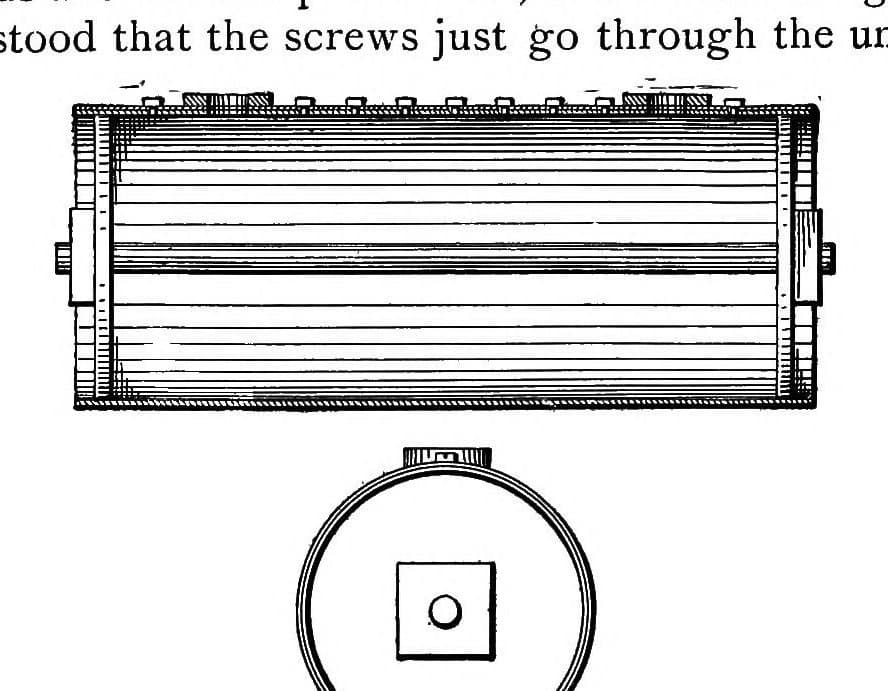
A screw extruder for thermoplastics: a turning screw in a steam-jacketed barrel pushes hot, softened plastic forward through a short nozzle heated electrically. The barrel is kept a little below the plastic's flow temperature and the nozzle well above it, so the extruded rod comes out with a smooth, glass-like skin.
Result: an extruder that makes rod, tube or strip at 25 to 30 feet a minute.
Source: B. Andersen and R. F. Strasdin (Celanese), US 2,384,521 (1945). Unknown: sizes and metals. Picture: the patent drawing.
Lanjutan
Unknown
Instruksi
1
1
Make the screw
Make the screw
Turn a screw to fit the barrel. Its thread may be single or double; to press the plastic harder toward the nozzle, make the pitch increase or the groove get shallower toward that end. Example: a double-thread screw. Ours: mild steel. Not given: sizes.
Material untuk langkah ini:
 Batang bulat baja lunak1 screw
Alat yang dibutuhkan:
 Mesin Bubut Logam
 Mesin Frais
 Dimensi tidak diketahui
2
2
Make the jacketed barrel
Make the jacketed barrel
Make the barrel with a steam jacket round it and a steam port into the jacket, and a feed throat at the back end. The inside wall may be grooved, pitched so that every flight of the screw always meets a groove; this stops the plastic slipping. Not given: the metal, the steam pressure.
Material untuk langkah ini:
 Logam tidak diketahui1 barrel and jacket
Alat yang dibutuhkan:
Mesin Bubut LogamDimensi tidak diketahui3
3
Fit the heated nozzle
Fit the heated nozzle
At the front, fit a streamlined nozzle head so no plastic can pocket and decompose, and a nozzle 1/2 to 18 inches long; about 6 inches in the example. Perforated plates may go between the screw and the nozzle. Heat the nozzle with an electric resistance coil. Ours: nichrome wire.
Material untuk langkah ini:
Logam tidak diketahui1 nozzle head and nozzle Kawat nikrom1 nozzle heating coil
 Bahan isolasi tidak diketahui1 coil insulation
Alat yang dibutuhkan:
Mesin Bubut Logam4
4
Drive the screw
Drive the screw
Drive the screw through a gear from a motor, so its speed can be kept steady; 20 revolutions a minute in the example. Not given: the drive.
Material untuk langkah ini:
 Motor listrik1 drive motorLogam tidak diketahui1 drive gears
Alat yang dibutuhkan:
Dimensi tidak diketahui5
5
Extrude a rod
Extrude a rod
Keep the barrel 0 to 100 °F below the plastic's flow temperature and the nozzle 50 to 100 °F above it. Example: barrel at about 270 °F by steam, nozzle at about 400 °F, for a cellulose acetate with a flow temperature of 307 °F. Feed the hot, softened plastic into the throat at a steady rate. Carry the rod away on a conveyor and cool it at once with cold water, then cut it to length.
Alat yang dibutuhkan:
 Ketel uap
 Pirometer
 Air
Bahan
5- 1 screwPlaceholder
- 1 drive gearsPlaceholder
- 1 nozzle heating coilPlaceholder
- 1 coil insulationPlaceholder
- 1 drive motorPlaceholder
Bahan cetak biru terhubung

Cetak biru ini membuat
CC0 Domain Publik
Cetak biru ini dirilis di bawah CC0. Anda bebas untuk menyalin, memodifikasi, mendistribusikan, dan menggunakan karya ini untuk tujuan apa pun, termasuk komersial, tanpa meminta izin.
Dukung Maker dengan membeli produk melalui Cetak Biru mereka di mana mereka mendapatkan Komisi Pembuat yang ditetapkan oleh Penjual, atau buat iterasi baru dari Cetak Biru ini dan masukkan sebagai koneksi di milik Anda sendiri.