SENI
KECANTIKAN & KESEHATAN
KERAJINAN
BUDAYA & SEJARAH
HIBURAN
LINGKUNGAN
MAKANAN & MINUMAN
REKAYASA BALIK
ILMU PENGETAHUAN
OLAHRAGA
TEKNOLOGI
PERANGKAT PAKAI

Urry Alkaline-Manganese Dry Cell
This cell uses exactly the same two active materials as the Leclanche cell of 1866: zinc on one side, manganese dioxide on the other. Not a similar couple - the same one. The theoretical capacity per gram is identical, and no chemist between 1866 and 1957 improved it by a single milliamp-hour.
It delivers roughly five times as much useful energy, and every bit of that came from changing things that are not the chemistry.
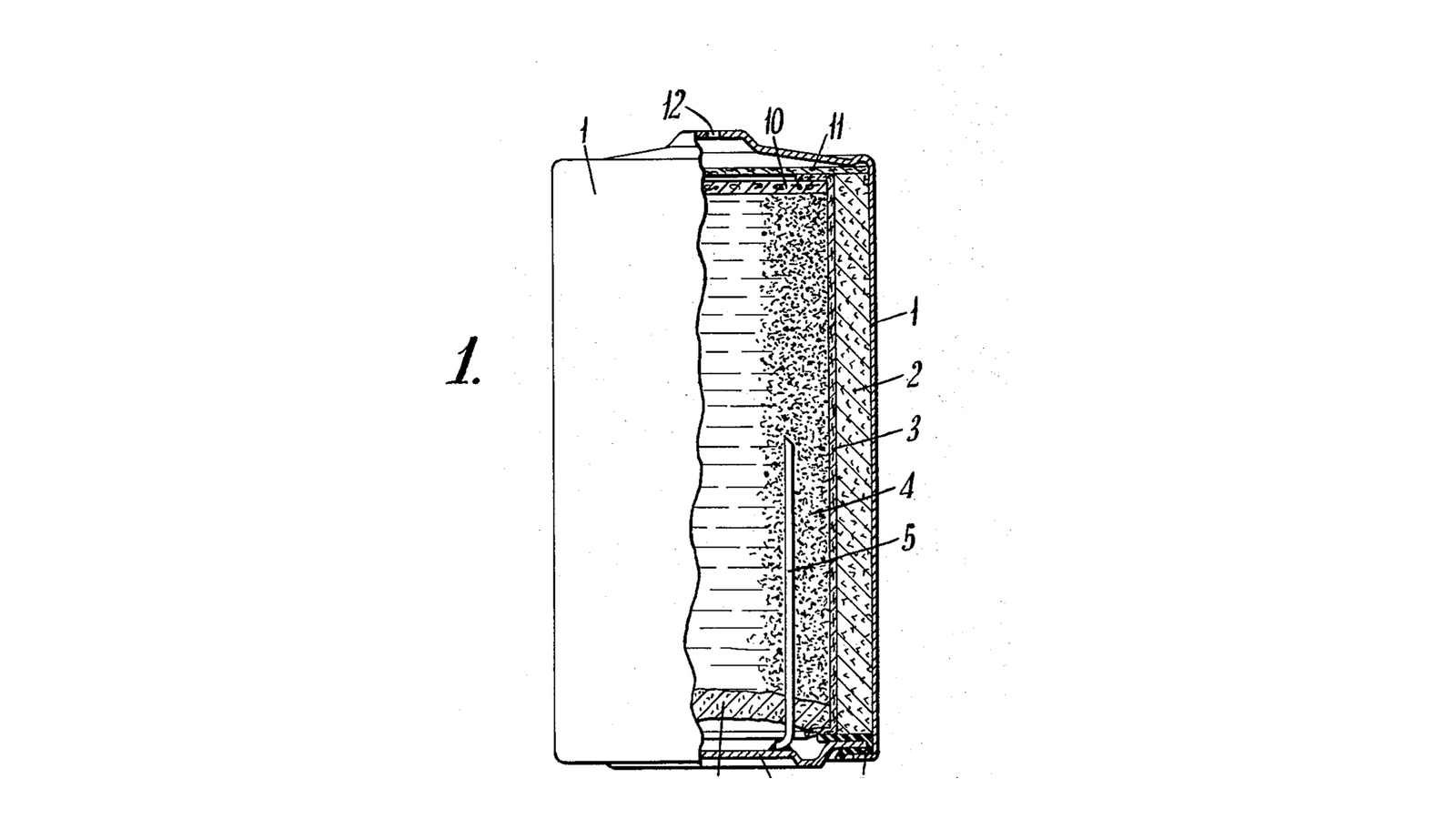
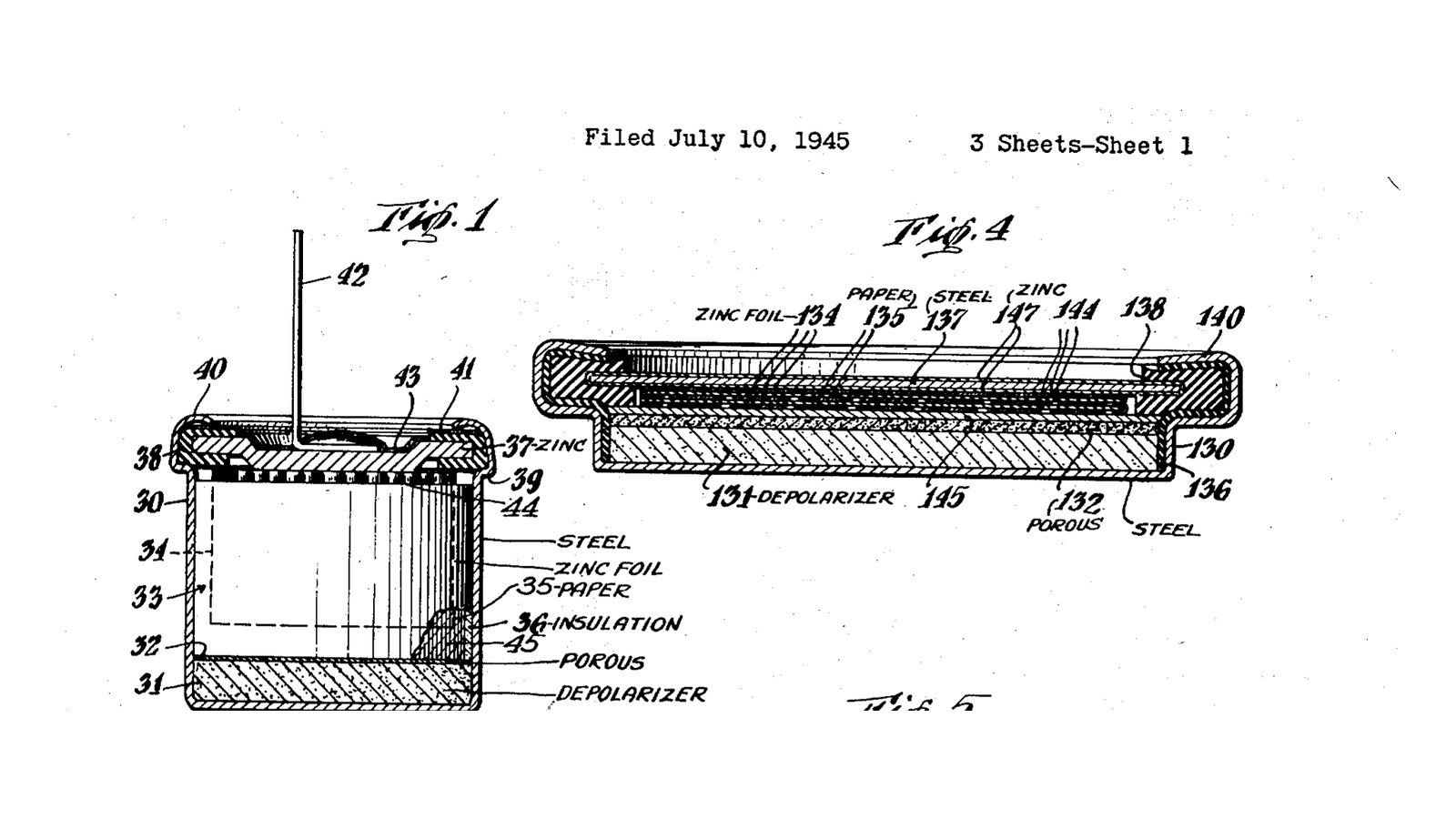
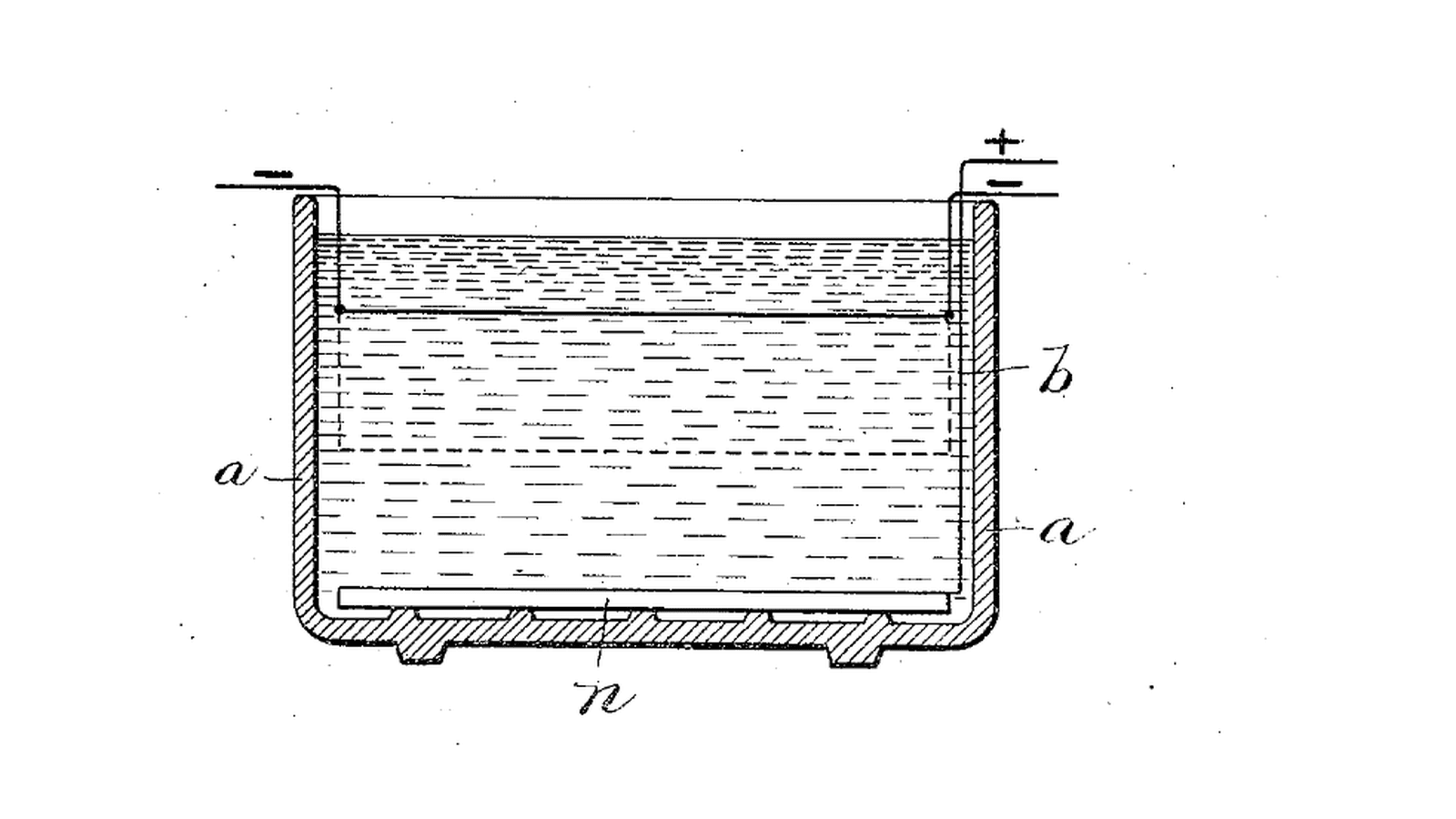
**US 2,960,558** "Dry cell", Paul A. Marsal, Karl Kordesch and Lewis F. Urry, assigned to Union Carbide, filed 9. October 1957 and granted 15. November 1960. The patent is direct about what it is: *"dry cells containing an alkaline electrolyte and a depolarizer consisting of manganese dioxide"*, with "an electron producing zinc anode" against "a hydroxyl ion-producing manganese dioxide cathode".
**Three changes, and it is worth being precise about which does what.**
First, potassium hydroxide replaces ammonium chloride. The alkali is not consumed by the reaction - hydroxide is produced at the cathode and taken up at the anode - which is the same property Jungner built his accumulator on, and it removes the ammonia gassing that made Leclanche cells burst.
Second, the zinc is a powder suspended in gel rather than a sheet. A sheet reacts only on the face the electrolyte can reach; a powder reacts almost everywhere at once, which drops the internal resistance and is why an alkaline cell can run a motor that a zinc-carbon cell can only sulk at.
Third, and least obvious, the cell is built **inside out**. In a Leclanche cell the zinc IS the can, so the container is being eaten while it works - which is exactly why old batteries leaked in the back of torches. Here the steel can is a cathode collector and the zinc sits in the middle, so nothing structural is consumed.
Same chemistry. Different machine. That distinction is most of what this catalogue exists to record.
Menengah
3 hours, plus an overnight discharge test
Instruksi
1
1
The cathode ring: manganese dioxide and enough carbon to conduct it
The cathode ring: manganese dioxide and enough carbon to conduct it
Manganese dioxide is a semiconductor at best, so a cathode of pure MnO2 is a cathode that barely works - the same problem Jungner had with nickel hydroxide and Ruben with mercuric oxide, and it gets the same answer.
Weigh 12 g of manganese dioxide and 3 g of graphite powder, about 20 per cent carbon, and mix them dry until the colour is completely even with no black or brown streaks. Add electrolyte a few drops at a time until the mix just holds together when squeezed - damp, not wet.
Press it firmly against the inside wall of a 20 mm steel or nickel-plated can to form a ring about 5 mm thick, leaving a clear cylindrical hole up the middle. A short length of dowel wrapped in cling film makes a serviceable former: pack around it, then twist it out.
Press hard. The can is the current collector for this whole ring, and the only thing carrying electrons from the mix to the steel is contact.
Material untuk langkah ini:
 Manganese Dioxide (Pyrolusite)12 g
 Graphite Powder3 g
Alat yang dibutuhkan:
 Mortar and Pestle
 Digital Kitchen Scale
 Wooden Dowel
 Nitrile Rubber Gloves
 Safety Goggles
2
2
The separator, which is the only thing preventing a short
The separator, which is the only thing preventing a short
Roll a strip of filter paper into a tube that fits the hole in the cathode ring, with a 10 mm overlap, and close the bottom by folding it and pressing it flat. The tube has to be complete: any gap and the zinc paste touches the cathode ring directly and the cell is a short circuit with a voltage briefly across it.
Soak it in the electrolyte before you fill it. A dry separator resists ion flow just as effectively as it resists the short you wanted to prevent.
Two layers is not over-cautious for a hand-built cell. The capacitance you lose is nothing; the failure you avoid is total.
Material untuk langkah ini:
 Filter Paper3 buah
Alat yang dibutuhkan:
 Craft Knife
 Needle-Nose PliersNitrile Rubber Gloves
3
3
The anode: powdered zinc in a gel, and the collector down the middle
The anode: powdered zinc in a gel, and the collector down the middle
This is Urry's change, and it is worth doing deliberately.
Make about 30 per cent potassium hydroxide - 15 g of KOH into 35 ml of distilled water, solid into water, never the reverse, and it will get hot. Wear the face shield.
Stir 8 g of zinc powder into roughly 8 ml of the electrolyte to a thick grey paste. A commercial cell adds a gelling agent to stop the powder settling; a pinch of cornflour or carboxymethyl cellulose does the same job here. Fill the separator tube with it.
Push a brass rod down the centre of the paste as the anode collector, stopping short of the bottom fold. Brass because it is the traditional choice and does not amalgamate or corrode in alkali the way steel or aluminium would.
If you only have zinc sheet, cut it into the finest strips you can and use those - the cell will work and give you noticeably less current, which is itself the experiment this step exists to make.
Material untuk langkah ini:
 Zinc Powder8 g
 Potassium Hydroxide15 g
 Distilled Water40 ml
 Brass Rod1 buah
Alat yang dibutuhkan:
 Glass Beaker
 Borosilicate Glass RodDigital Kitchen ScaleNitrile Rubber Gloves
 Face ShieldSafety Goggles
4
4
Close it, and read it against a zinc-carbon cell
Close it, and read it against a zinc-carbon cell
Seal the top with a plastic disc pierced for the brass rod and a bead of silicone around the rim. The cell needs to be closed enough not to dry out and not so closed that pressure has nowhere to go.
Open-circuit it should read about 1.5 V - the same as the zinc-carbon cell you are comparing it against, and that is the point. **The open-circuit voltage tells you nothing about which cell is better.** Both couples produce the same potential.
The difference appears the moment current flows. Load both through the same resistor for a 50 mA draw and log terminal voltage every fifteen minutes overnight. Plot the two curves together.
The zinc-carbon cell will sag immediately and keep sagging. This one should hold much closer to its starting voltage for much longer before falling away, and should deliver several times the total charge before either reaches 0.9 V. That ratio is the entire invention, and you will have measured it.
Material untuk langkah ini:
 Silicone Sealant1 buah
 Acrylic Sheet1 buah
Alat yang dibutuhkan:
 Digital Multimeter - Lab Grade
 Stopwatch
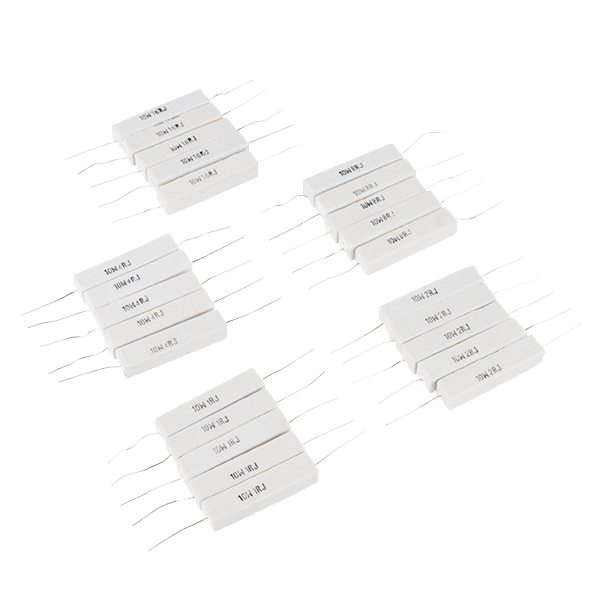 Power Resistor Kit - 10W (25 pack)
 Alligator Clip Test LeadsCraft Knife
5
5
Same couple, different machine
Same couple, different machine
Memuat notebook Jupyter…
6
6
When it underperforms the cell it should beat
When it underperforms the cell it should beat
Three faults cover almost everything, and the last line of the notes is the one most people need.
Flow
Loading...
Alat yang dibutuhkan:
Digital Multimeter - Lab Grade7
7
Compendium: why this one is still in the drawer
Compendium: why this one is still in the drawer
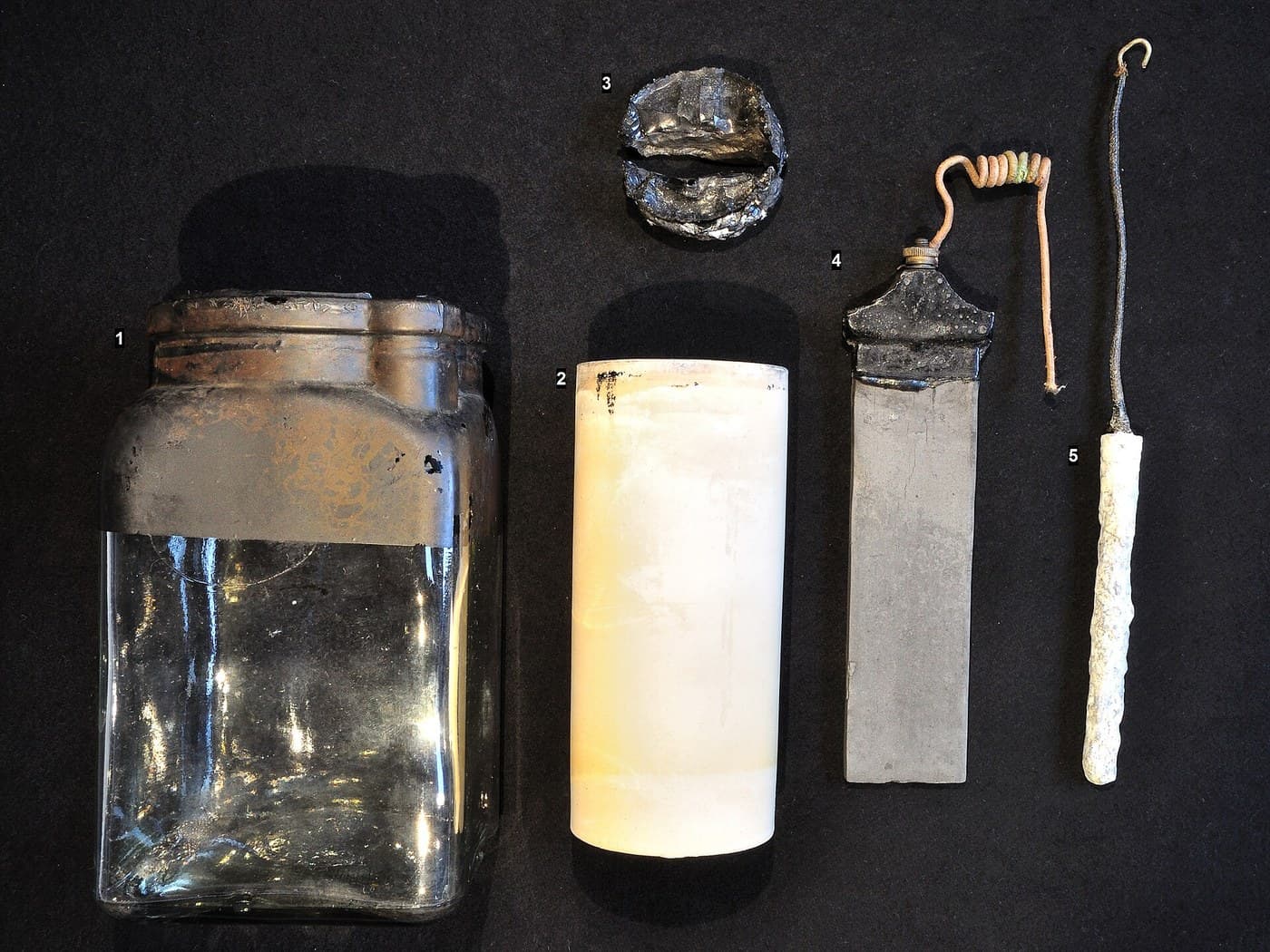
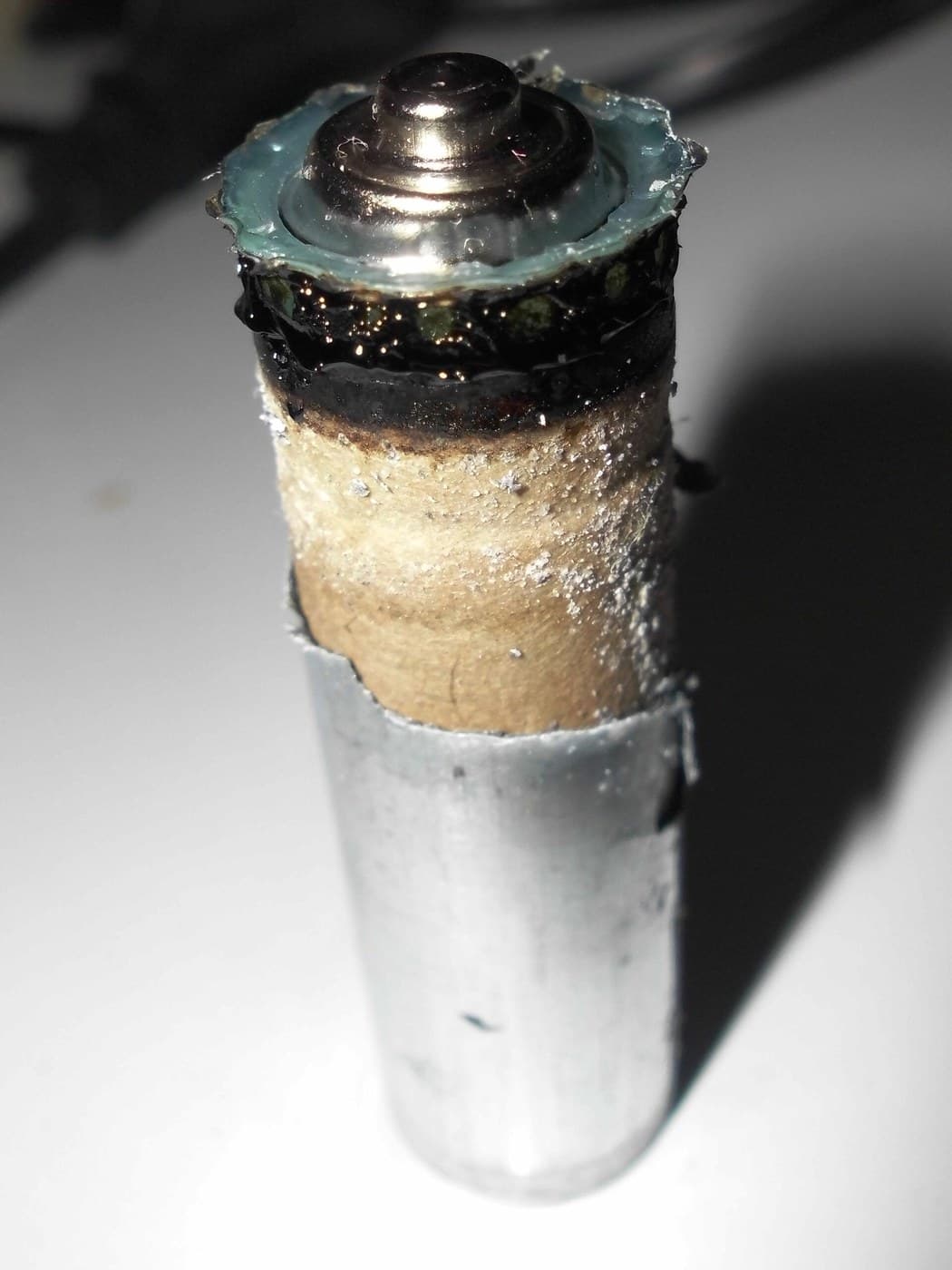
**Why it stopped leaking.** In a Leclanche cell the zinc can is a structural part that is consumed by the reaction; run it flat and the wall thins until it perforates, and what comes out is ammonium chloride paste. Turning the cell inside out made the container inert. That is a mechanical fix to what looks like a chemical problem, and it is the reason a modern alkaline cell left in a torch for a decade is usually only a disappointment rather than a repair job. Leaking still happens when a cell is deep-discharged or reverse-charged in a series string, because zinc oxide occupies more volume than zinc and something has to give.
**Why the voltage is the same.** The couple sets the potential and nothing about geometry can change it. Zinc against manganese dioxide gives about 1.5 V in 1866 and about 1.5 V today. Anyone who tells you a battery is better because it measures 1.6 V on a meter is reading the manufacturing tolerance, not the chemistry.
**Why alkaline cells are not rechargeable, mostly.** The zinc does not re-deposit where it came from. It plates back as dendrites that grow through the separator and short the cell, and the manganese dioxide does not fully return either. Rechargeable alkaline cells exist and work for a limited number of shallow cycles for exactly these reasons.
**Why the mercury went away.** Alkaline cells contained added mercury until the 1990s, for the same hydrogen-suppression reason as the Ruben cell in this chain. Removing it took better zinc purity and organic corrosion inhibitors rather than a new chemistry - a good example of a constraint being engineered around instead of designed out.
**What this cell lost to.** Nothing, for its job. It is still the default primary cell six decades on. Lithium chemistries beat it on energy density and cold performance and cost more; the alkaline cell survives because it is cheap, shelf-stable for years, and made by the billion.
Bahan
9- Placeholder
- Placeholder
- 3 buahPlaceholder
- 8 gPlaceholder
- Placeholder
- 40 mlPlaceholder
- 1 buahPlaceholder
- 1 buahPlaceholder
- 1 buahPlaceholder
Alat yang Diperlukan
14- Placeholder
- Placeholder
- Placeholder
- Placeholder
- Placeholder
- Placeholder
- Placeholder
- Placeholder
- Placeholder
- Placeholder
- Placeholder
- Placeholder
- Power Resistor Kit - 10W (25 pack)komisi 10%$5.80
- Placeholder
Blueprint terkait
Blueprint ini berbagi pengetahuan — teknik, bahan, atau prinsip


CC0 Domain Publik
Cetak biru ini dirilis di bawah CC0. Anda bebas untuk menyalin, memodifikasi, mendistribusikan, dan menggunakan karya ini untuk tujuan apa pun, termasuk komersial, tanpa meminta izin.
Dukung Maker dengan membeli produk melalui Cetak Biru mereka di mana mereka mendapatkan Komisi Pembuat yang ditetapkan oleh Penjual, atau buat iterasi baru dari Cetak Biru ini dan masukkan sebagai koneksi di milik Anda sendiri.