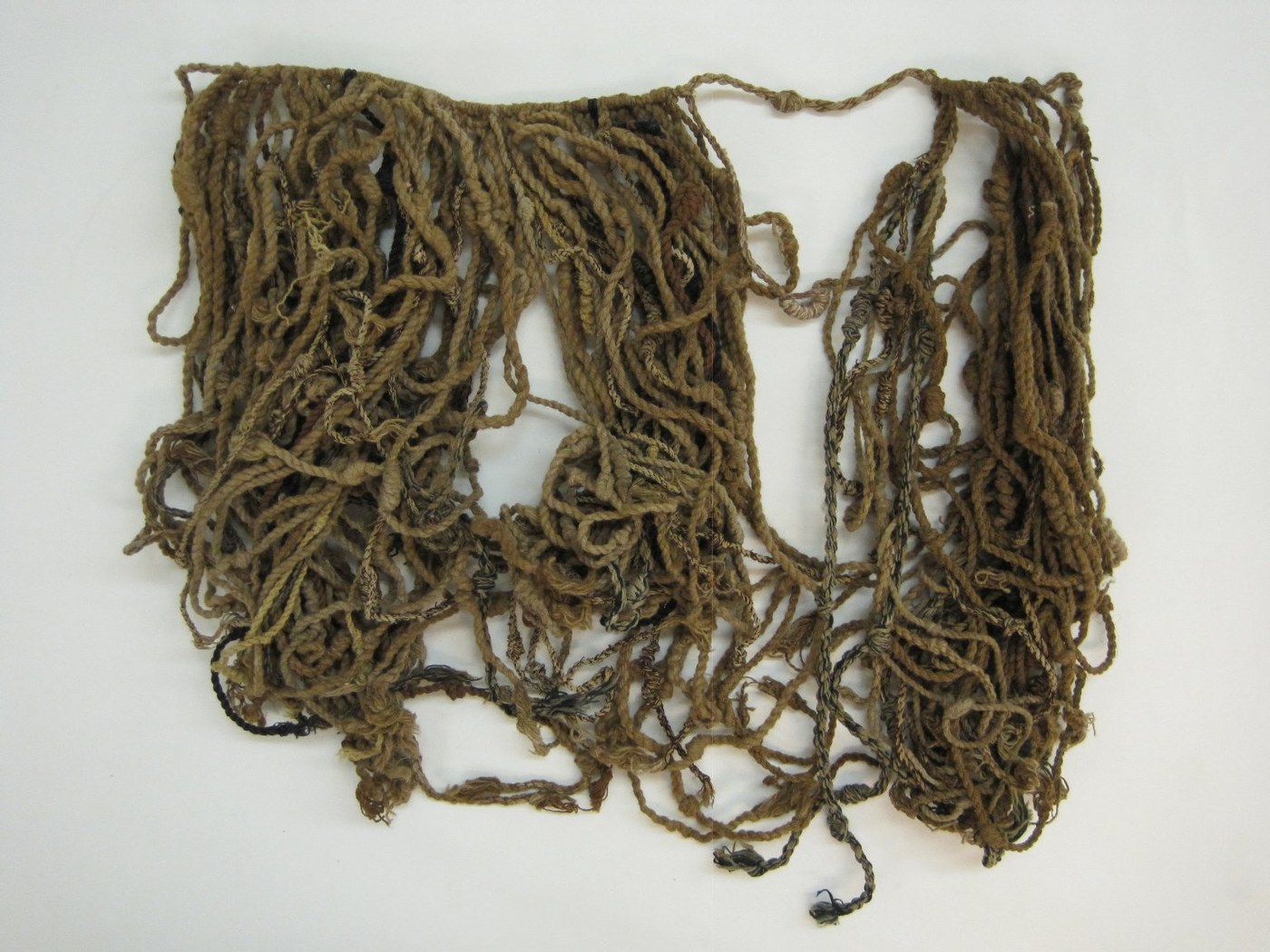


Quipu
निर्देश
Set up the main cord and pendants
Set up the main cord and pendants
One horizontal cord, many hanging from it.
- Stretch a thicker main cord between two points.
- Attach a dozen pendant cords along it, hanging down.
- Keep the pendants the same length and mark equal height bands across all of them.
इस चरण के लिए सामग्री:
 सूती डोरी1 रोल
 जूट की रस्सी1 length
Tie the three knot types
Tie the three knot types
Digit and place are encoded differently, and that is deliberate.
- Long knot — a knot with 2 to 9 turns, used ONLY in the units position; the number of turns is the digit.
- Single knots — plain overhand knots, one per unit, used in tens, hundreds and above.
- Figure-eight knot — means exactly one, in the units position.
Record numbers and show the zero
Record numbers and show the zero
Encode a set of values, including one with a zero in the middle.
- Tie 327 on one pendant: 3 single knots in the hundreds band, 2 in the tens, a long knot of 7 turns at the units.
- Now tie 306 — leave the tens band EMPTY.
- Hand both to someone else to read back.
Add a summary cord and audit it
Add a summary cord and audit it
Real quipus carry totals, and that makes them checkable.
- Add a further cord attached so as to be clearly distinct from the pendants.
- Record on it the sum of the pendant values.
- Hand the whole thing to someone and have them verify the total.
इस चरण के लिए सामग्री:
 डिजिटल रसोई तराज़ू1 टुकड़ा
History and context
History and context
Quipus predate the Inca — examples from the Caral and Wari cultures are much older — but the Inca state used them at administrative scale from roughly 1400 to 1532. Specialists called quipucamayocs made, read and kept them, and Spanish colonial courts initially accepted quipu testimony as evidence in tribute disputes, which tells you the accounts were trusted as accurate.
The numerical part is decoded and the rest is not. Leland Locke established the base-ten knot system in 1923, and it is solid. But quipus also vary in fibre, spin direction, ply direction, colour and attachment method, and a substantial minority — the so-called narrative quipus — do not fit the numerical pattern at all. Whether these encode language, or categories, or something else, is genuinely unresolved. Work by Gary Urton and others has proposed binary-coded and phonetic readings; none is established.
Much of the corpus was deliberately destroyed. Colonial authorities ordered quipus burned as idolatrous objects in the later sixteenth century, and with the quipucamayocs' oral knowledge lost alongside them, the reading tradition was broken. Roughly a thousand quipus survive worldwide.
Why it belongs in a maths catalogue: it is independent evidence that positional notation with zero is not a single European or Indian invention but something arithmetic converges on. It also makes the point that a writing system need not be visual marks on a flat surface — and that our expectation that records look like text is a habit, not a requirement.
सामग्री
3- 1 रोलप्लेसहोल्डर
- 1 lengthप्लेसहोल्डर
- 1 टुकड़ाप्लेसहोल्डर
यह ब्लूप्रिंट बनाता है
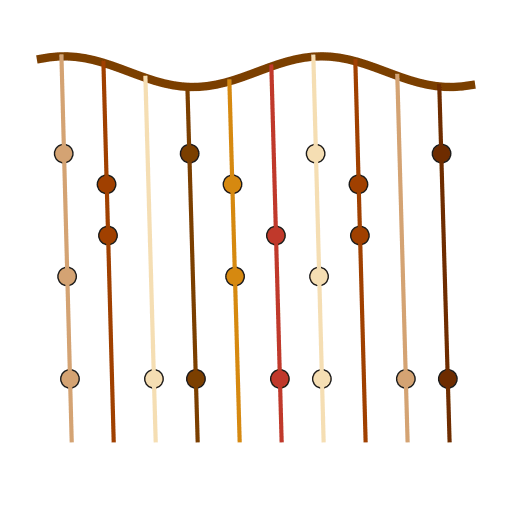
संबंधित ब्लूप्रिंट
ये ब्लूप्रिंट ज्ञान साझा करते हैं — तकनीक, सामग्री या सिद्धांत

CC0 पब्लिक डोमेन
यह ब्लूप्रिंट CC0 के तहत जारी किया गया है। आप बिना अनुमति माँगे इस कार्य को किसी भी उद्देश्य के लिए कॉपी, संशोधित, वितरित और उपयोग करने के लिए स्वतंत्र हैं।
उनके ब्लूप्रिंट के माध्यम से उत्पाद खरीदकर मेकर का समर्थन करें जहाँ वे मेकर कमीशन कमाते हैं जो विक्रेताओं द्वारा निर्धारित होता है, या इस ब्लूप्रिंट का नया संस्करण बनाएँ और राजस्व साझा करने के लिए इसे अपने ब्लूप्रिंट में कनेक्शन के रूप में शामिल करें।