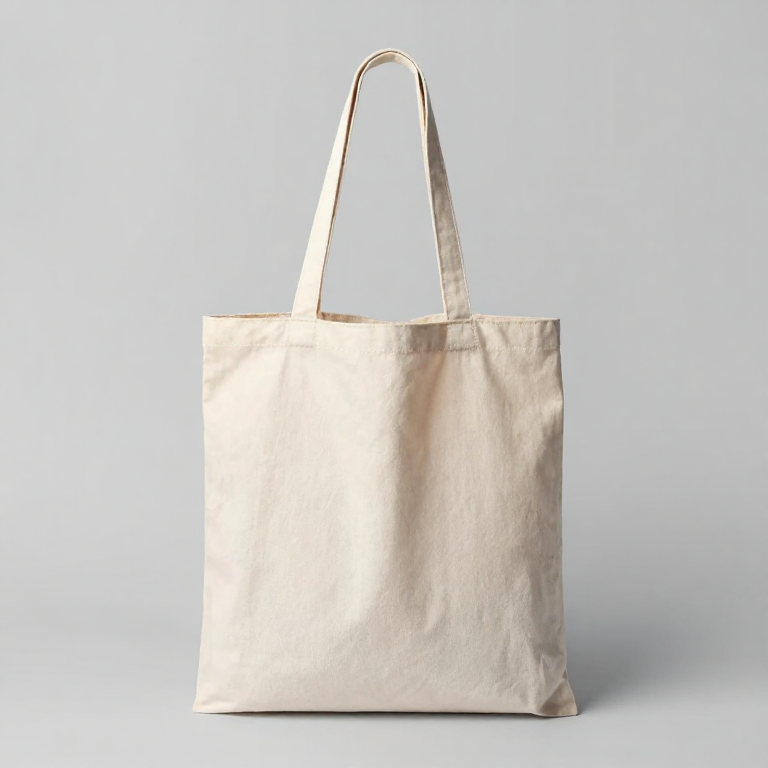


The Tote Bag
A tote bag is a rectangle of cloth with two straps, and almost all of them fail in the same place for the same reason.
The load does not hang from the bag. It hangs from two short lines of stitching where the straps meet the fabric, and everything the bag is carrying is trying to tear the cloth along those lines. A seam that runs across the direction of pull is being asked to shear cloth apart thread by thread; the same seam turned into a box-with-cross spreads the load over an area and turns tearing into stretching.
Two other decisions matter as much. The straps should be continuous — carried right down the outside of the bag and back up, so the fabric hangs inside a loop rather than the loop hanging off the fabric. And the seams should be enclosed, French or flat-felled, so no raw edge is exposed to fray under load.
Then there is the sizing rule nobody writes down: a tote's usable capacity is set by its base, and a flat bag has no base at all. Boxing the corners — a small triangle folded and sewn at each bottom corner — turns a floppy envelope into a bag that stands up and holds its shape.
Make one, then load it until something fails and see whether you were right about where.
निर्देश
Cut on grain
Cut on grain
Cut two rectangles about 400 x 450 mm from heavy cotton duck, with the long edge parallel to the selvedge.
Cut two strap lengths of about 750 mm, also on grain.
Grain direction is a structural decision. Woven cloth barely stretches along the warp, a little along the weft, and a great deal on the bias — a strap cut off-grain will elongate under load and never recover.
इस चरण के लिए सामग्री:
 Cotton Duck Canvas (10 oz, 2 Yards)1 टुकड़ा
आवश्यक उपकरण:
 Tape Measure
Make the straps, and make them continuous
Make the straps, and make them continuous
Fold each strap in four along its length and edge-stitch both sides, or use woven webbing.
Lay each strap so it runs from the top edge, down the outside of the panel, across the base and back up the other side.
Pin, do not sew yet.
A continuous strap means the cloth sits inside the loop. The load is then carried by the strap along its whole length, and the stitching mainly stops the panel sliding.
इस चरण के लिए सामग्री:
 Nylon Webbing2 मीटर
 Polyester Thread1 टुकड़ा
आवश्यक उपकरण:
 Sewing Machine
Box-stitch the strap ends
Box-stitch the strap ends
At each point where a strap meets the top hem, sew a rectangle roughly 40 mm tall and the strap's width, then sew both diagonals inside it.
Backstitch at start and finish.
Expect this to look excessive. It is not.
A straight bar-tack tears the cloth along a single line of needle holes. The box-and-cross spreads the same force over an area and across two thread directions, and it is why every rucksack you have ever owned has one.
Sew enclosed side seams
Sew enclosed side seams
Join the panels with a French seam: wrong sides together first, trim the allowance close, turn, press, and sew again with right sides together so the raw edge is sealed inside.
Press each stage.
Pressing is not tidiness, it is accuracy — an unpressed seam hides several millimetres of error that accumulate into a twisted bag. And an enclosed edge cannot fray, which is what eventually kills an overlocked seam.
Box the corners to create a base
Box the corners to create a base
At each bottom corner, flatten the side seam onto the base seam so they align, forming a triangle. Measure 80 mm across, sew straight across, and trim.
Turn out.
Measure the internal volume roughly, before and after.
Expect a large gain and a bag that now stands on its own. A flat tote has capacity only when stuffed; a boxed one has a base.
Load it to destruction
Load it to destruction
Hang the finished bag by its straps and add weight in measured steps, checking after each.
Record the load at first visible distress and at failure, and record where it failed.
Expect failure at the strap attachment or at a seam end — very rarely in the middle of the cloth.
Fabric is far stronger than the joins between pieces of it. That is the single most transferable lesson in sewn construction.
आवश्यक उपकरण:
 Force Meter (Spring Scale)
 Digital Kitchen Scale
History & Context
History & Context
"Tote" as a verb means to carry, and the bag is a twentieth-century American object. The recognisable ancestor is the heavy canvas ice bag — the L.L.Bean Boat and Tote, introduced in 1944, was designed to haul blocks of ice, which is why it is absurdly overbuilt for a bag now used to carry books. Its proportions, the continuous straps and the heavy duck are all consequences of a specification nobody has needed since domestic refrigeration.
Cotton duck is the material for a reason. "Duck" is a plain-woven cotton with a tighter, heavier weave than ordinary canvas, from the Dutch doek for cloth; weight is quoted in ounces per square yard, and a bag wants roughly 10-12 oz. It resists abrasion, it does not stretch much on grain, and — importantly for a bag — it fails gracefully, fraying and thinning long before it tears through, which gives warning that a synthetic often does not.
The environmental arithmetic is genuinely counter-intuitive and worth stating honestly. A cotton tote has a far higher manufacturing footprint than a single plastic carrier — cotton is water- and pesticide-intensive — so a tote only becomes the better choice after being used a great many times, with published estimates ranging from dozens to many hundreds of uses depending on which impact is measured and how the cotton was grown. The conclusion is not "totes are bad", it is "the reusable bag only wins if it is genuinely reused", which makes durability an environmental property rather than a convenience. A bag that fails at the strap in its first year has already lost the argument, and that is exactly why steps 3 and 6 are in this blueprint.
Where the modern versions differ. Commercial totes add an interior lining and interfacing for structure, a base insert, riveted or bar-tacked strap ends, and sometimes a laminated or waxed finish for water resistance. Waxing cotton — impregnating it with a paraffin and oil blend — is an old technique that makes duck genuinely weatherproof at the cost of stiffness and washability.
Honest limits. This construction is not waterproof; a French seam resists fraying, not water. Untreated cotton mildews if stored damp, and shrinks on first hot wash, so pre-wash the cloth if the finished size matters. Domestic sewing machines struggle through several layers of 10 oz duck at the box stitch — use a heavy needle, slow down, and hand-wheel through the thickest crossings rather than forcing the motor.
सामग्री
3- प्लेसहोल्डर
- 2 मीटरप्लेसहोल्डर
- 1 टुकड़ाप्लेसहोल्डर
आवश्यक उपकरण
4- 1 vendor sell this, none ship to you yetप्लेसहोल्डर
- प्लेसहोल्डर
- प्लेसहोल्डर
- प्लेसहोल्डर
कनेक्टेड ब्लूप्रिंट सामग्री
संबंधित ब्लूप्रिंट
ये ब्लूप्रिंट ज्ञान साझा करते हैं — तकनीक, सामग्री या सिद्धांत
CC0 पब्लिक डोमेन
यह ब्लूप्रिंट CC0 के तहत जारी किया गया है। आप बिना अनुमति माँगे इस कार्य को किसी भी उद्देश्य के लिए कॉपी, संशोधित, वितरित और उपयोग करने के लिए स्वतंत्र हैं।
उनके ब्लूप्रिंट के माध्यम से उत्पाद खरीदकर मेकर का समर्थन करें जहाँ वे मेकर कमीशन कमाते हैं जो विक्रेताओं द्वारा निर्धारित होता है, या इस ब्लूप्रिंट का नया संस्करण बनाएँ और राजस्व साझा करने के लिए इसे अपने ब्लूप्रिंट में कनेक्शन के रूप में शामिल करें।