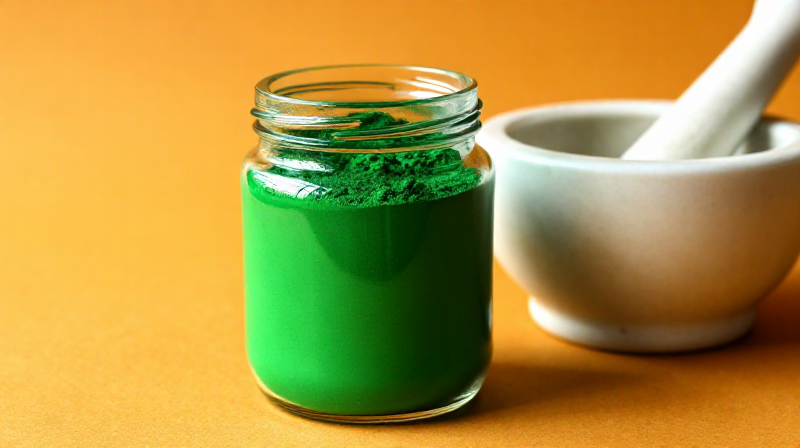


Making Phthalocyanine Green — The Halogenated Phthalo That Replaced Viridian
Phthalocyanine Green (Pigment Green 7, CI 74260) is made by chlorinating copper phthalocyanine blue — replacing the sixteen hydrogen atoms on the outer benzene rings with chlorine atoms. This seemingly simple modification shifts the absorption spectrum dramatically: where phthalo blue absorbs orange-red light and appears cyan-blue, the fully chlorinated version absorbs red light and appears a vivid, bluish green.
First produced commercially in 1938 by ICI (who also commercialised phthalo blue), PG7 rapidly displaced viridian (hydrated chromium oxide, PG18) as the green of choice for artists and industry. It offered everything viridian could not: far greater tinting strength, lower cost, perfect lightfastness, and complete chemical resistance. A single gram of phthalo green tints as much paint as twenty grams of viridian.
The chlorination is performed by dissolving copper phthalocyanine in molten aluminium chloride (a Friedel-Crafts catalyst) and passing chlorine gas through the melt at 180–200 °C. Each of the four outer benzene rings acquires four chlorine atoms, yielding copper hexadecachlorophthalocyanine — CuCl₁₆C₃₂N₈. The molecule retains the extraordinary stability of the parent phthalocyanine framework while gaining the green colour shift from the electron-withdrawing chlorine substituents.
A related pigment, PG36 (Pigment Green 36), is produced by partial bromination instead of full chlorination, giving a warmer, yellowish green. Both are manufactured in vast quantities for automotive paints, printing inks, and plastics.
SAFETY WARNING: This synthesis uses chlorine gas (acutely toxic, corrosive to lungs), molten aluminium chloride (violent reaction with water, liberates HCl), and temperatures above 180 °C. Perform ONLY in a proper fume hood or outdoors with full respiratory protection. Chlorine is heavier than air and pools in low areas.
Instructions
Prepare fume hood and full respiratory protection
Prepare fume hood and full respiratory protection
This is one of the most hazardous syntheses in this series. Chlorine gas is acutely toxic at concentrations above 3 ppm, and molten aluminium chloride reacts violently with moisture to release HCl fumes. Set up inside a functioning fume hood with the sash at working height. Wear a full-face respirator with combination acid gas and particulate cartridges, chemical splash goggles (under the respirator), heavy-duty nitrile gloves, and a full lab coat. Have a chlorine gas emergency escape plan before starting.
Tools needed:
 P100/FFP3 Respirator with Acid Gas Cartridge
 Chemical Splash Goggles
 Nitrile Rubber Gloves (Thick)
 Lab Coat
Weigh copper phthalocyanine blue
Weigh copper phthalocyanine blue
Weigh out 10 g of copper phthalocyanine blue (PB15) — the starting material for this synthesis. You can use commercially purchased phthalo blue pigment or the product of the Phthalocyanine Blue blueprint. The pigment should be a fine, intense blue powder. This is the macrocyclic core that will be chlorinated — the four outer benzene rings each carry four hydrogen atoms that will be replaced by chlorine.
Materials for this step:
 Phthalic Anhydride10 g
Tools needed:
 Digital Precision Scale
Weigh anhydrous aluminium chloride
Weigh anhydrous aluminium chloride
Weigh 30 g of anhydrous aluminium chloride (AlCl₃) — a yellowish-white solid that fumes in moist air. Handle quickly in a dry environment. Aluminium chloride serves as the Friedel-Crafts catalyst: it activates molecular chlorine by forming a reactive chloronium complex (Cl⁺) that attacks the electron-rich benzene rings of the phthalocyanine. NEVER allow aluminium chloride to contact water — the reaction is violent, liberating large volumes of HCl gas and generating intense heat.
Materials for this step:
 Aluminium Chloride (anhydrous)30 g
Weigh sodium chloride diluent
Weigh sodium chloride diluent
Weigh 15 g of anhydrous sodium chloride (table salt, dried in an oven). The salt acts as a diluent and grinding medium in the melt — it prevents the phthalocyanine particles from fusing into large, intractable lumps during the high-temperature chlorination. It also moderates the exothermic chlorination reaction. Ensure the salt is completely dry — any moisture will react with the aluminium chloride.
Materials for this step:
 Sodium Chloride (table salt)15 g
Combine solids in reaction vessel
Combine solids in reaction vessel
In a round-bottom flask or deep iron crucible fitted with a gas inlet tube, combine the copper phthalocyanine blue, aluminium chloride, and sodium chloride. Mix thoroughly with a glass rod. The mixture should be a blue-grey powder. Fit a reflux condenser or gas outlet tube connected to a scrubber (a flask of dilute sodium hydroxide solution) to neutralise excess chlorine and HCl vapours.
Tools needed:
 Iron Crucible
 Glass Stirring Rod (25cm)
Heat to melt the aluminium chloride
Heat to melt the aluminium chloride
Place the vessel on a sand bath and heat gradually to 180 °C. The aluminium chloride melts at 192 °C (sublimes at 180 °C), forming a liquid melt that dissolves the phthalocyanine and salt. The mixture becomes a dark blue-green viscous liquid. Ensure the gas outlet is functioning and the scrubber is bubbling — HCl is already being released from the melt.
Tools needed:
 Thermometer (Lab)
Begin chlorine gas addition
Begin chlorine gas addition
Once the melt is fluid at 180–200 °C, begin passing chlorine gas slowly through the gas inlet tube into the melt. Chlorine gas can be generated separately by dripping concentrated hydrochloric acid onto potassium permanganate, or from a lecture bottle of compressed chlorine. The flow rate should produce a steady stream of small bubbles through the melt — not a torrent. Each chlorine molecule that reacts releases one molecule of HCl, which exits through the scrubber.
Materials for this step:
 Hydrochloric Acid (37% concentrated)50 ml
 Potassium Permanganate15 g
Maintain chlorination for three hours
Maintain chlorination for three hours
Continue passing chlorine through the melt at 180–200 °C for three hours. During this period, the sixteen peripheral hydrogen atoms on the four benzene rings are progressively replaced by chlorine atoms. The colour shifts dramatically: from deep blue through blue-green to a vivid, intense green as more chlorine is incorporated. Stir the melt every 30 minutes to ensure uniform chlorination. The scrubber solution will turn yellow-green from absorbed chlorine.
Test for complete chlorination
Test for complete chlorination
After three hours, stop the chlorine flow temporarily. Take a tiny sample of the melt on a glass rod, cool it, and dissolve in concentrated sulfuric acid — if the solution is a vivid green (not blue-green), chlorination is complete. If still blue-green, continue chlorinating for another hour. Full chlorination (all 16 positions) gives PG7; partial chlorination gives intermediate hues that are less stable.
Cool the melt and quench in water
Cool the melt and quench in water
Stop the chlorine flow, disconnect the gas inlet, and allow the melt to cool to 100 °C. Then carefully pour the viscous green melt into 2 litres of cold water with vigorous stirring. The aluminium chloride dissolves immediately in the water, releasing the green pigment as a fine suspension. This step is violently exothermic — add the melt slowly and in small portions. HCl fumes are released — maintain respiratory protection.
Materials for this step:
 Distilled Water (1 Liter)2 liters
Tools needed:
 Heat-Resistant Glass Beaker (1 liter)
Filter and wash the crude pigment
Filter and wash the crude pigment
Filter the green suspension through filter paper. The vivid green pigment collects on the filter while the aluminium chloride and sodium chloride pass through as a clear, acidic filtrate (dispose as chemical waste). Wash the filter cake with 500 ml of hot distilled water, then with 200 ml of dilute hydrochloric acid (10%) to remove any aluminium hydroxide, and finally with 500 ml more hot water until the filtrate is neutral.
Materials for this step:
 Filter Paper (fine pore)3 pieces
 Dilute Hydrochloric Acid (10% HCl)200 mlDistilled Water (1 Liter)1 liter
Tools needed:
 Glass Funnel (Stemmed)
Alkali wash to remove acid residues
Alkali wash to remove acid residues
Return the filter cake to a beaker, add 300 ml of dilute sodium hydroxide (5%), stir at 60 °C for 20 minutes, then filter again. This removes any residual aluminium salts and chlorinated organic impurities that are soluble in alkali. Wash with hot water until neutral. Like its parent phthalo blue, the chlorinated pigment is completely resistant to both strong acids and strong alkalis.
Materials for this step:
 Sodium Hydroxide (Lab Grade, 500g)10 gDistilled Water (1 Liter)500 ml
Dry the purified pigment
Dry the purified pigment
Spread the washed pigment on a clean glass plate and dry at 100 °C for 4–6 hours. Like phthalo blue, the chlorinated version is thermally stable to over 400 °C — oven-drying is safe. The dried pigment is a hard, dark green mass that appears almost black in thick layers but reveals a brilliant, vivid green when spread thin.
Grind to final pigment fineness
Grind to final pigment fineness
Grind the dried mass in a porcelain mortar. Like its parent phthalo blue, phthalo green is very hard for an organic pigment and requires vigorous grinding. As particle size decreases, the colour transforms from dark blackish-green to a vivid, brilliant bluish-green with extraordinary tinting strength. A tiny amount turns a large volume of white paint intensely green. Pass through a 120-mesh sieve to remove coarse particles.
Tools needed:
 Mortar and Pestle (Porcelain)
 120-Mesh Sieve
Store finished phthalocyanine green
Store finished phthalocyanine green
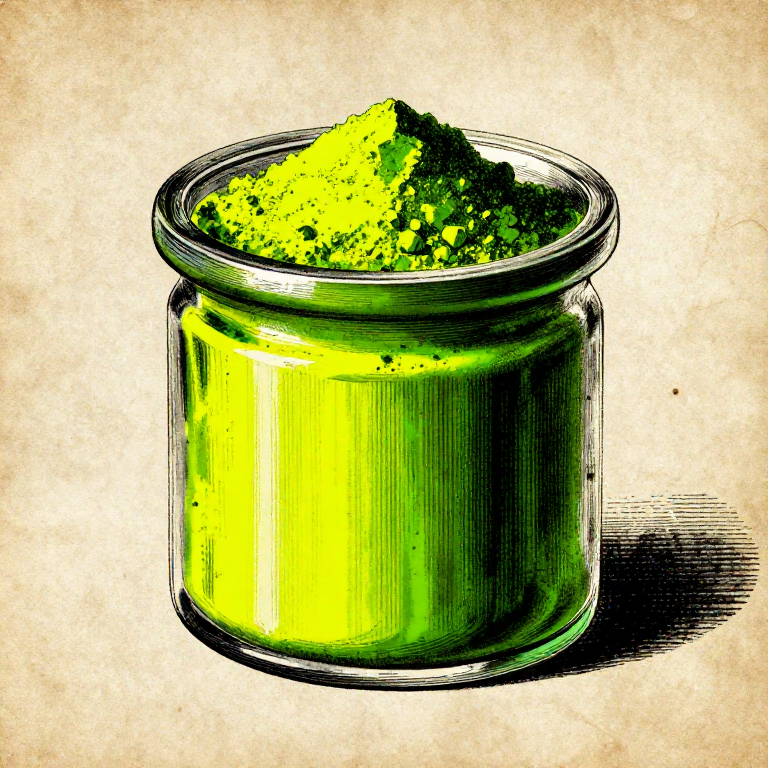
Transfer the sieved pigment to a glass jar with a tight-fitting lid. Label with the pigment name (Phthalocyanine Green, PG7, CI 74260), date, and properties: lightfastness ASTM I (excellent), heat stability to 400 °C, resistant to all acids, alkalis, and solvents. Expected yield from 10 g of phthalo blue starting material: approximately 12–15 g of finished pigment (the weight increases because sixteen chlorine atoms are added). This single pigment now accounts for the majority of all green pigment manufactured worldwide.
Tools needed:
 Glass Storage Jar with Lid
Materials
10- Placeholder
- Placeholder
- Placeholder
- Placeholder
- Placeholder
- 3 litersPlaceholder
- 3 piecesPlaceholder
- Placeholder
- Placeholder
- Placeholder
Tools Required
13- Placeholder
- Placeholder
- Placeholder
- Placeholder
- Placeholder
- Placeholder
- Placeholder
- Placeholder
- Placeholder
- Placeholder
- Placeholder
- Placeholder
Connected Blueprint Materials
Related Blueprints
These blueprints share knowledge with this one — techniques, materials, or principles that connect them in the learning graph.
Related blueprints
Other builds that share materials, tools, or techniques with this one.
CC0 Public Domain
This blueprint is released under CC0. You are free to copy, modify, distribute, and use this work for any purpose, without asking permission.
Support the Maker by purchasing products through their Blueprint where they earn a Maker Commission set by Vendors, or create a new iteration of this Blueprint and include it as a connection in your own Blueprint to share revenue.