Extracting Iodine from Seaweed Ash — The Violet Vapor That Prevents Goiter
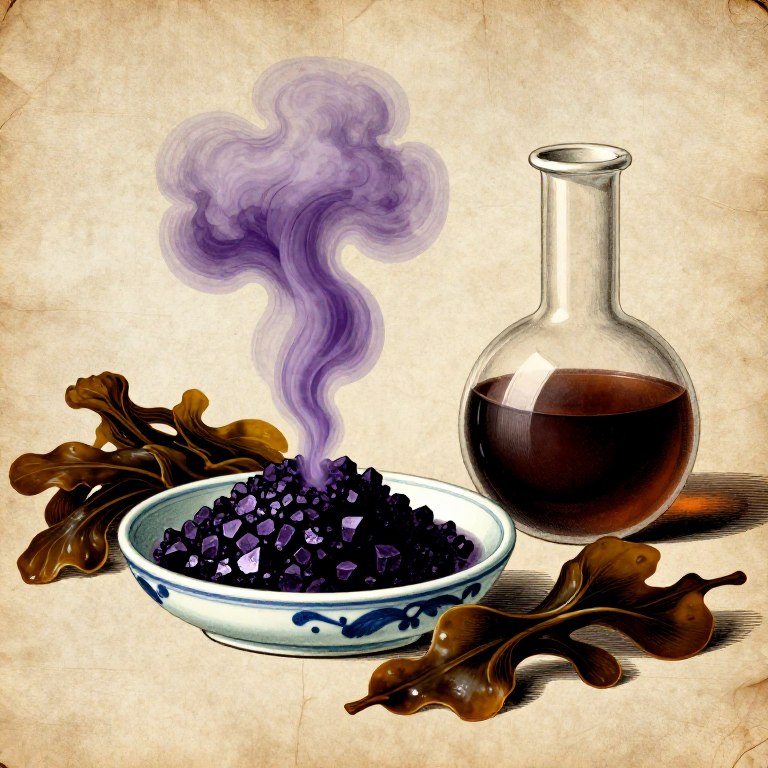
Iodine is element 53 — the heaviest stable halogen and one of the most visually dramatic elements in chemistry. As a solid, iodine forms lustrous, dark purple-black crystals with a faint metallic sheen. When gently heated, it sublimes directly from solid to gas without passing through a liquid phase (at atmospheric pressure), producing a breathtaking dense violet vapor — iodine's Greek name, 'ioeides', means 'violet-colored'. This sublimation, first observed by Bernard Courtois in 1811, announced the discovery of a new element.
Courtois discovered iodine accidentally while extracting sodium carbonate from seaweed ash (kelp) for use in gunpowder manufacture during the Napoleonic Wars. When he added excess sulfuric acid to the kelp liquor, brilliant violet fumes erupted from the vessel. Humphry Davy and Joseph Gay-Lussac independently confirmed it as a new element in 1813–1814.
Iodine is an essential trace element for human life — the thyroid gland requires it to synthesize thyroxine (T₄) and triiodothyronine (T₃), hormones that regulate metabolism, growth, and brain development. Iodine deficiency causes goiter (enlarged thyroid) and, in severe cases during pregnancy, cretinism — permanent intellectual disability in the child. Universal salt iodization, adopted worldwide since the 1920s, is considered one of the most successful public health interventions in history.
This blueprint recreates Courtois's original extraction: recovering iodine from seaweed ash by leaching, oxidation, and sublimation purification.
HAZARD: Iodine vapor is irritating to eyes and respiratory tract. Concentrated iodine solutions stain skin and clothing dark brown (temporarily). Sulfuric acid causes burns. Work in a well-ventilated area or under a fume hood. Wear safety goggles and gloves.
دستورالعملها
Understand iodine's chemistry and biological importance
Iodine (I, atomic number 53, atomic mass 126.90) is the heaviest stable halogen. Unlike the lighter halogens (fluorine, chlorine, bromine — all highly reactive), iodine is a comparatively mild oxidizer that exists as a stable, crystalline solid at room temperature. Iodine's electron configuration [Kr]4d¹⁰5s²5p⁵ gives it one electron short of a noble gas configuration — but its large atomic radius (1.33 Å) and high polarizability make its chemistry gentler than fluorine or chlorine.
The I₂ molecule absorbs strongly in the yellow-green region of the visible spectrum (around 520 nm), giving iodine vapor its characteristic violet color and iodine solutions in nonpolar solvents (hexane, CCl₄) a beautiful violet hue. In polar solvents like water, iodine forms a brown triiodide complex (I₃⁻) through the equilibrium I₂ + I⁻ ⇌ I₃⁻. The brown color of tincture of iodine and Lugol's solution is due to this triiodide ion, not molecular I₂.
Collect and dry seaweed
Collect brown seaweed (kelp) from a clean, unpolluted coastal area. The best species for iodine content are the large brown algae: Laminaria (kombu), Fucus (bladderwrack), and Ascophyllum (knotted wrack). These concentrate iodine from seawater by a factor of 10,000–30,000, storing it as iodide (I⁻) in their cell vacuoles — a remarkable bioconcentration. Fresh kelp contains approximately 0.03–0.5% iodine by dry weight.
Spread the collected seaweed in a thin layer on a clean surface in direct sunlight and dry for 2–3 days until brittle and crackly. Alternatively, dry in an oven at 60–80 °C for 6–8 hours. Do not exceed 100 °C — some iodine will volatilize. You need approximately 500 grams of dried seaweed to obtain a visible quantity of iodine (0.5–2 grams). If coastal collection is impractical, dried kelp is available from Asian grocery stores (kombu) or health food stores.
Burn the seaweed to ash
Place the dried seaweed in a metal container (a steel bucket or old pot) outdoors. Ignite it and allow it to burn completely. Seaweed burns with a characteristic salty, acrid smoke. Once the flames die, continue heating the residue with a gas burner or by adding small amounts of charcoal to ensure complete combustion of organic matter. The goal is a grey-white ash — if black carbon remains, the combustion was incomplete.
The ash (historically called 'kelp' or 'varec') contains sodium and potassium carbonates, sulfates, chlorides, and — crucially — iodides (NaI and KI). The iodide survives the combustion because it is thermally stable at the temperatures reached in an open fire (~600–800 °C). Allow the ash to cool completely. You should have approximately 50–100 grams of ash from 500 grams of dried seaweed. This ash is the same material that Courtois was processing in 1811 when he made his discovery.
ابزارهای مورد نیاز:
Safety Goggles
Leather Gauntlet GlovesLeach the ash with hot water
Leach the ash with hot water
Transfer the seaweed ash to a heat-resistant glass beaker. Add 300 mL of hot distilled water (80–90 °C) and stir for 15 minutes. The soluble salts — sodium carbonate (Na₂CO₃), potassium chloride (KCl), sodium iodide (NaI), and sodium sulfate (Na₂SO₄) — dissolve, while insoluble calcium carbonate, silica, and unburned carbon remain as sediment.
Filter the hot solution through fine filter paper. The clear filtrate is a pale yellow to brown solution containing dissolved iodide ions (I⁻) along with the other soluble salts. Wash the filter cake once with 100 mL of hot water and combine the washings with the filtrate. Discard the insoluble residue. This leachate is your crude iodide solution — the starting material for iodine recovery.
مواد مورد نیاز این مرحله:
Distilled Water (1 Liter)400 mLابزارهای مورد نیاز:
Heat-Resistant Glass Beaker (1 liter)
Borosilicate Glass Rod
Filter Paper (fine pore)
Hot Plate (Laboratory/Kitchen)Concentrate the leachate by evaporation
Concentrate the leachate by evaporation
The iodide concentration in the raw leachate is low. To concentrate it, gently heat the filtrate on a hot plate and evaporate to approximately one-third of its original volume (reduce 400 mL to about 130 mL). Do not boil vigorously — gentle simmering is sufficient. As the solution concentrates, sodium chloride (NaCl) and sodium sulfate (Na₂SO₄) may begin to crystallize — this is desirable, as it removes unwanted salts while iodide remains in solution.
If crystals form during evaporation, decant the concentrated liquid away from the salt crystals while still hot. The concentrated liquid is enriched in iodide relative to the other salts. This concentration step mimics the industrial process where kelp leachate was evaporated in large iron pots along the Scottish and Breton coastlines during the 18th and 19th centuries — the kelp industry employed thousands of people and was a major source of income for coastal communities.
ابزارهای مورد نیاز:
Hot Plate (Laboratory/Kitchen)
Heat-Resistant Glass Beaker (1 liter)Oxidize iodide to elemental iodine with sulfuric acid
Oxidize iodide to elemental iodine with sulfuric acid
This is the step that Courtois performed in 1811. Add concentrated sulfuric acid (96% H₂SO₄) dropwise to the concentrated iodide solution. The sulfuric acid oxidizes iodide to elemental iodine: 2NaI + H₂SO₄ → I₂ + Na₂SO₄ + H₂ (with excess H₂SO₄, further oxidation to SO₂ also occurs). Add acid slowly — approximately 10–20 mL for the concentrated leachate — while stirring.
Perform this step under a fume hood or outdoors. As iodine forms, the solution turns dark brown, and striking violet-purple vapors rise from the surface — this is molecular iodine subliming. These are the exact fumes Courtois observed. If a cold glass surface (an inverted flask or watch glass filled with ice water) is held above the fumes, iodine crystals condense on it as dark, metallic-looking platelets. This is a crude but effective collection method.
مواد مورد نیاز این مرحله:
Sulfuric Acid (96% concentrated)20 mLابزارهای مورد نیاز:
Borosilicate Glass Rod
Watch Glass
Chemical Splash Goggles
Chemical-Resistant Gloves
P100/FFP3 Respirator with Acid Gas CartridgeAlternative oxidation with hydrogen peroxide
Alternative oxidation with hydrogen peroxide
A safer alternative to concentrated sulfuric acid is hydrogen peroxide (H₂O₂) in acidic solution. First acidify the concentrated iodide leachate with dilute hydrochloric acid (10% HCl) to pH 2–3. Then add 3% hydrogen peroxide dropwise while stirring: 2I⁻ + H₂O₂ + 2H⁺ → I₂ + 2H₂O. The solution turns progressively darker brown to black as molecular iodine forms.
The iodine precipitates as dark, lustrous crystals once the solution is saturated (iodine's solubility in water is only 0.03 g per 100 mL at 20 °C). If the solution remains dark brown without precipitating crystals, the iodine is held in solution as triiodide (I₃⁻) by excess iodide. Add more H₂O₂ to convert more I⁻ to I₂, reducing the I⁻ available for triiodide formation. Cool the solution in ice to promote crystallization. Filter and collect the dark iodine crystals.
مواد مورد نیاز این مرحله:
Hydrogen Peroxide (3%)50 mL
Hydrochloric Acid (10% dilute)30 mLابزارهای مورد نیاز:
Borosilicate Glass Rod
Litmus Paper
Filter Paper (fine pore)Purify iodine by sublimation
Purify iodine by sublimation
The crude iodine crystals contain trapped moisture and salt impurities. Purification by sublimation exploits iodine's most distinctive physical property: it passes directly from solid to gas at accessible temperatures (sublimation point 184 °C at 1 atm, but appreciable sublimation occurs well below this). Place the crude iodine in an evaporating dish or small beaker. Invert a round-bottom flask or large watch glass filled with cold water above it as a condenser.
Heat the evaporating dish gently on a hot plate. The iodine sublimes as dense violet vapor and redeposits on the cold surface above as pure, lustrous, dark purple-black crystals with a faint metallic sheen. The impurities (NaCl, Na₂SO₄) do not sublime and remain in the dish. Scrape the purified iodine crystals from the cold surface with a spatula. This sublimation purification produces laboratory-grade iodine. Weigh the product — from 500 grams of dried kelp, expect 0.3–1.5 grams of purified iodine.
ابزارهای مورد نیاز:
Evaporating Dish (Porcelain)
Hot Plate (Laboratory/Kitchen)
Round-Bottom Flask
Precision Scale (0.01g)
Safety Goggles
P100/FFP3 Respirator with Acid Gas CartridgePerform the iodine starch test
Perform the iodine starch test
The most famous qualitative test in chemistry: dissolve a tiny crystal of purified iodine in a few mL of water (it dissolves poorly — add a pinch of potassium iodide or table salt to improve solubility via triiodide formation). The solution should be amber-brown. Now add a drop of this iodine solution to a starch-containing surface — a piece of bread, a potato slice, or a solution of cornstarch in water.
The result is an intense, deep blue-black color — one of the most dramatic color changes in all of chemistry. This reaction occurs because iodine (as the linear I₅⁻ or I₃⁻ polyiodide chain) inserts itself into the helical cavity of the amylose component of starch, forming a charge-transfer complex that absorbs all visible wavelengths except deep blue. The color disappears on heating (the helix unwinds, releasing the iodine) and returns on cooling. This test is sensitive to parts-per-million levels of either iodine or starch, and has been used since the early 1800s as a diagnostic test in both chemistry and food science.
Observe iodine sublimation and crystal structure
Place a few crystals of purified iodine in a small beaker and cover with a watch glass. Warm gently — even the heat of your hand or a desk lamp is sufficient to see wisps of violet vapor rising from the crystals. The sublimation is a direct solid-to-gas transition: iodine's crystal lattice (face-centred orthorhombic, with I₂ molecules held together by van der Waals forces) has weak enough intermolecular bonds that surface molecules escape directly into the gas phase at room temperature.
Examine the purified crystals closely. Iodine forms distinctive flat, rhombic plates with a dark, almost metallic lustre — unlike any other nonmetal. This quasi-metallic appearance reflects iodine's position on the border between nonmetals and metals: it has the highest polarizability of any halogen, its band gap (1.3 eV) approaches that of a semiconductor, and under high pressure (>23 GPa) iodine actually becomes a metallic conductor. Record the crystal form, colour (transmitted light: deep violet-red; reflected light: metallic grey-black), and the rate of sublimation at different temperatures.
ابزارهای مورد نیاز:
Watch GlassUnderstand iodine's role in preventing goiter
Understand iodine's role in preventing goiter
The thyroid gland actively concentrates iodide from the blood by a factor of 20–50, using it to synthesize thyroxine (T₄, containing four iodine atoms) and triiodothyronine (T₃, three iodine atoms). These hormones control basal metabolic rate, protein synthesis, and are critical for brain development during fetal and infant life. The daily requirement is tiny — just 150 micrograms for adults — but if dietary iodine is insufficient, the thyroid enlarges in a desperate attempt to capture more iodide, forming a goiter.
Before iodized salt, goiter affected up to 70% of the population in iodine-deficient inland regions (the 'goiter belt' of the Alps, Himalayas, and Great Lakes region of the USA). David Marine's 1917 study in Akron, Ohio, demonstrated that sodium iodide supplements eliminated goiter in schoolchildren. Switzerland introduced iodized salt in 1922, the USA followed in 1924. Today, approximately 86% of the world's households use iodized salt, and the WHO considers universal salt iodization one of the most cost-effective public health measures ever implemented — a single element, discovered by accident in seaweed ash, preventing millions of cases of intellectual disability worldwide.
مواد
4- جایگزین
- جایگزین
- جایگزین
- جایگزین
ابزارهای لازم
14- جایگزین
- جایگزین
- جایگزین
- جایگزین
- جایگزین
مواد نقشههای متصل
CC0 مالکیت عمومی
این نقشه تحت مجوز CC0 منتشر شده است. شما آزاد هستید آن را کپی، ویرایش، توزیع و برای هر هدفی بدون نیاز به اجازه استفاده کنید.
با خرید محصولات از طریق نقشه از سازنده حمایت کنید و او کمیسیون سازنده تعیین شده توسط فروشندگان، دریافت میکند یا یک نسخه جدید از این نقشه ایجاد کنید و آن را به عنوان اتصال در نقشه خود قرار دهید تا درآمد به اشتراک گذاشته شود.