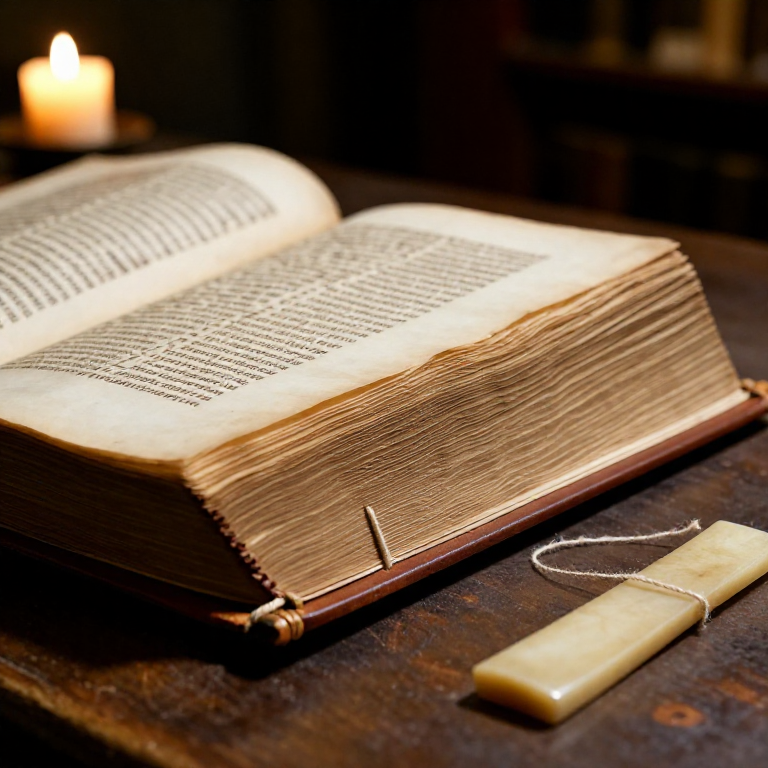


Binding a Codex with Wooden Boards — Medieval Bookbinding
دستورالعملها
Fold and Collate Signatures
Fold and Collate Signatures
Fold each sheet of parchment or paper in half to form a bifolium (a sheet with four pages). Nest 3 to 5 bifolia inside each other to form a signature (also called a quire or gathering). The typical medieval quire contained 4 bifolia (8 leaves, 16 pages) — hence the term quaternion. Collate the signatures in order and tap them on a flat surface to align the spines. Using an awl, pierce sewing holes through the fold of each signature at the points where the sewing cords will cross the spine — typically 3 to 4 evenly spaced points plus one near each end (kettle stitch positions). The holes should be pierced from the inside of the signature fold outward, and all signatures must have holes at exactly the same positions so they will align when sewn.
مواد مورد نیاز این مرحله:
 پوست نازک جانوری20-40 sheets قطعه
 نخ کتان5 metres قطعه
 چکش چوبی2 boards sized to text block قطعه
 چرم1 piece large enough to cover both boards and spine قطعه
 چسب آرد گندمsmall amount قطعه
ابزارهای مورد نیاز:
 مجموعهٔ سوزن خیاطی
 استخوان تازنی
 درفش
درفش چاقوی کاردستی
 ارهٔ دستی
Sew the Signatures onto Cords
Sew the Signatures onto Cords
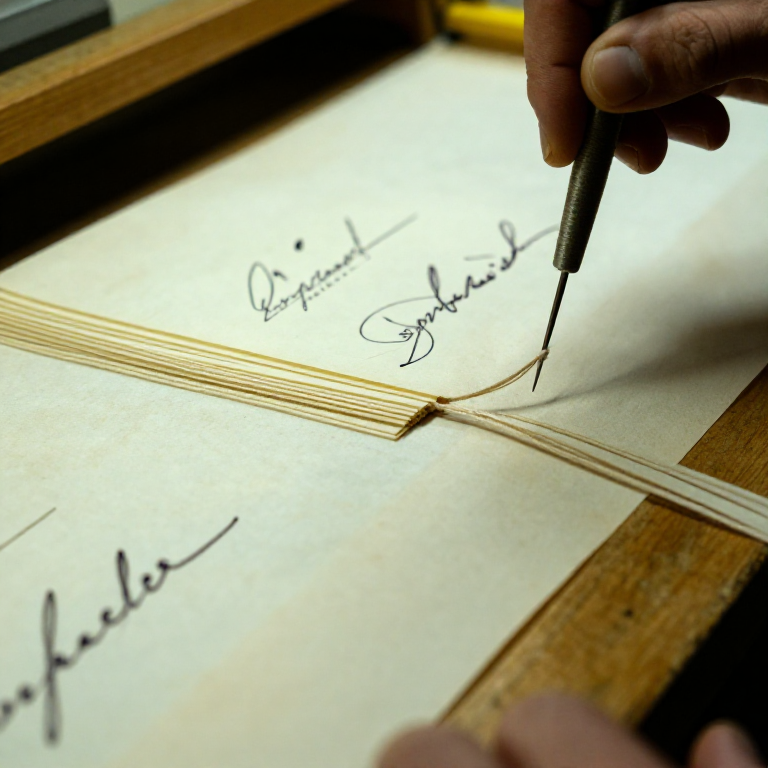
Set up the sewing frame (or improvise by stretching the cords between two fixed points). Tension the cords vertically, spaced to match the sewing hole positions. Place the first signature on the frame and sew through the spine from inside to outside at the first kettle stitch position, then proceed along the spine, looping the thread around each cord as you pass it, sewing in and out of the signature at each sewing station. At the end, link to the next signature with a kettle stitch (a loop that connects adjacent signatures at the spine ends). Add each subsequent signature, sewing it onto the cords and linking it to the previous signature. Pull each stitch tight to create a solid, compact text block. The raised cords create the characteristic ridges visible on the spine of a medieval bound book.
Attach the Wooden Boards
Attach the Wooden Boards
Cut two wooden boards (oak or beech, 3 to 5 mm thick) to the dimensions of the text block plus a slight overhang of 2 to 3 mm on three sides (the fore-edge, head, and tail) — this overhang (called the square) protects the page edges. On the inner face of each board, cut channels or drill angled tunnels from the spine edge inward to receive the cord ends. Thread the protruding sewing cords through these channels and peg, wedge, or paste them into the board. The cords should pull the board tight against the spine of the text block. This cord-to-board attachment is the structural heart of the medieval binding — it transfers the weight of the boards directly to the sewing structure, making the binding very strong. Medieval boards were often bevelled on the outer edge for a tapered appearance.
Cover with Leather
Cover with Leather
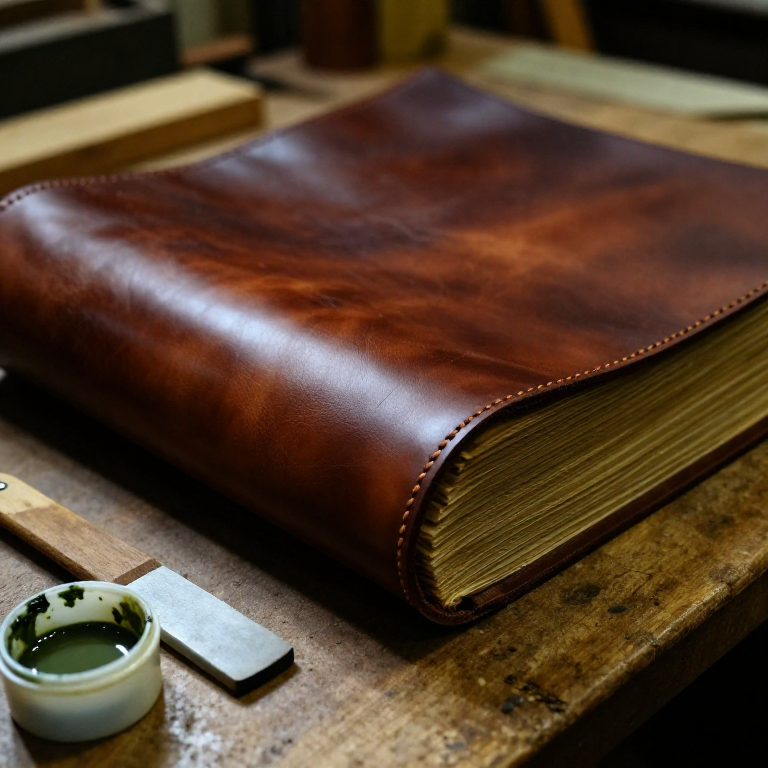
Cut a piece of leather large enough to cover both boards, the spine, and wrap approximately 2 to 3 cm over the inner edges (turn-ins). Pare (thin) the leather at the edges and around the raised cords using a sharp knife to reduce bulk at the folds. Dampen the leather and apply wheat paste to the flesh side. Starting at the spine, lay the leather over the text block, pressing it down between and around the raised cords to create the characteristic ridged spine. Smooth the leather over both boards, working from the spine outward to eliminate air bubbles. Fold the turn-ins over the board edges, mitering the corners, and paste them down. Use a bone folder to press the leather firmly into all contours. Allow to dry under light pressure for 24 hours.
Add Endpapers and Final Finishing
Add Endpapers and Final Finishing
Paste a leaf of parchment or paper over the inside of each board to cover the cord lacings and leather turn-ins — this is the pastedown. A matching free flyleaf can be tipped in adjacent to the pastedown. These endpapers create a clean interior finish and protect the first and last pages of the text. If desired, add a clasp mechanism — medieval books were stored flat on shelves and needed clasps to keep the covers closed so the parchment pages (which naturally curl) would remain flat under compression. Simple clasps consist of a leather strap with a brass catch that hooks over a pin on the opposite board. The completed codex should open and close smoothly, with the spine flexing at the cord positions. A properly bound medieval codex can withstand centuries of use — the structural principles of sewing on raised cords with wooden boards remain the gold standard for book conservation and fine binding today.
مواد
9- 20-40 sheets قطعهجایگزین
- Hemp or linen cords (for sewing supports)3-4 cords, each 30 cm long سانتیمتر
- 2 boards sized to text block قطعهجایگزین
- 1 piece large enough to cover both boards and spine قطعهجایگزین
- 20-40 sheets قطعهجایگزین
- 5 metres قطعهجایگزین
- 3-4 cords, each 30 cm long قطعهجایگزین
- 2 boards sized to text block قطعهجایگزین
- small amount قطعهجایگزین
ابزارهای لازم
10- جایگزین
- جایگزین
- جایگزین
- جایگزین
- Pressing boards and weights
- جایگزین
- جایگزین
- جایگزین
- جایگزین
- جایگزین
CC0 مالکیت عمومی
این نقشه تحت مجوز CC0 منتشر شده است. شما آزاد هستید آن را کپی، ویرایش، توزیع و برای هر هدفی بدون نیاز به اجازه استفاده کنید.
با خرید محصولات از طریق نقشه از سازنده حمایت کنید و او کمیسیون سازنده تعیین شده توسط فروشندگان، دریافت میکند یا یک نسخه جدید از این نقشه ایجاد کنید و آن را به عنوان اتصال در نقشه خود قرار دهید تا درآمد به اشتراک گذاشته شود.