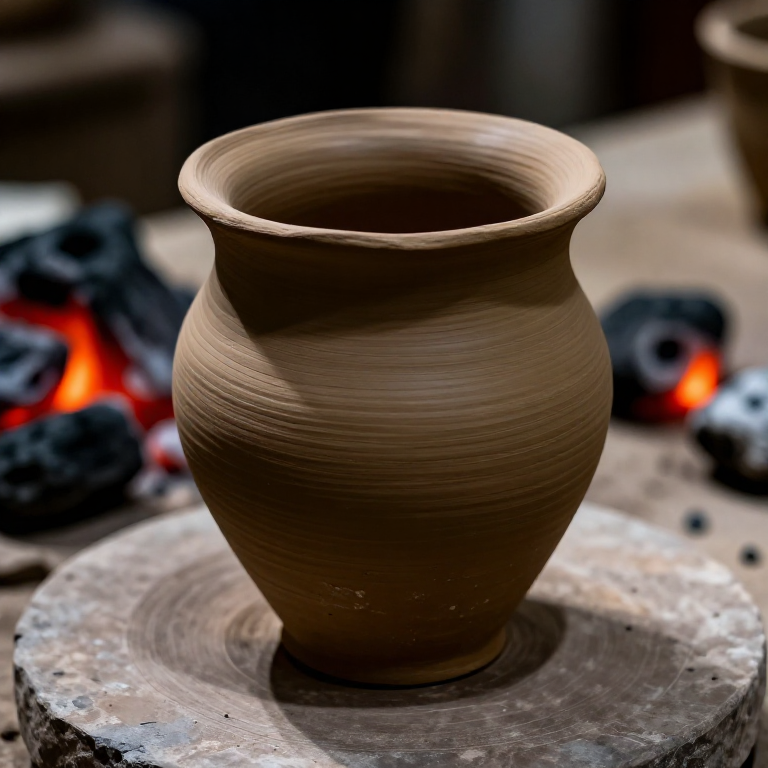


Making a Clay Crucible for Smelting — The Vessel That Holds Molten Metal
The clay crucible is the most essential tool in early metallurgy — a hand-formed vessel of refractory clay and grog that can withstand the 1,100 °C temperatures needed to melt copper and bronze. Without it, smelting is impossible.
This blueprint follows the Bronze Age method of mixing local clay with crushed pottery (grog) to create a thermal-shock-resistant vessel. The grog opens the clay body, allowing steam to escape during firing instead of shattering the crucible. The thick walls and tapered form channel heat inward while the pouring lip allows controlled transfer of molten metal into moulds.
Every bronze tool, weapon, and ornament of the ancient world began inside a vessel like this one.
Leiðbeiningar
Collect and prepare the clay
Collect and prepare the clay
Efni fyrir þetta skref:
 Eldfastur leir2 kg
Crush fired pottery into grog
Crush fired pottery into grog
Efni fyrir þetta skref:
 Skerfur (malað brennt leirtau)500 g
Mix the crucible body
Mix the crucible body
Efni fyrir þetta skref:
 Kvarssandur200 g
 Vatn500 ml
Nauðsynleg verkfæri:
 Flöt steinhella
 Tréprik til blöndunar
Wedge the clay to remove air
Wedge the clay to remove air
Form the base
Form the base
Build up the walls with coils
Build up the walls with coils
Smooth and compress the walls
Smooth and compress the walls
Nauðsynleg verkfæri:
 Sléttur steinn
Form the pouring lip
Form the pouring lip
Thicken the base and lower walls
Thicken the base and lower walls
Dry the crucible slowly
Dry the crucible slowly
Pre-heat near a fire
Pre-heat near a fire
Fire the crucible in a kiln
Fire the crucible in a kiln
Inspect and test
Inspect and test
Efni
4- 2 kgStaðgengill
- Staðgengill
- 200 gStaðgengill
- 500 mlStaðgengill
Nauðsynleg verkfæri
3- Staðgengill
- Staðgengill
- Staðgengill
Efni úr tengdum teikningum
Þessi teikning býr til



Tengd Blueprint
Þessi blueprint deila þekkingu — tækni, efni eða meginreglur

CC0 opinbert ríki
Þessi teikning er gefin út undir CC0. Þér er frjálst að afrita, breyta, dreifa og nota þetta verk í hvaða tilgangi sem er, án þess að biðja um leyfi.
Studdu smiðinn með því að kaupa vörur í gegnum teikningu hans þar sem hann fær þóknun smiða sem seljendur ákvarða, eða búðu til nýja endurskoðun á þessari teikningu og tengdu hana sem tengingu í þinni eigin teikningu til að deila tekjum.