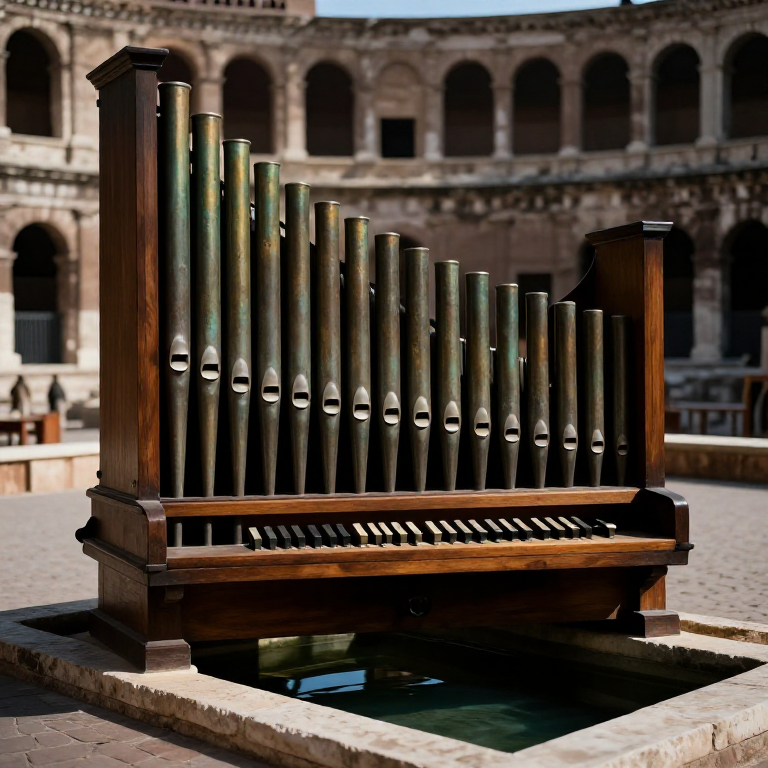


Building a Hydraulis — The Water-Powered Pipe Organ of Ancient Greece
The hydraulis (ὕδραυλις — from Greek 'hydro' water + 'aulos' pipe) is the world's first keyboard instrument and the direct ancestor of every organ built in the 2,000 years since. It was invented by Ctesibius of Alexandria around 270–246 BCE and described in detail by Hero of Alexandria, Vitruvius, and later by the Roman writer Tertullian, who called it 'the great organ, so many members, so many parts, such intricate framework of pipes and machinery.'
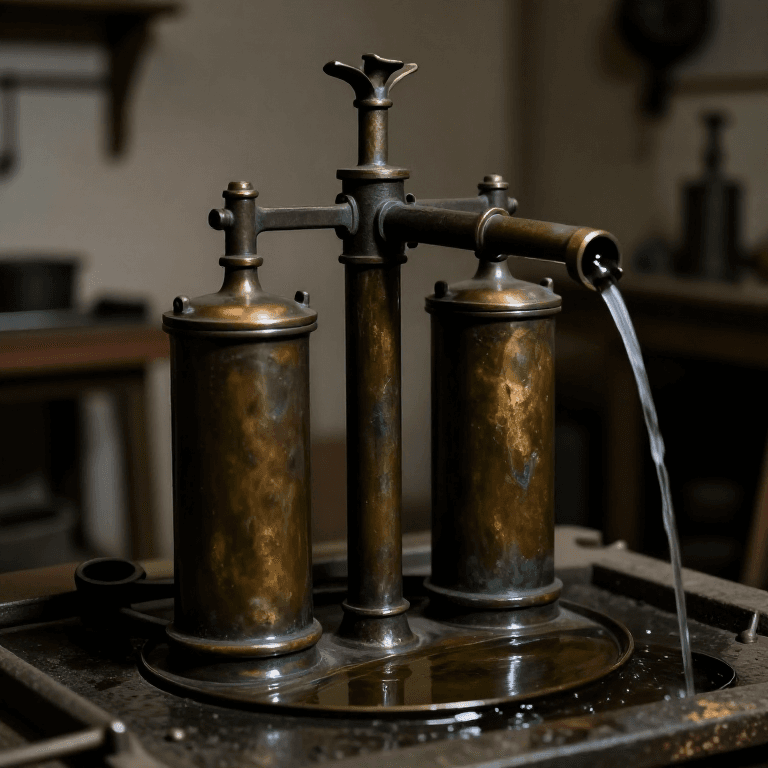
The genius of Ctesibius' design lies in the pnigeus — an inverted bronze bell submerged in a water-filled tank. A hand pump forces air into the pnigeus, compressing it against the water surface. The water cannot compress, so it rises around the outside of the bell. When the pump stops, the compressed air in the pnigeus continues to feed the wind chest at constant pressure — the water acts as a pneumatic accumulator, maintaining steady air pressure independent of the pump rhythm. Without this water regulation, a hand-pumped organ produces trembling, uneven notes. With the pnigeus, the tone is pure and sustained as long as the air supply lasts.
The hydraulis was played at Roman gladiatorial games, in theatres, at banquets, and in military processions. The historian Suetonius records that the emperor Nero was so passionate about the hydraulis that he was still discussing improvements to its mechanism while Rome burned around him in 64 CE. The instrument spread throughout the Roman world: examples were found at Aquincum (Budapest) and Nîmes in France. By the 4th century CE the bellows-driven wind chest replaced the water stabiliser, producing the direct precursor of the medieval cathedral organ — but the keyboard, pipe, and slider valve system of every organ today traces directly to Ctesibius' hydraulis.
Leiðbeiningar
Design the pipe scales and key layout
Design the pipe scales and key layout
Before any fabrication, design the pipe set. The pitch of an open cylindrical pipe is determined by its length: a pipe open at both ends sounds a pitch whose fundamental wavelength is twice the pipe length. At 20°C, sound travels at 343 m/s, so a pipe 0.5 m long sounds at 343 / (2 × 0.5) = 343 Hz, close to the musical note F4. To build a one-octave (8-note) diatonic scale from C4 (261.6 Hz) to C5 (523.2 Hz), calculate pipe lengths for each note: C4 = 65.6 cm, D4 = 58.4 cm, E4 = 52.1 cm, F4 = 49.2 cm, G4 = 43.8 cm, A4 = 39.0 cm, B4 = 34.8 cm, C5 = 32.8 cm. These are theoretical lengths for open cylindrical pipes — actual pipes require an 'end correction' of approximately +0.3 × internal diameter added to each end, which slightly shortens the required physical pipe length.
Ancient hydraulis instruments had between 4 and 19 stops (rows of pipes), each producing the same pitch set at different octaves or timbres. Start with a single rank of 8 pipes for this foundational build. Arrange the keys from left to right in ascending pitch order — the same orientation as a modern piano.
Build the water tank and pnigeus pressure vessel
Build the water tank and pnigeus pressure vessel
The water tank is a sealed wooden or bronze box approximately 40 cm × 40 cm × 50 cm deep, watertight and filled to 80% capacity with water. The pnigeus (πνιγεύς — 'strangler', from its role of trapping air) is an inverted bronze dome or bell approximately 25 cm diameter and 30 cm tall, suspended open-end down inside the water tank on a central post. Air pumped into the pnigeus accumulates under the bell and compresses slightly as its volume decreases — the water inside the bell is displaced downward as air pressure builds, and water around the outside of the bell rises. The air pressure inside the pnigeus at equilibrium equals the weight of the water column displaced — for 10 cm of water displacement, pressure ≈ 10 cm × 0.001 kg/cm³ × gravity ≈ 0.01 bar gauge, sufficient to supply the pipes with sustained airflow.
Drill an outlet hole in the top of the pnigeus (or a tube soldered to the top) that connects via a pipe to the wind chest above. The air pressure in the pnigeus is what drives air into the pipes when slider valves open. Build the water tank from 3 cm hardwood planks, calking all joints with oakum and pine pitch, and test for watertightness before installing the pnigeus.
Efni fyrir þetta skref:
 Harðviðarkubbur4 stykki
 Járnnaglar30 stykki
Nauðsynleg verkfæri:
 Handsög
Build the hand pump to charge the pnigeus
Build the hand pump to charge the pnigeus
The hand pump (identical in principle to the Ctesibius force pump) charges the pnigeus with air on each stroke. For the hydraulis, a simpler single-cylinder bellows-pump suffices: a wooden box approximately 15 cm × 15 cm × 20 cm with a leather-sealed piston operated by a handle, with two check valves — one drawing in ambient air on the upstroke, one delivering air into the pnigeus pipe on the downstroke. An assistant (the calcant, from the Latin 'to tread') operates the pump continuously while the organist plays.
Alternatively, use a lever-operated bellows of the same type as the box bellows in the bellows blueprint: a hinged wooden box with flexible leather sides and two flap check valves. The lever bellows is easier to make than a piston pump but delivers less pressure — for a simple 8-pipe hydraulis at low pressure, either design is adequate. The pump must be connected to the pnigeus air inlet by a pipe that runs under the water tank into the submerged bell.
Efni fyrir þetta skref:
Harðviðarkubbur2 stykkiBuild the wind chest from hardwood
Build the wind chest from hardwood
The wind chest is the pressurised manifold that distributes air from the pnigeus to each pipe. It is a sealed rectangular wooden box approximately 60 cm long (for 8 pipes), 15 cm wide, and 10 cm deep, with a pressurised interior. The air inlet from the pnigeus connects through the bottom. The top surface of the wind chest has eight holes, equally spaced, each directly below its corresponding pipe.
The critical internal component is the table — a flat upper surface of the wind chest through which the pipe holes pass. Each hole is controlled by a slider valve (the register) — a thin hardwood or bronze slide that passes horizontally through a slot in the side of the wind chest and can be pushed in or pulled out to open or close each individual pipe hole. When the slider is pushed in, its own hole aligns with the table hole, allowing air to reach the pipe. When pulled out, the slider's solid material blocks the table hole. These are the keys of the hydraulis — a primitive but functional keyboard.
Efni fyrir þetta skref:
Harðviðarkubbur3 stykkiJárnnaglar20 stykkiNauðsynleg verkfæri:
 Sýll
SýllFabricate the bronze organ pipes
Fabricate the bronze organ pipes
Each pipe is a cylindrical bronze tube, open at the top, closed at the bottom except for a slot cut just above the closed foot — this slot and the flat 'languide' plate (a horizontal shelf inside the pipe just below the slot) form the flue, where air accelerates through the narrow gap and strikes the upper edge of the slot opening, creating the acoustic oscillation that produces the note. This is a flue pipe (the same type as found in modern classical organs) — simpler to make and more stable in pitch than reed pipes.
Roll sheet bronze (0.5 mm thick) into cylinders of the calculated diameter (typically 1.5–3 cm internal diameter for a small instrument) and solder the seam with tin-lead solder. Solder a bronze disc with a central hole to the bottom to form the foot of the pipe. Cut the flue slot — a rectangular opening 2 mm wide by 5 mm long — horizontally across the pipe just above the foot cap. Solder the languide (a flat bronze disc) inside the pipe just below the slot, leaving a 1–1.5 mm gap between the languide edge and the slot. The final pipe length is calculated as above but reduced by the end correction factor.
Nauðsynleg verkfæri:
 Hnífur
Tune the pipes by cutting and adjusting length
Tune the pipes by cutting and adjusting length
Mount each pipe temporarily on the wind chest with the pump running and listen to its pitch against a reference — use a stringed instrument (lyre or kithara) tuned to the target scale, or a monochord (a single string instrument with a calibrated bridge). If the pipe is flat (too low in pitch), cut 5 mm from the open top end and re-test — cutting shortens the resonating air column and raises the pitch. If the pipe is sharp (too high), carefully solder a bronze extension ring of 5 mm to the open top end to lower the pitch.
Tuning is iterative — cut conservatively and re-test frequently, as each 5 mm cut raises pitch by approximately one semitone on shorter pipes. The ancient hydraulis likely used a Pythagorean scale (pure fifths and fourths) or a diatonic scale based on the ratios described by Pythagoras: the ratios of pipe lengths for a diatonic scale starting from the longest (lowest) pipe are 1 : 8/9 : 64/81 : 3/4 : 2/3 : 16/27 : 128/243 : 1/2 for the eight notes of the octave. Cutting the longest pipe to exactly 65.6 cm (for C4) and calculating subsequent pipe lengths from these ratios gives the Pythagorean scale used in ancient Greek music.
Nauðsynleg verkfæri:
 Kvarnarsteinn
Mount pipes on the wind chest and seal joints
Mount pipes on the wind chest and seal joints
Once tuned, permanently mount each pipe on its corresponding table hole in the wind chest. The pipe foot (the closed bottom with the central air-entry hole) fits over the table hole — seal the junction with pine pitch or beeswax to prevent air leakage around the pipe foot. Air leakage at the pipe base causes the pipe to speak quietly and unstably, with insufficient air pressure reaching the flue slot to create a clean tone.
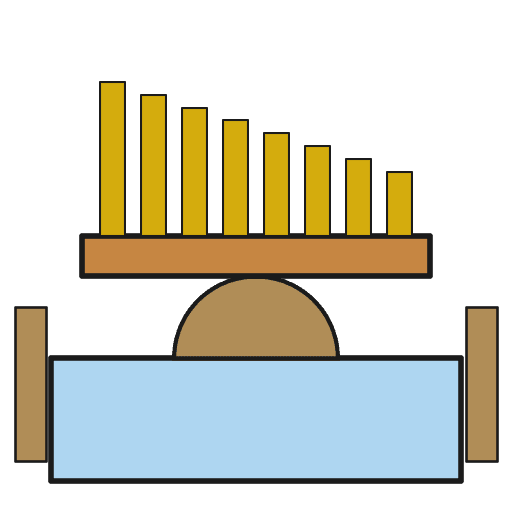
Space the pipes evenly along the wind chest, arranged in order of decreasing length from left to right (largest pipe C4 at left, smallest pipe C5 at right). Support the tops of the taller pipes with a horizontal wooden rail above the wind chest to prevent vibration-induced swaying that would knock adjacent pipes out of alignment. The completed pipe array should be visually similar to the depictions in Roman mosaics from Carthage and Nennig, which show the hydraulis pipes in ascending pitch order from left to right.
Build the keyboard with return springs
Build the keyboard with return springs
The slider valves (keys) should return automatically to the closed position when released by the player — without springs, the organist must both push to open and pull to close each valve while also pumping the bellows and remembering the next note. Add return springs made from bent bronze wire or strips of springy horn, positioned to pull each slider back to the closed position when finger pressure is released. The spring force should be light enough that a single finger can easily depress the key, but strong enough to close the valve quickly and produce a clean note cutoff.
Engrave or paint marker symbols on the exposed outer ends of each slider to identify the notes — ancient Greek letter-note notation (using the letters Alpha through Theta for an 8-note scale) is historically authentic. Add a wooden key frame that guides the sliders smoothly in and out without lateral wobble, preventing adjacent valve holes from being inadvertently opened or partially opened.
Nauðsynleg verkfæri:
 Grafstíll
Connect the pump to the pnigeus and prime the water tank
Connect the pump to the pnigeus and prime the water tank
Connect the pump air outlet to the air inlet of the pnigeus using a sealed bronze pipe or a tightly pitched leather hose. The connection must be air-tight — any leak path between the pump outlet and the pnigeus means the pump works against atmospheric pressure rather than building pressure in the bell, resulting in no air reaching the pipes when valves open. Test the connection by blocking the outlet pipe to the wind chest and pumping: the resistance on the pump handle should increase noticeably as pressure builds in the sealed pnigeus system.
Fill the water tank to 80% capacity through a fill hole in the tank top. Observe the water level inside the pnigeus: it should be the same as the surrounding tank level before pumping. As the pump delivers air into the pnigeus, the water level inside the bell drops and the water outside rises slightly (conservation of volume). This visible water movement is the confirmation that the pnigeus is sealed correctly and pressure is building. Fill the tank with clean fresh water — mineral deposits from hard water will eventually encrust the bronze bell interior and alter the acoustic resonance of the instrument.
First sounding — voicing the pipes
First sounding — voicing the pipes
With the pump running and the pnigeus pressurised, depress the lowest note key (C4) and listen. The pipe should speak immediately with a clear, steady tone. If the tone is breathy or airy (too much turbulence), narrow the flue slot by carefully bending the languide upward by 0.1 mm and re-test. If the pipe does not speak at all (silence despite air entering), the flue slot may be too narrow or the languide too close to the slot edge — carefully lower the languide by 0.1 mm increments until speech begins. This process of adjusting the languide and flue to achieve the correct tone is called voicing and requires patient iterative adjustment.
The ideal tone for a flue pipe is clear, stable, and begins promptly when the key is depressed without any breathy 'chiff' at the onset. A slight chiff (a brief airy breath before the full tone establishes) is acceptable and was probably characteristic of the ancient hydraulis — modern ears accustomed to electronically regulated pipe organs may find the slight variation in tone quality between the water-pressure instrument and a bellows-driven modern organ aesthetically interesting rather than defective.
Play the Pythagorean scale and verify all eight notes
Play the Pythagorean scale and verify all eight notes
With all eight pipes voiced, play each note in sequence from C4 to C5 and listen for consistency. The water pressure in the pnigeus should keep the pitch stable regardless of the pump rhythm — this is the defining advantage of the hydraulis over a direct bellows-driven instrument. Have an assistant pump continuously at approximately one stroke per second while you hold each key for five seconds, listening for pitch drift. Drift of more than half a semitone (the pitch rising as the pump over-pressurises or falling as pressure drops) indicates the pnigeus volume is too small — increase it by fitting a larger bell or extending the existing one downward.
Play simple Greek musical phrases documented by ancient scholars — the Seikilos epitaph (the oldest complete surviving song, 1st century CE) uses only five distinct pitches within an octave and is playable on this 8-note hydraulis. Hearing an ancient melody on an instrument built to the original specifications closes a 2,000-year gap between the maker and the ancient world with remarkable immediacy.
Tune drift correction and long-term maintenance
Tune drift correction and long-term maintenance
Bronze pipes slightly change pitch with temperature — at 20°C versus 10°C, the speed of sound changes by approximately 0.6%, causing all pipes to sound approximately 10 cents (one-tenth of a semitone) sharp at the warmer temperature. This is within the pitch tolerance of the ancient diatonic scale where intervals are already slightly different from modern equal temperament. If the instrument is used outdoors in varying temperatures, expect to re-tune the pipe lengths seasonally.
The water in the tank should be changed monthly to prevent algal growth that can clog the pnigeus air inlet. Drain the tank completely through the bottom drain plug, rinse with fresh water, and refill. Inspect the leather seals in the pump annually and replace if cracked or stiff. The wooden wind chest joints should be re-pitched every two to three years as the original pine pitch gradually becomes brittle and cracks — open the wind chest, clean out the old pitch with a hot iron, and apply fresh hot pine pitch. A hydraulis maintained this way will remain functional for decades — the 4th century CE Aquincum organ remained structurally intact for approximately 160 years before the building housing it was destroyed.
Efni úr tengdum teikningum
Þessi teikning býr til
Tengd Blueprint
Þessi blueprint deila þekkingu — tækni, efni eða meginreglur

CC0 opinbert ríki
Þessi teikning er gefin út undir CC0. Þér er frjálst að afrita, breyta, dreifa og nota þetta verk í hvaða tilgangi sem er, án þess að biðja um leyfi.
Studdu smiðinn með því að kaupa vörur í gegnum teikningu hans þar sem hann fær þóknun smiða sem seljendur ákvarða, eða búðu til nýja endurskoðun á þessari teikningu og tengdu hana sem tengingu í þinni eigin teikningu til að deila tekjum.