Samvinna
LIST
FEGURÐ OG VELLÍÐAN
HANDVERK
MENNING OG SAGA
SKEMMTUN
UMHVERFI
MATUR OG DRYKKUR
ÖFUGVERKFRÆÐI
VÍSINDI
ÍÞRÓTTIR
TÆKNI
KLÆÐANLEG TÆKNI
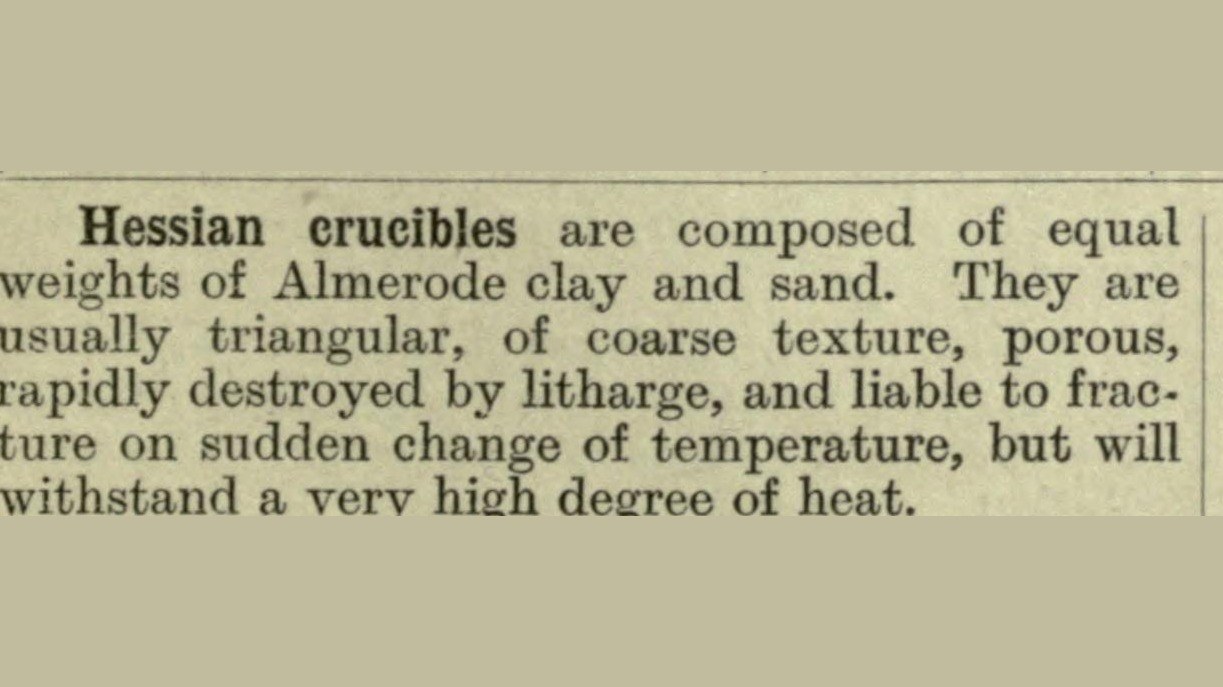


Ceramic Crucible: a Hessian Crucible of Equal Weights of Clay and Sand (Thorpe 1912)
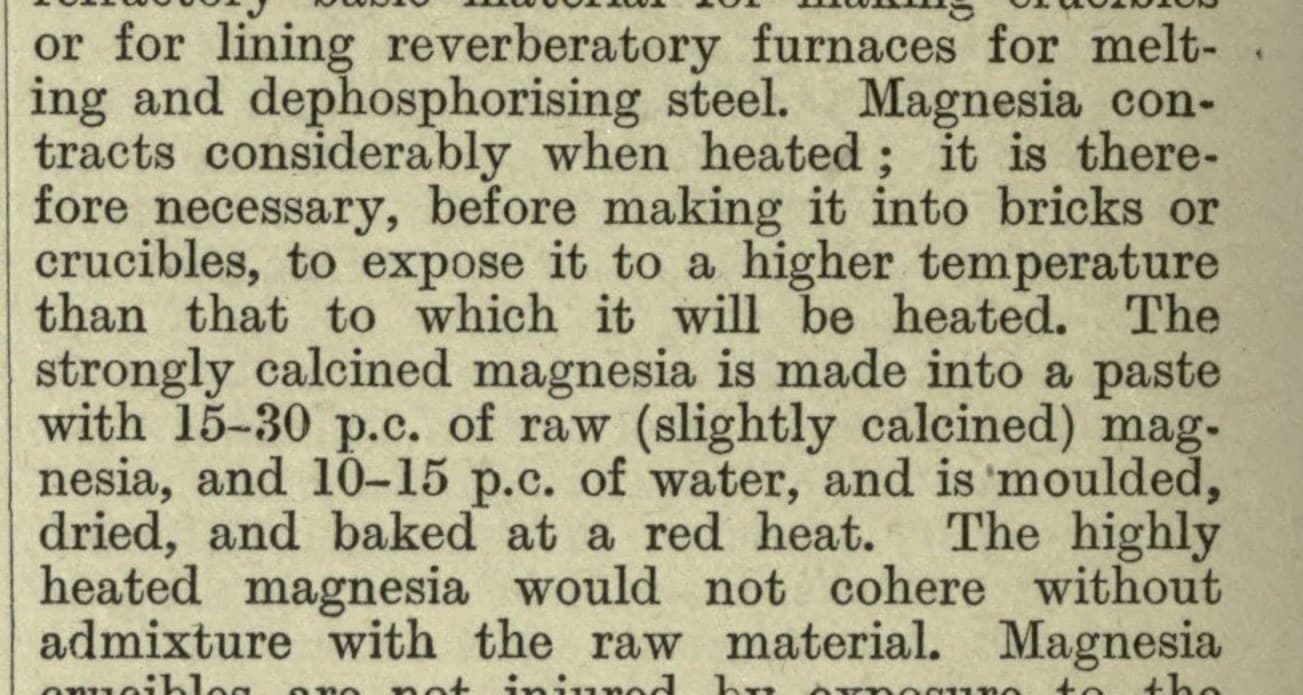
A ceramic crucible is a fired clay pot for melting metal. Thorpe's Dictionary of Applied Chemistry (1912) describes the Hessian crucible: equal weights of clay and sand, usually triangular, coarse and porous; it withstands a very high heat but cracks on sudden changes of temperature and is quickly eaten by litharge.
His general rules for clay crucibles fill in the work: weather the clay, beat it fine to drive out air, mix in the sand, form the crucibles and bake small ones in a kiln. Sizes, forming and baking heat are not given.
Source: Thorpe, Dictionary of Applied Chemistry vol. II (1912), CRUCIBLES, pp. 168-169. Picture: the Hessian paragraph.
Byrjandi
Weeks of weathering, then two days
Leiðbeiningar
1
1
Read Thorpe
Read Thorpe
"Hessian crucibles are composed of equal weights of Almerode clay and sand."
2
2
Weather and clean the clay
Weather and clean the clay
Leave the clay exposed to the air in a moist state for some months; it breaks down, grows more plastic and is easier to clean. Pick out foreign matter, above all iron pyrites, which turns into a flux and leaves cavities, and lime.
Efni fyrir þetta skref:
 Leir1 half by weight
Nauðsynleg verkfæri:
 Vatn
3
3
Beat and mix
Beat and mix
Beat the clay well, as fine as you can get it, to drive out air bubbles. Weigh it, and mix in an equal weight of sand; Berthier warns that the sand should not be too fine, or it combines with the clay and lowers the melting point.
Efni fyrir þetta skref:
 Kvarssandur1 half by weight
Nauðsynleg verkfæri:
 Trésleggja
 Nákvæm stafræn vog
4
4
Form the crucibles
Form the crucibles
Form the crucibles; Hessian crucibles are usually triangular. Thorpe gives no sizes and no forming method (unknown).
Nauðsynleg verkfæri:
 Leirverkfærasett
 Óþekkt mál
5
5
Bake
Bake
Bake small crucibles in a kiln. Thorpe notes that the higher the baking heat, the more liable the crucible is to crack when heated again; the temperature is not given.
Nauðsynleg verkfæri:
 Brennsluofn
 Hitaþolnir hanskar
6
6
History and honest limits
History and honest limits
Thorpe sets the Hessian crucible beside others of his day: French crucibles of raw and burnt clay, Cornish crucibles for copper assaying, Stourbridge crucibles with old glass-pot grog, and graphite crucibles for melting metals. The sand forms a skeleton that keeps the pot from slumping at heats where the clay alone would soften.
He gives the proportions only; the size, the forming and the baking heat are not given, and plain clay and quartz sand stand for Almerode clay and its sand.
Nauðsynleg verkfæri
7- Staðgengill
- Staðgengill
- Staðgengill
- Staðgengill
- Staðgengill
- Staðgengill
- Staðgengill
Þessi teikning býr til

Tengd Blueprint
Þessi blueprint deila þekkingu — tækni, efni eða meginreglur
CC0 opinbert ríki
Þessi teikning er gefin út undir CC0. Þér er frjálst að afrita, breyta, dreifa og nota þetta verk í hvaða tilgangi sem er, án þess að biðja um leyfi.
Studdu smiðinn með því að kaupa vörur í gegnum teikningu hans þar sem hann fær þóknun smiða sem seljendur ákvarða, eða búðu til nýja endurskoðun á þessari teikningu og tengdu hana sem tengingu í þinni eigin teikningu til að deila tekjum.