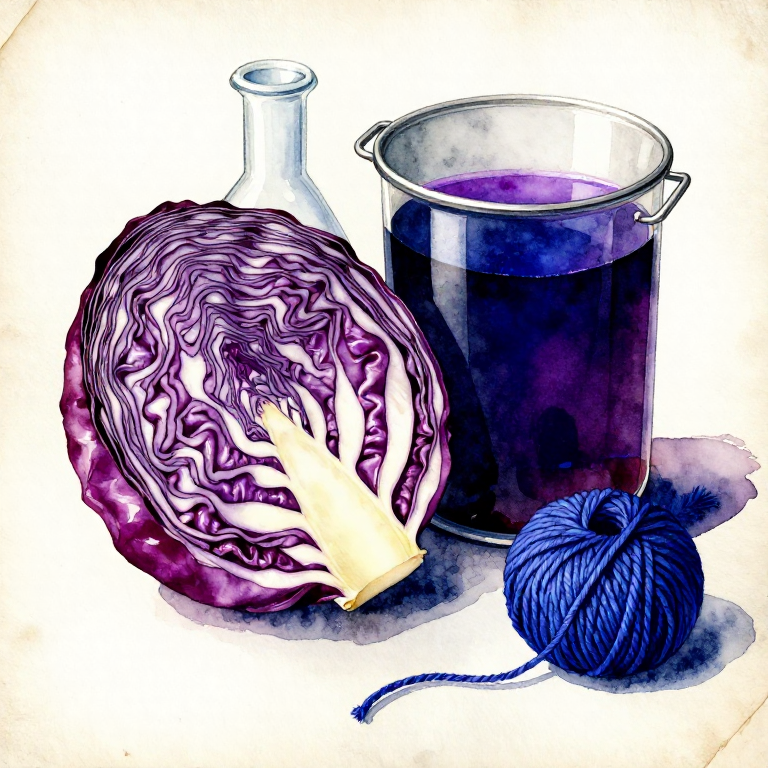


Dyeing Blue-Purple with Red Cabbage — The Kitchen-Chemistry pH Indicator Dye
Red cabbage (Brassica oleracea var. capitata f. rubra) is one of the most remarkable dye materials in the plant kingdom — not for its permanence (which is poor) but for its extraordinary pH sensitivity. The anthocyanin pigments in red cabbage change colour dramatically with pH: red in acid, purple at neutral, blue in mild alkali, green in strong alkali, and yellow at very high pH. This makes red cabbage juice one of the best natural pH indicators and a favourite of chemistry teachers worldwide.
As a textile dye, red cabbage produces blue-purple shades on alum-mordanted wool. The colour is vivid when fresh but fugitive — it fades significantly with light and washing. This limits its use for permanent textiles but makes it an ideal teaching dye for understanding dye chemistry, pH effects, and mordant interactions. A single dyeing session with red cabbage teaches more about dye chemistry than any textbook.
Red cabbage has been cultivated since at least Roman times. The wild ancestor of all cabbages (Brassica oleracea) is native to coastal Europe. Red varieties were selected for their anthocyanin-rich leaves, valued for food colour and later for dye use. The plant is available year-round in virtually every supermarket worldwide, making it the most accessible dye source for classroom and experimental dyeing.
Leiðbeiningar
Chop the red cabbage
Chop the red cabbage
Use one medium red cabbage (approximately 500-800 g) for 100 g of wool. Chop the cabbage into thin strips or rough chunks — smaller pieces release pigment faster. The outer leaves are richest in anthocyanins — include them. The cabbage should be a deep purple-red throughout. Pale or mostly-green cabbages give weak results.
Efni fyrir þetta skref:
 Rauðkál1 stykki
Nauðsynleg verkfæri:
 Stafræn eldhúsvog
Simmer the cabbage at 70-75°C for 30 minutes
Simmer the cabbage at 70-75°C for 30 minutes
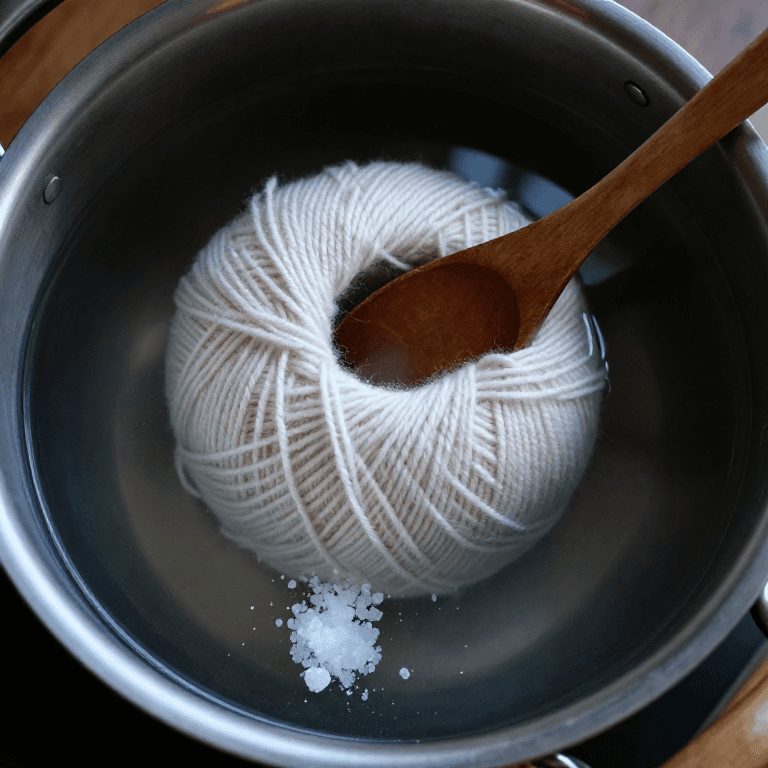
Place the chopped cabbage in a dye pot with 4 litres of water. Bring slowly to 70-75°C and hold for 30 minutes. Do not boil — excessive heat degrades the anthocyanins. The water will turn a vivid blue-purple as the pigment dissolves. Stir occasionally. Red cabbage releases its dye rapidly — the colour change is dramatic within the first 10 minutes.
Nauðsynleg verkfæri:
 Soðpottur
 Eldhúshitamælir
 Trésleif
Strain out the cabbage
Strain out the cabbage
Strain the dye liquor through a fine mesh strainer into a clean pot. Press the cabbage to extract all remaining purple liquid. The spent cabbage will be pale and limp. The strained liquor should be a vivid blue-purple — this is the natural pH of the cabbage extract (around pH 6-7). Adding vinegar turns it red. Adding baking soda turns it blue-green. This pH responsiveness is the hallmark of red cabbage anthocyanins.
Nauðsynleg verkfæri:
 Fínt sigti
Dye alum-mordanted wool at 65-70°C for 45 minutes
Dye alum-mordanted wool at 65-70°C for 45 minutes
Pre-wet the alum-mordanted wool in lukewarm water for 15 minutes, squeeze gently, and lower it into the red cabbage dye bath at room temperature. Slowly raise to 65-70°C over 15 minutes, then hold for 45 minutes. Turn gently every 10 minutes. The wool will develop a blue-purple to lavender tone. The alum mordant slightly shifts the pH and produces a bluer result than un-mordanted wool. Experiment with pH modifiers after dyeing: a brief dip in vinegar water shifts the colour toward pink, while a dip in soda water shifts toward blue-green.
Efni fyrir þetta skref:
 Ullarbandshespa100 g
 Álún (kalíumálún)10 g
Cool overnight, rinse, and dry
Cool overnight, rinse, and dry
Turn off the heat and let the wool cool in the dye bath overnight. Remove, squeeze gently, and rinse in lukewarm water until the runoff is mostly clear. The final colour is a soft blue-purple to lavender. Lightfastness is poor — red cabbage anthocyanins fade significantly within weeks of sunlight exposure. Washfastness is also limited. This makes red cabbage unsuitable for garments or items exposed to light, but ideal for educational dyeing, craft projects stored indoors, and understanding dye chemistry. The colour's pH sensitivity makes every skein a chemistry experiment. Dry in shade.
Efni
3- 1 stykkiStaðgengill
- 100 gStaðgengill
- Staðgengill
Nauðsynleg verkfæri
5- Staðgengill
- Staðgengill
- Staðgengill
- Staðgengill
- Staðgengill
Efni úr tengdum teikningum
Þessi teikning býr til

Tengd Blueprint
Þessi blueprint deila þekkingu — tækni, efni eða meginreglur
CC0 opinbert ríki
Þessi teikning er gefin út undir CC0. Þér er frjálst að afrita, breyta, dreifa og nota þetta verk í hvaða tilgangi sem er, án þess að biðja um leyfi.
Studdu smiðinn með því að kaupa vörur í gegnum teikningu hans þar sem hann fær þóknun smiða sem seljendur ákvarða, eða búðu til nýja endurskoðun á þessari teikningu og tengdu hana sem tengingu í þinni eigin teikningu til að deila tekjum.