LIST
FEGURÐ OG VELLÍÐAN
HANDVERK
MENNING OG SAGA
SKEMMTUN
UMHVERFI
MATUR OG DRYKKUR
ÖFUGVERKFRÆÐI
VÍSINDI
ÍÞRÓTTIR
TÆKNI
KLÆÐANLEG TÆKNI
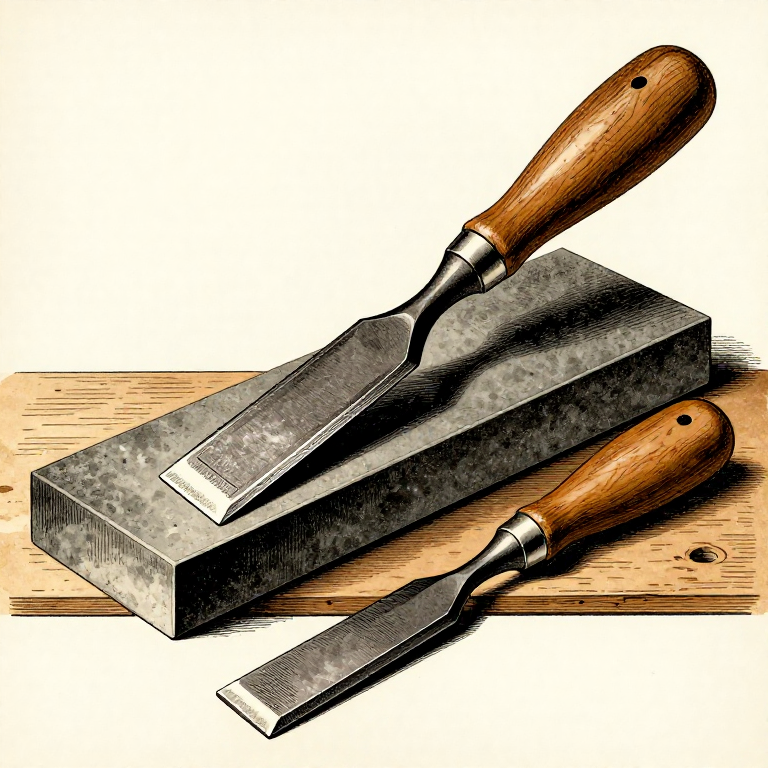

The Bevel: One Angle to Grind, Another to Hone
Grinding the whole bevel every time is slow, and it is unnecessary. Only the last fraction of a millimetre does any cutting, so only that fraction needs to be polished.
Hence two angles: a PRIMARY bevel ground a degree or two shallower, which removes the bulk and is redone rarely, and a narrow SECONDARY bevel honed at the working angle, which is the actual edge and takes a minute. The secondary can be refreshed many times before the primary needs touching again.
It is the difference between sharpening taking two minutes and taking twenty, and it is why a working woodworker's tools are sharp and a beginner's are not.
Miðlungs
3 hours
Leiðbeiningar
1
1
Grind the primary, and keep it cool
Grind the primary, and keep it cool
Grind the primary bevel a degree or two below the working angle, quenching often in water and never letting the edge change colour.
If the steel turns straw or blue at the edge you have tempered it soft, locally and permanently, and the only cure is to grind past the damaged part. That heat arrives far faster than it feels — the thin edge has almost no mass to absorb it, so it reaches tempering temperature while the body of the blade is still cool enough to hold.
Light pressure, keep the tool moving across the wheel, and dip it before it feels hot rather than after. A hollow grind from a round wheel is a help, not a fault: it leaves two contact points that register the angle on the stone.
Nauðsynleg verkfæri:
 Bekkslípivél
 Slípiskífa
 Tær öryggisgleraugu
2
2
Hold the angle — by jig or by hand, but hold it
Hold the angle — by jig or by hand, but hold it
A honing guide clamps the blade at a set projection and rolls at a fixed angle. Set it once, write the projection on the tool, and every future sharpening reproduces the same bevel exactly.
Freehand is faster and entirely possible, but it must be a CONSISTENT angle, not a swept one. The failure mode is rocking: the wrist rises through the stroke, the bevel becomes convex, and the very tip ends up blunter than the angle you think you are holding. The marker test catches this immediately.
There is no virtue in freehand for its own sake. Use the guide while you learn what the angle feels like, and you will end up able to do both.
Nauðsynleg verkfæri:
 Brýnistýring
 Brýni
Brýni Stemmjárnasett - fösuð egg
 Merkipenni
3
3
The secondary bevel, and why it saves so much time
The secondary bevel, and why it saves so much time
Hleð Jupyter-vinnubók…
Nauðsynleg verkfæri:
BrýnistýringBrýni Reiknivél
4
4
Hollow, flat or convex — and which tool wants which
Hollow, flat or convex — and which tool wants which
A grinding wheel leaves a HOLLOW bevel, a flat stone leaves a FLAT one, and stropping or sharpening on a soft backing leaves a CONVEX one. All three cut; they suit different tools.
Hollow is easiest to hone freehand, because the concave face touches the stone at heel and tip and registers the angle for you. Flat is the most stable and what a guide produces. CONVEX — a rounded 'apple seed' bevel — puts the most steel behind the edge and is what an axe or a froe wants, because those are struck and levered.
An axe sharpened to a flat 25 degrees will chip on the first knot. That is not a sharpening failure; it is the wrong geometry for a tool that is swung.
Nauðsynleg verkfæri:
 Öxi
Öxi BrýnisþjölBrýniBekkslípivél
Tengd Blueprint
Þessi blueprint deila þekkingu — tækni, efni eða meginreglur
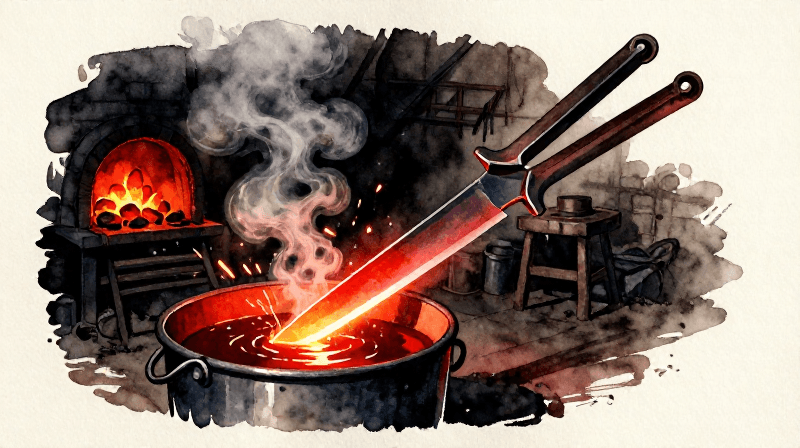
Quench Hardening and Tempering a Steel Blade — Heat Treatment Fundamentals
eftir Forge
Forn
78
0
0
0
2
0
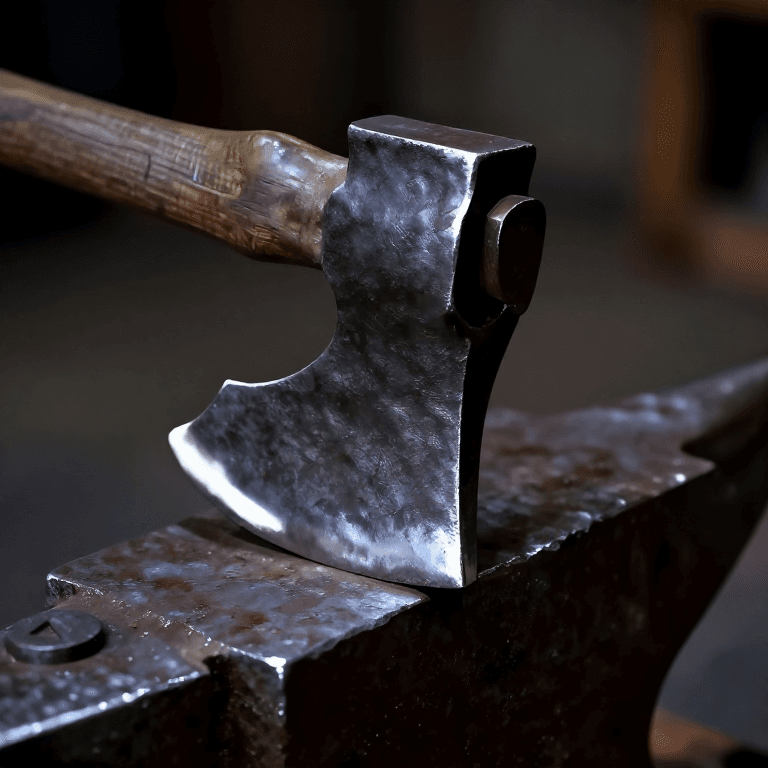
Forging an Iron Axe Head — The Tool That Cleared the Forests
eftir Forge
Málmsmíðaverkfæri
41
0
0
0
1
0

Forging an Iron Chisel — The Cutting Tool That Shapes Stone, Wood, and Metal
eftir Forge
Málmsmíðaverkfæri
43
0
0
0
1
0
CC0 opinbert ríki
Þessi teikning er gefin út undir CC0. Þér er frjálst að afrita, breyta, dreifa og nota þetta verk í hvaða tilgangi sem er, án þess að biðja um leyfi.
Studdu smiðinn með því að kaupa vörur í gegnum teikningu hans þar sem hann fær þóknun smiða sem seljendur ákvarða, eða búðu til nýja endurskoðun á þessari teikningu og tengdu hana sem tengingu í þinni eigin teikningu til að deila tekjum.