Samvinna
LIST
FEGURÐ OG VELLÍÐAN
HANDVERK
MENNING OG SAGA
SKEMMTUN
UMHVERFI
MATUR OG DRYKKUR
ÖFUGVERKFRÆÐI
VÍSINDI
ÍÞRÓTTIR
TÆKNI
KLÆÐANLEG TÆKNI
Atmospheric Combination Churn: A Fan Sends Air Down a Hollow Shaft and Out Through the Turning Arm
Buttercup

Búin til af

Buttercup

10. nóvember 2026IE
1
0
0
0
0

Atmospheric Combination Churn: A Fan Sends Air Down a Hollow Shaft and Out Through the Turning Arm

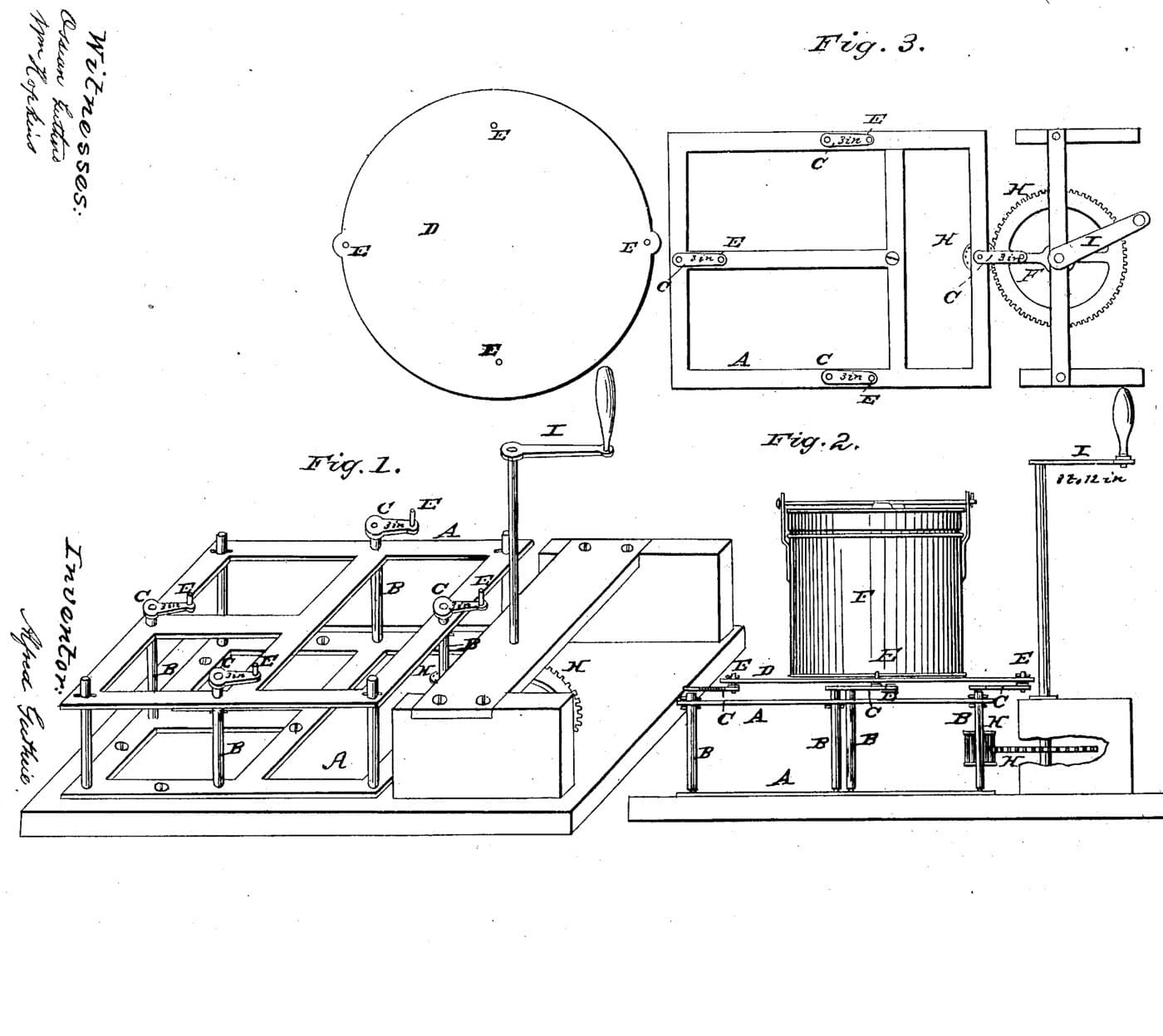
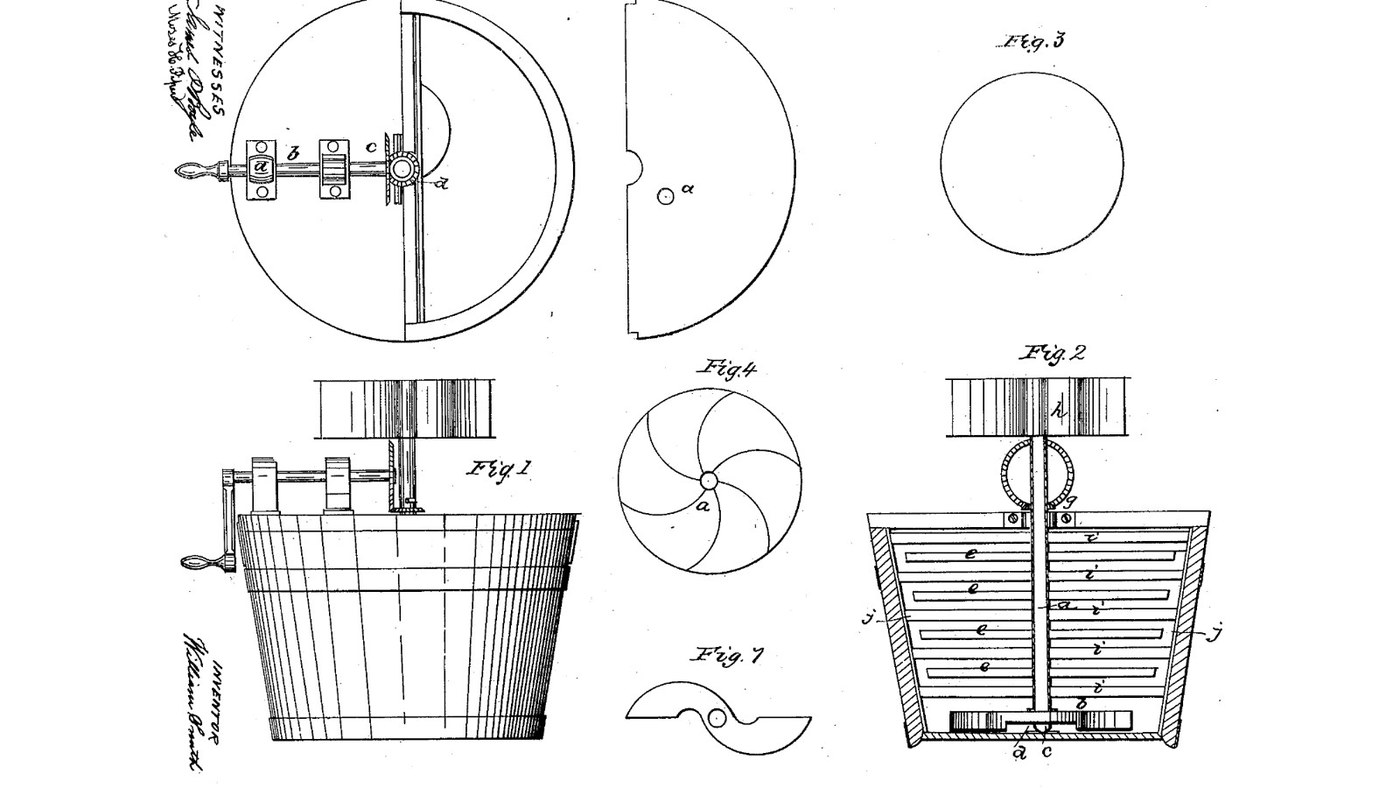
William Smith Hall of Quincy, Massachusetts, received US 24,934, dated 2 August 1859, for what he called the "Atmospheric Combination-Churn". A crank on the cover turns a hollow upright shaft three times as fast through a large wheel and a pinion. A fan on the shaft's top takes in air, which goes down the shaft and out through a hollow arm at the bottom, while solid paddles on the shaft swing the cream past a rack of fixed bars. This rung builds it in a 20-litre bucket with printed parts. Hall gives no sizes but the 3:1 wheel; every other size is ours.
Miðlungs
About 2 days, plus printing

Leiðbeiningar

1

When does air come out of the hollow arm?

Hleð Jupyter-vinnubók…
2

Air through the cream, before it

That churn pushed air down a hollow staff by hand. Hall's turns, and a fan feeds the air.
3

Read US 24,934

"By a rapid rotary motion of the hollow shaft from right to left, which is produced by the driving wheel being three times the size of the pinion, the air is forced into the fan down through the hollow shaft, while the curve of the hollow arm or paddle at the bottom of the shaft being in an opposite direction from the arms of the fan, a vacuum is created, which allows the air to be discharged, causing a vertical action on the milk or cream".
4

Print the hollow arm b

Two hollow half-discs (48 mm radius, 24 mm deep) on a hub that takes the 16 mm tube, their straight faces open on opposite sides as Fig. 7 draws, with the point c under the hub. Print it hub down with tree supports and pull them out through the open faces. PETG, 0.2 mm layers, 40 % infill, 4 walls.
HönnunarskráSTLCC0 - Free
5

Print the cup d

The 60 mm cup with a cone recess for the point, a trap for an M6 nut underneath and a groove for an O-ring about 30 mm across on a 2 mm cord. PETG, 0.2 mm layers, 40 % infill, 4 walls.
HönnunarskráSTLCC0 - Free
6

Print the paddles e

One solid paddle: a split hub for the 16 mm tube with an M5 clamp bolt, and a blade 24 mm tall reaching 96 mm. Print four. PETG, 0.2 mm layers, 40 % infill, 4 walls.
HönnunarskráSTLCC0 - Free
7

Print the pinion g

The 12-tooth spur pinion (module 2) with a hub, bored for the 16 mm tube and cross-drilled for a pin. PETG, 0.2 mm layers, 40 % infill, 4 walls.
HönnunarskráSTLCC0 - Free
8

Print the driving wheel c

The 36-tooth crown wheel (module 2, three times the pinion) with its hub, bored for the 12 mm crank shaft and cross-drilled for a pin. Print it teeth up. PETG, 0.2 mm layers, 40 % infill, 4 walls.
HönnunarskráSTLCC0 - Free
9

Print the fan's upper disc

The plain 160 mm disc (Fig. 3) with the six curved arms standing on it (Fig. 4). Print it disc down. PETG, 0.2 mm layers, 40 % infill, 4 walls.
HönnunarskráSTLCC0 - Free
10

Print the fan's lower disc

The 160 mm disc with the centre hole (Fig. 4, a) on a split hub that clamps to the tube's top with an M5 bolt, Hall's "screw". PETG, 0.2 mm layers, 40 % infill, 4 walls.
HönnunarskráSTLCC0 - Free
11

Cup d in the bucket's floor

Drill a 6.5 mm hole in the middle of the bucket's floor. Push an M6 nut into the cup's trap and lay the O-ring in its groove. Stand the cup over the hole and bolt it from underneath with a stainless M6 x 16 bolt and a washer, just tight enough to squeeze the O-ring. Fill the bucket with water to check it does not leak, then empty it.

Efni fyrir þetta skref:

20 lítra fata20 lítra fata1 stykki
SexkantboltaúrvalSexkantboltaúrval1 stykki
SexkantróSexkantró1 stykki
Flöt skinnaFlöt skinna1 stykki
O-hringurO-hringur1 stykki

Nauðsynleg verkfæri:

HleðsluborHleðslubor
BorasettBorasett
SkiptilykillSkiptilykill
VatnVatn
12

Hollow shaft a, arm b and paddles e

Cut the stainless tube 507 mm long and deburr both ends. Press it 26 mm into the hollow arm's hub and check you can blow through the tube and out of both open faces. Clamp the four paddles on the tube with their middles 80, 140, 200 and 260 mm above the bucket's floor, each turned 45 degrees from the one below, with stainless M5 bolts and lock nuts. Stand the arm's point in the cup.

Efni fyrir þetta skref:

Rör úr ryðfríu stáliRör úr ryðfríu stáli1 stykki
SexkantboltaúrvalSexkantboltaúrval4 stykki
Læsiró með nælonhringLæsiró með nælonhring4 stykki
PETG-þráðurPETG-þráður1 stykki

Nauðsynleg verkfæri:

FDM-þrívíddarprentariFDM-þrívíddarprentari
JárnsögJárnsög
Þjalir (handþjöl)Þjalir (handþjöl)
SkiptilykillSkiptilykill
MálbandMálband
13

Rack of bars i on uprights j

Cut two hardwood uprights 30 x 20 mm, 366 mm long, and four bars 200 x 20 x 12 mm. Glue and screw the bars between the uprights' faces at 110, 170, 230 and 290 mm up, so the rack is 260 mm wide. Lower it into the bucket beside the shaft, the bars' middle line 25 mm from the shaft, and turn the shaft by hand: every paddle must pass between two bars.

Efni fyrir þetta skref:

HarðviðarborðHarðviðarborð1 stykki
TrélímTrélím1 stykki
TréskrúfurTréskrúfur8 stykki

Nauðsynleg verkfæri:

HandsögHandsög
HleðsluborHleðslubor
BorasettBorasett
SandpappírSandpappír
MálbandMálband
14

Cover, journal f, chair and crank

Cut a 320 mm disc of 12 mm plywood and saw it in half. Notch the front half 24 mm across and the back half 50 mm across at the middle of the cut, as Fig. 6 draws, and bore a 24 mm air opening in the back half 90 mm from the middle. On the front half screw a hardwood block 80 x 56 x 30 mm over the notch, bored 17 mm for the tube, and two bearing blocks 44 x 30 mm, 110 mm tall, their near faces 45 and 115 mm from the middle, bored 12.6 mm through 90 mm up. Slide a 190 mm stainless rod through them for the crank shaft, pin the driving wheel on its inner end and a hardwood crank arm with a dowel handle 88 mm out on the other.

Efni fyrir þetta skref:

KrossviðarplataKrossviðarplata1 stykki
HarðviðarborðHarðviðarborð1 stykki
HarðviðartapparHarðviðartappar1 stykki
Stöng úr ryðfríu stáliStöng úr ryðfríu stáli1 stykki
TrélímTrélím1 stykki
TréskrúfurTréskrúfur6 stykki

Nauðsynleg verkfæri:

StingsögStingsög
HandsögHandsög
HleðsluborHleðslubor
Spaðabora-settSpaðabora-sett
BorasettBorasett
JárnsögJárnsög
MálbandMálband
15

Pinion g and fan h

Lay both cover halves on the bucket, the tube through the journal. Pin the pinion on the tube so its teeth mesh fully with the driving wheel, just above the journal. Glue the fan's two discs together, arms between, and clamp the fan on the tube's top. Turn the crank: the shaft turns three times for each turn, and you feel air drawn in at the fan's rim.

Efni fyrir þetta skref:

TrélímTrélím1 stykki
SexkantboltaúrvalSexkantboltaúrval1 stykki
Læsiró með nælonhringLæsiró með nælonhring1 stykki

Nauðsynleg verkfæri:

SkiptilykillSkiptilykill
HleðsluborHleðslubor
BorasettBorasett
16

The build in 3D

FreeCAD model of this build, cut open: the bucket, the cup and the hollow arm on the floor, the hollow shaft with four paddles passing between the rack of bars, the two-piece cover with its journal, chair and air opening, the driving wheel on the crank shaft turning the pinion, and the fan on top. The shaft was checked at 16 angles.
HönnunarskráBLENDCC0 - Free
17

Churn

Pour about 10 litres of heavy cream at about 15 °C into the bucket, checked with the thermometer, and put the cover on. Turn the crank steadily, faster than the notebook's lowest speed, and time it. Lift the back half now and then to look. When the butter comes, lift the shaft and rack out, pour off the buttermilk, wash the butter in cold water until it runs clear, work in a pinch of salt and weigh it.

Efni fyrir þetta skref:

RjómiRjómi10 l
Gróft sjávarsaltGróft sjávarsalt1 stykki
VatnVatn1 stykki

Nauðsynleg verkfæri:

Hitamælir með nema sem situr íHitamælir með nema sem situr í
SkeiðklukkaSkeiðklukka
Stafræn eldhúsvogStafræn eldhúsvog
Stór hrærskál úr ryðfríu stáliStór hrærskál úr ryðfríu stáli
18

Troubleshooting

Atmospheric churn troubleshooting.

Flow

Loading...
19

History and honest limits

**William Smith Hall** of Quincy, Massachusetts, US 24,934, 2 August 1859, "Churn". He claimed forcing a current of air through the milk or cream by the rotary fan combined with the upright hollow shaft, the rotary hollow and solid paddles and the stationary bars. He gives no sizes but the driving wheel three times the pinion, so every size here is ours: a crown wheel and pinion stand in for his wheel and pinion, and the fan, arm, paddles and rack are printed or cut to fit a 20-litre bucket. Our notebook is a rough upper-bound estimate, not a test.

Efni

17

Nauðsynleg verkfæri

16

Hönnunarskrár

8

CC0 opinbert ríki

Þessi teikning er gefin út undir CC0. Þér er frjálst að afrita, breyta, dreifa og nota þetta verk í hvaða tilgangi sem er, án þess að biðja um leyfi.

Studdu smiðinn með því að kaupa vörur í gegnum teikningu hans þar sem hann fær þóknun smiða sem seljendur ákvarða, eða búðu til nýja endurskoðun á þessari teikningu og tengdu hana sem tengingu í þinni eigin teikningu til að deila tekjum.

Umræða

(0)

Skrá inn til að taka þátt í umræðunni

Hleður athugasemdum...