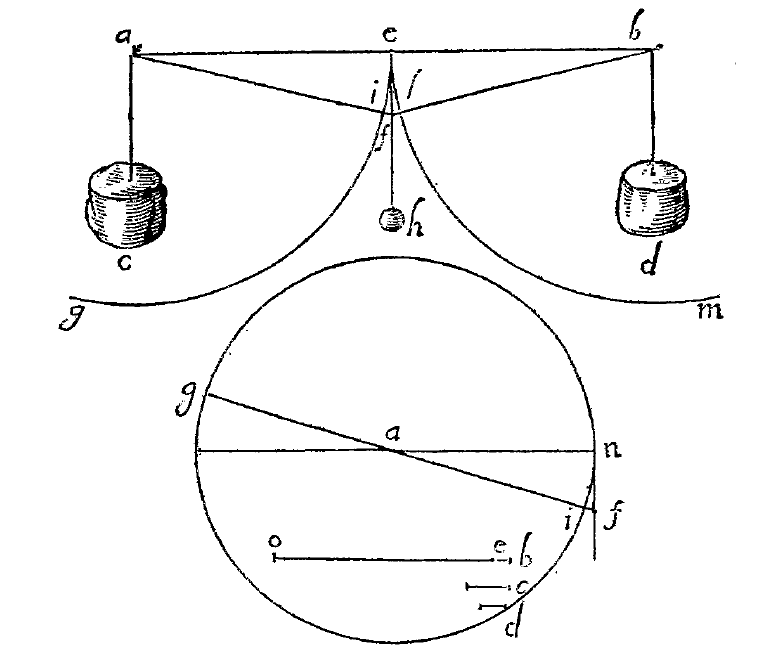


Hydrostatic Balance
You can find out what a metal object is made of without cutting it, melting it or marking it. Weigh it in air. Weigh it again hanging in water. The difference is the weight of the water it displaced, and weight in air divided by that difference is the material's density relative to water — its specific gravity. Gold gives about 19.3, silver about 10.5, and an alloy of the two lands in between.
This is the measurement behind the Archimedes story, and in 1586 a twenty-two-year-old Galileo built the instrument that makes it precise. His bilancetta was an equal-arm balance with a fine wire wound along one arm: instead of reading a position off a scale, you count turns of wire. Counting is exact where eyeballing a mark is not.
Build it, then test it against a known metal before you trust it on an unknown one.
Leiðbeiningar
Make the beam
Make the beam
Cut a straight wooden strip 400 x 15 x 8 mm. A beam that flexes under load spoils every reading, so choose a stiff, straight-grained piece.
Efni fyrir þetta skref:
 Lindiviðarplata1 stykki
Nauðsynleg verkfæri:
 Reglustika
Find and mark the exact centre
Find and mark the exact centre
Mark the midpoint of the beam and drill a fine hole through it for the pivot. Every millimetre of error here shows up as a constant bias in all your results.
Hang the beam on a low-friction pivot
Hang the beam on a low-friction pivot
Mount the beam on a thin nail or needle through the centre hole, resting in two notched uprights. Test it: a light tap should leave it swinging for several seconds.
Balance the empty beam
Balance the empty beam
Level the bare beam by sanding the heavy end or adding a scrap of tape to the light one. It must sit level before anything is hung on it.
Hang a pan on each end
Hang a pan on each end
Hang two identical light pans from equal distances, and rebalance if needed. Use thread rather than wire — thread is lighter and does not spring.
Efni fyrir þetta skref:
 Bómullarþráður2 metrar
Wind fine wire along one arm
Wind fine wire along one arm
Wind fine wire in tight touching turns along one arm, starting at the pivot. Sliding a rider along this winding lets you count turns instead of reading a scale — Galileo's actual innovation on the instrument.
Efni fyrir þetta skref:
 Grannur messingvír1 metri
Count turns per centimetre
Count turns per centimetre
Count the turns in 10 mm and write the number down. That figure converts a count of turns into a distance, which is what turns your balance into a measuring instrument.
Weigh the sample in air
Weigh the sample in air
Hang the object from one pan and balance it with weights or a rider. Record the reading as the weight in air.
Nauðsynleg verkfæri:
 Stafræn vog
Suspend the sample in water
Suspend the sample in water
Without changing anything else, lower the object on its thread into a beaker of water so it hangs fully submerged and touches neither the sides nor the bottom. Contact with the glass transfers weight and ruins the reading.
Brush off every air bubble
Brush off every air bubble
Check the object for clinging bubbles and brush them away. A single trapped bubble adds buoyancy and makes the sample read lighter than it is — the commonest source of error in this experiment.
Rebalance and record the submerged weight
Rebalance and record the submerged weight
Rebalance and record the second reading. The difference between the two is the weight of the water displaced.
Calculate the specific gravity
Calculate the specific gravity
Divide the weight in air by the loss of weight in water. That ratio is the specific gravity — no units, no calibration, and independent of how big the object is.
Check the instrument against a known metal
Check the instrument against a known metal
Measure something whose material you know — an aluminium block should give about 2.7, brass about 8.5, steel about 7.8. If your known sample reads wrong, the instrument is wrong, and no unknown result from it means anything.
Repeat five times and take the spread
Repeat five times and take the spread
Repeat the same measurement five times and record the highest and lowest values. The spread is your real precision, and quoting a result tighter than that spread is a false claim.
Test an alloy and read it against the table
Test an alloy and read it against the table
Now measure a coin or an unknown piece. Compare against pure values: gold 19.3, lead 11.3, silver 10.5, brass around 8.5, iron 7.9, aluminium 2.7. A result between two pure metals is consistent with an alloy of them — but a single density can match more than one mixture, so it narrows the answer without proving it.
Correct for water temperature
Correct for water temperature
Take the water temperature. Water is 1.000 g/cm³ near 4 °C and about 0.997 at 25 °C — a few parts in a thousand. It is negligible at this precision and it is exactly the kind of correction a real measurement has to account for, so note it rather than ignore it.
Nauðsynleg verkfæri:
 Eldhúshitamælir
Compendium — the crown, Galileo, and what the method can prove
Compendium — the crown, Galileo, and what the method can prove
The story everyone knows. Hiero of Syracuse suspected his goldsmith had adulterated a votive crown with silver, and asked Archimedes to test it without damaging it. The familiar version has Archimedes noticing the water rise in his bath and running through the streets. The displacement-volume method that story implies would need a very precise measurement of a small rise in water level — hard to do well even now.
Galileo's objection, and his instrument. In 1586, aged twenty-two, Galileo wrote La Bilancetta — "the little balance" — arguing that Archimedes, being Archimedes, would have used something far more exact than a water level, and proposing the balance method: weigh in air, weigh in water, take the ratio. His practical contribution was the wire wound along one arm, so the balance point could be found by counting turns rather than reading a mark. It is a genuinely clever piece of instrument design: it replaces an estimate with a count.
Why the ratio needs no calibration. Specific gravity is a ratio of two weights taken on the same instrument, so any constant error in the balance divides out. This is why the method works on a homemade beam and why it was trusted for centuries before standardised weights existed.
What it cannot tell you. Density identifies a material only if you already have a short list of candidates. Different mixtures can share a density, and a hollow object of a dense metal reads like a solid object of a lighter one — which is precisely how a fraudulent crown could be built to defeat the test if the goldsmith knew it was coming. Modern assay uses X-ray fluorescence or touchstone testing for that reason. The hydrostatic balance remains the fastest non-destructive first check, and it is still the standard demonstration of buoyancy because the physics is visible in the two readings.
Efni
3- 1 stykkiStaðgengill
- 2 metrarStaðgengill
- 1 metriStaðgengill
Nauðsynleg verkfæri
3- Staðgengill
- Staðgengill
- Staðgengill
Þessi teikning býr til
Tengd Blueprint
Þessi blueprint deila þekkingu — tækni, efni eða meginreglur

CC0 opinbert ríki
Þessi teikning er gefin út undir CC0. Þér er frjálst að afrita, breyta, dreifa og nota þetta verk í hvaða tilgangi sem er, án þess að biðja um leyfi.
Studdu smiðinn með því að kaupa vörur í gegnum teikningu hans þar sem hann fær þóknun smiða sem seljendur ákvarða, eða búðu til nýja endurskoðun á þessari teikningu og tengdu hana sem tengingu í þinni eigin teikningu til að deila tekjum.