Samvinna
LIST
FEGURÐ OG VELLÍÐAN
HANDVERK
MENNING OG SAGA
SKEMMTUN
UMHVERFI
MATUR OG DRYKKUR
ÖFUGVERKFRÆÐI
VÍSINDI
ÍÞRÓTTIR
TÆKNI
KLÆÐANLEG TÆKNI
Turning-Tub Churn: A Crank Spins the Tub on a Geared Pedestal Against Two Fixed Triangular Beaters Held From Standards
Buttercup

Búin til af

Buttercup

11. nóvember 2026IE
0
0
0
0
0

Turning-Tub Churn: A Crank Spins the Tub on a Geared Pedestal Against Two Fixed Triangular Beaters Held From Standards

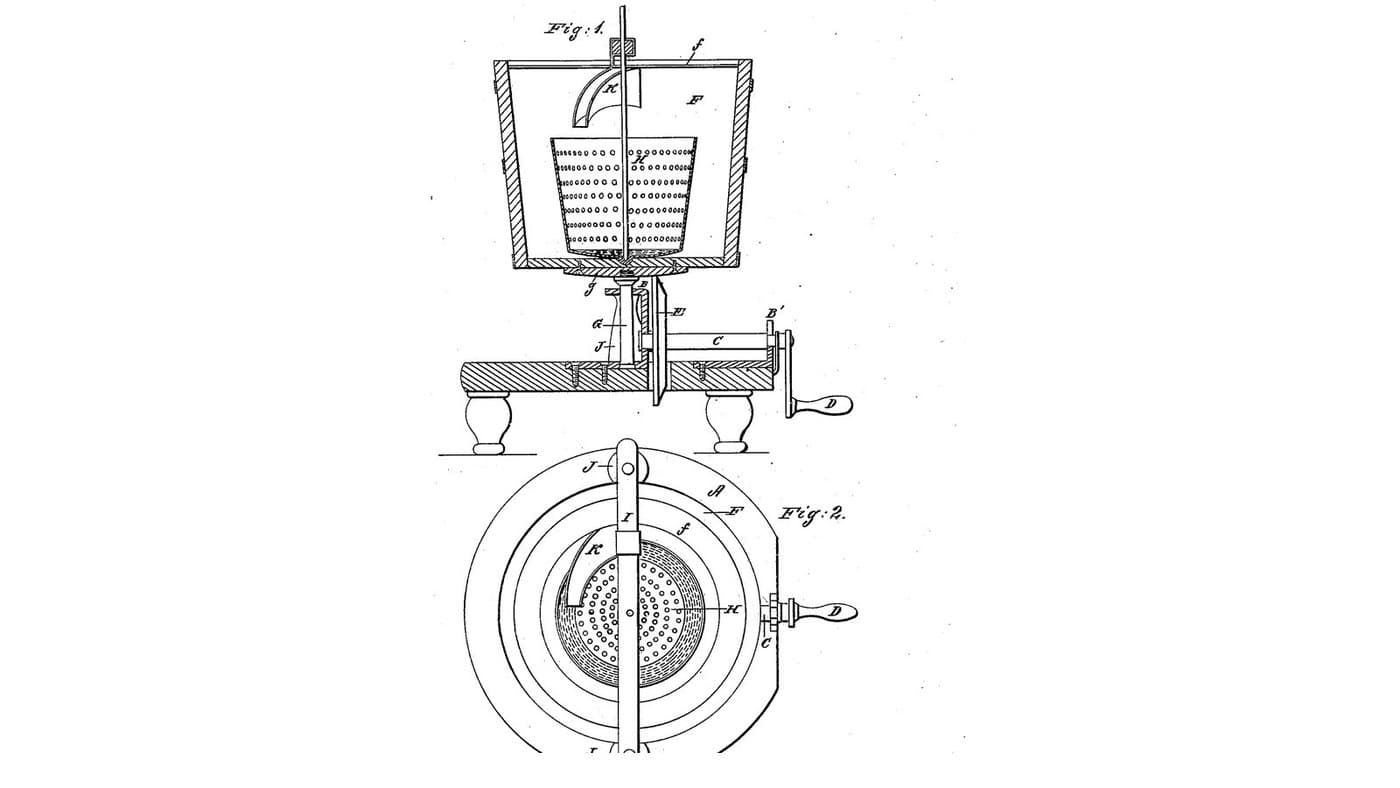
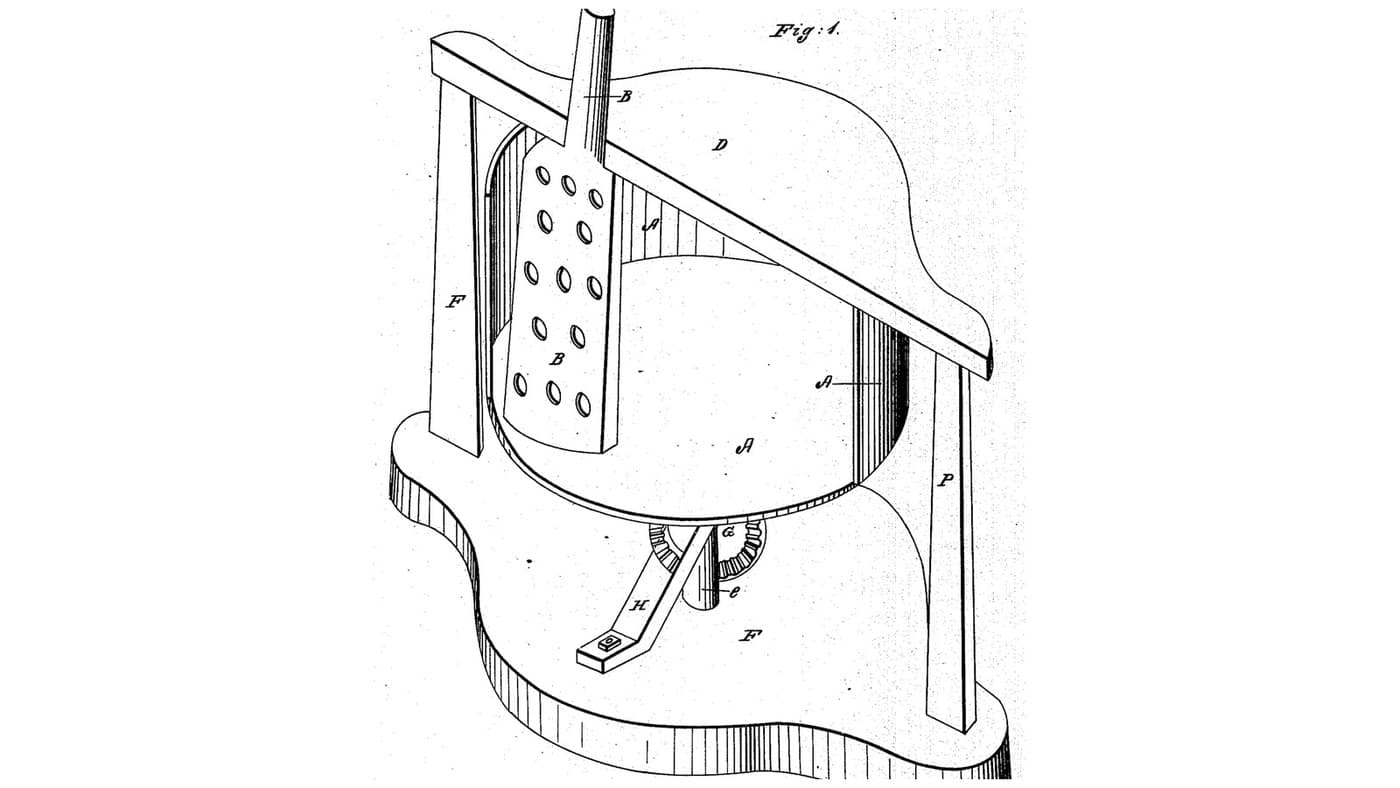
M. C. Longacre of Cleveland, Ohio, received US 31,355, dated 5 February 1861, for a churn that turns the tub instead of the dasher. A crank and bevel gears hidden in a drum on the base spin a disk on which the tub, or a common pail, stands. Two triangular wooden beaters, each with a hole along it for air, hang still inside the tub from arms on two standards and can be set nearer the wall or deeper. The tub throws the cream outward and the beaters throw it back. The patent gives no sizes; every size here is ours.
Lengra kominn
About 3 days

Leiðbeiningar

1

How fast to turn the tub

Hleð Jupyter-vinnubók…
2

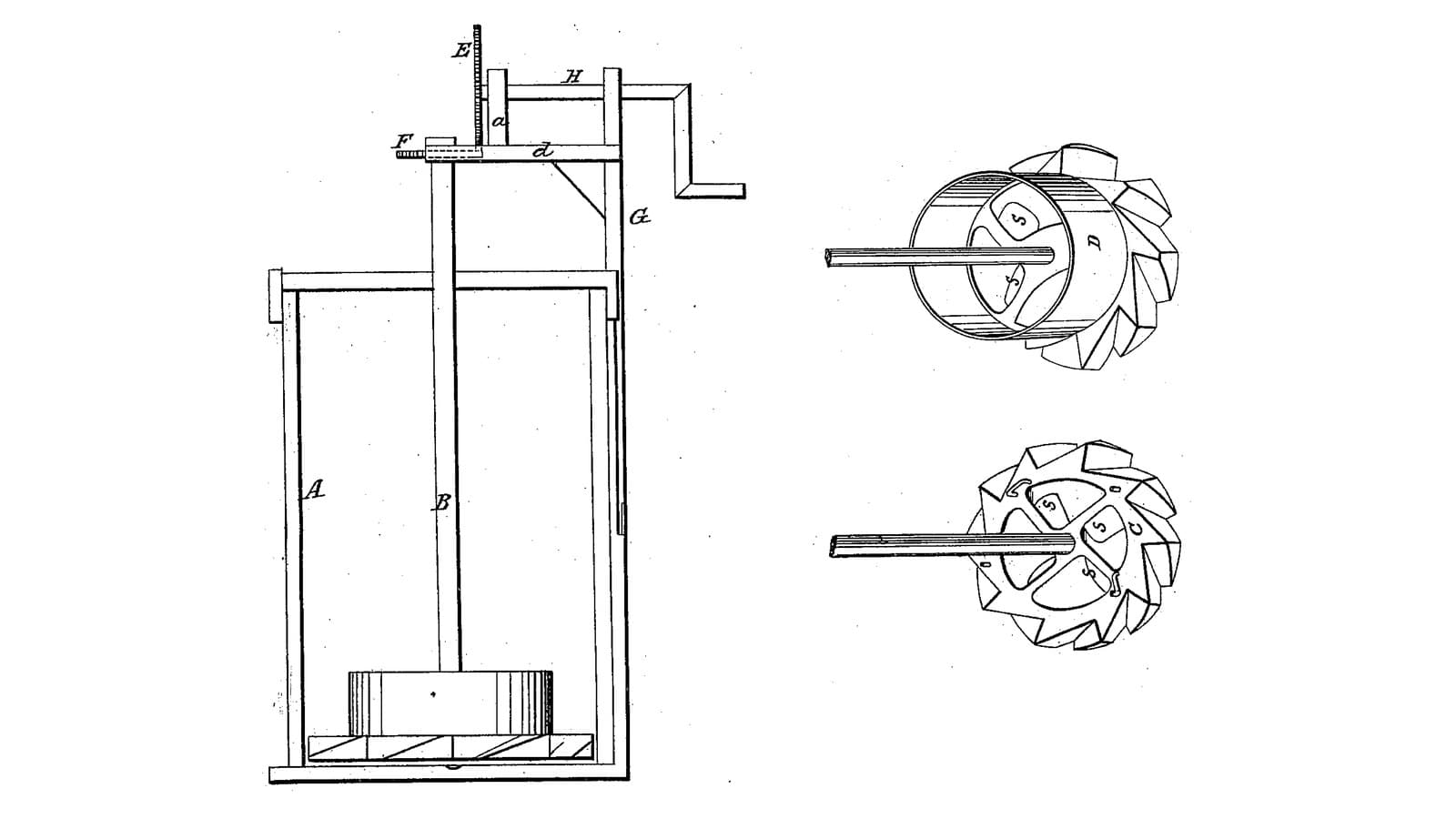
A turning vessel against a fixed break, a year and a half before

Harsha also turns the vessel against something fixed. Longacre stands the tub upright on a geared pedestal and makes the fixed beaters adjustable.
3

Read US 31,355

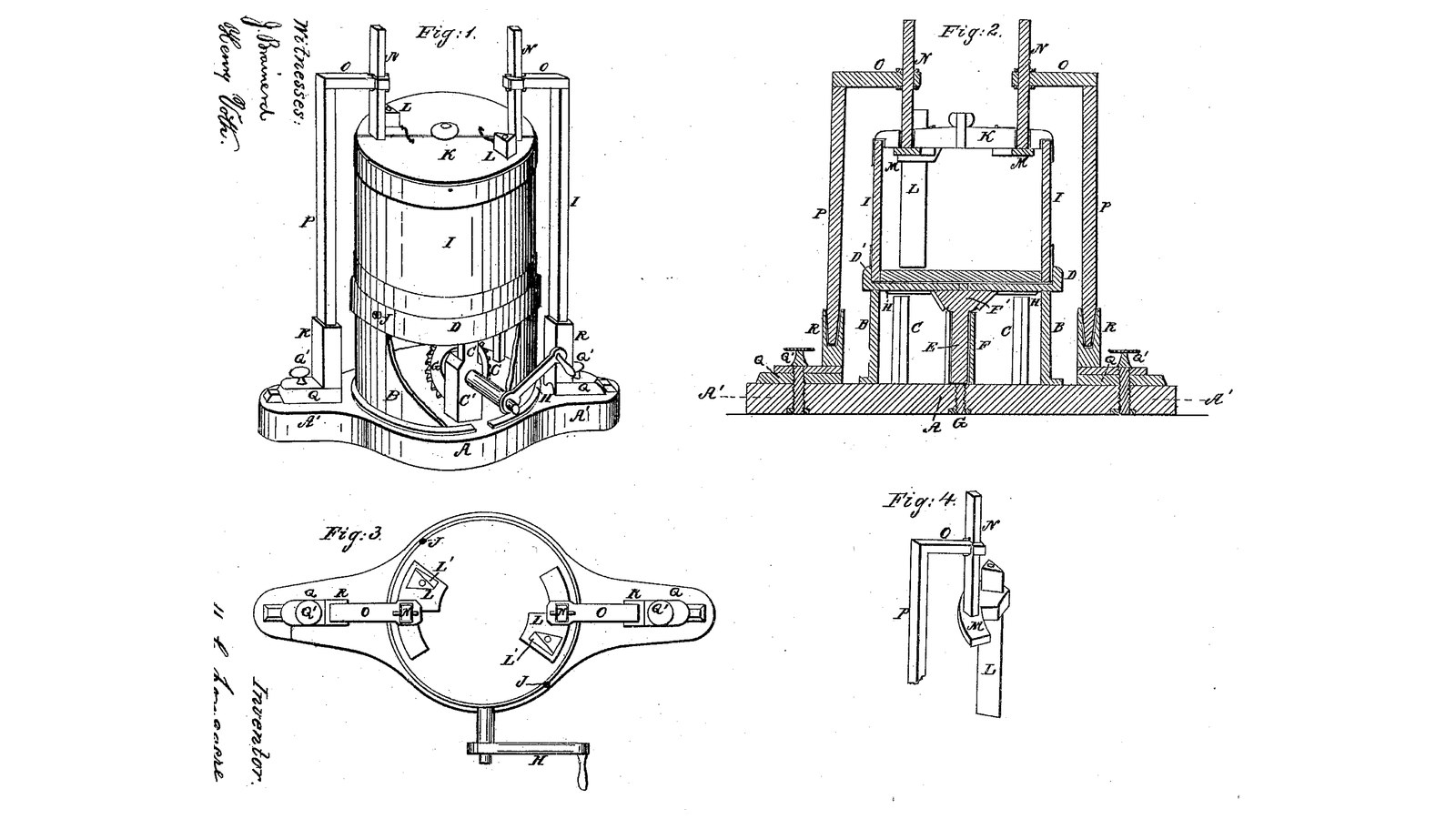
"Now, if the crank H is turned, the tub I, and disk D will receive a rotary motion, and the centrifugal force, tending to throw the fluid to the walls of the tub, the beaters at the same time tending to throw the same fluid back toward the center, the cream or milk has thus two forces constantly acting upon it, one a centrifugal, and the other a centripetal."
4

Base A, cylinder B and posts C

Glue up a hardwood base A 40 mm thick, a 400 mm circle with ends 120 mm wide running out to 700 mm overall. Cut a 30 mm slot 120 mm long along each end for the standards' feet. Roll a strip of 1.5 mm stainless sheet 168 mm wide into a cylinder B 310 mm across, rivet the lap, and screw it to the base through small tabs. Screw three hardwood posts C 40 mm square and 170 tall inside it, 110 mm from the centre and a third of a turn apart, the first at the back. Bore the cylinder 16.6 mm at the front, 97 mm up, for the crank shaft.

Efni fyrir þetta skref:

HarðviðarborðHarðviðarborð3 stykki
TrélímTrélím1 stykki
Plata úr ryðfríu stáliPlata úr ryðfríu stáli1 stykki
PoppnaglarPoppnaglar6 stykki
TréskrúfurTréskrúfur16 stykki

Nauðsynleg verkfæri:
BorðsögBorðsög
ÁttavitiÁttaviti
StingsögStingsög
HandfræsariHandfræsari
PlötuklippurPlötuklippur
PoppnaglabyssusettPoppnaglabyssusett
HleðsluborHleðslubor
BorasettBorasett
StangarþvingaStangarþvinga
SkrúfjárnasettSkrúfjárnasett
5

Print the cog wheel E'

The cog wheel E' on the spindle under the disk: 14 teeth, module 2.5, 16.2 mm bore, its hub up. PETG, 0.2 mm layers, 30 % infill, 4 walls.
HönnunarskráSTLCC0 - Free
6

Print the driving wheel G

The driving wheel G on the crank shaft: a crown wheel of 42 teeth, module 2.5, 16.2 mm bore. PETG, 0.2 mm layers, 30 % infill, 4 walls.
HönnunarskráSTLCC0 - Free
7

Step G, pipe box F, spindle E, gears and crank H

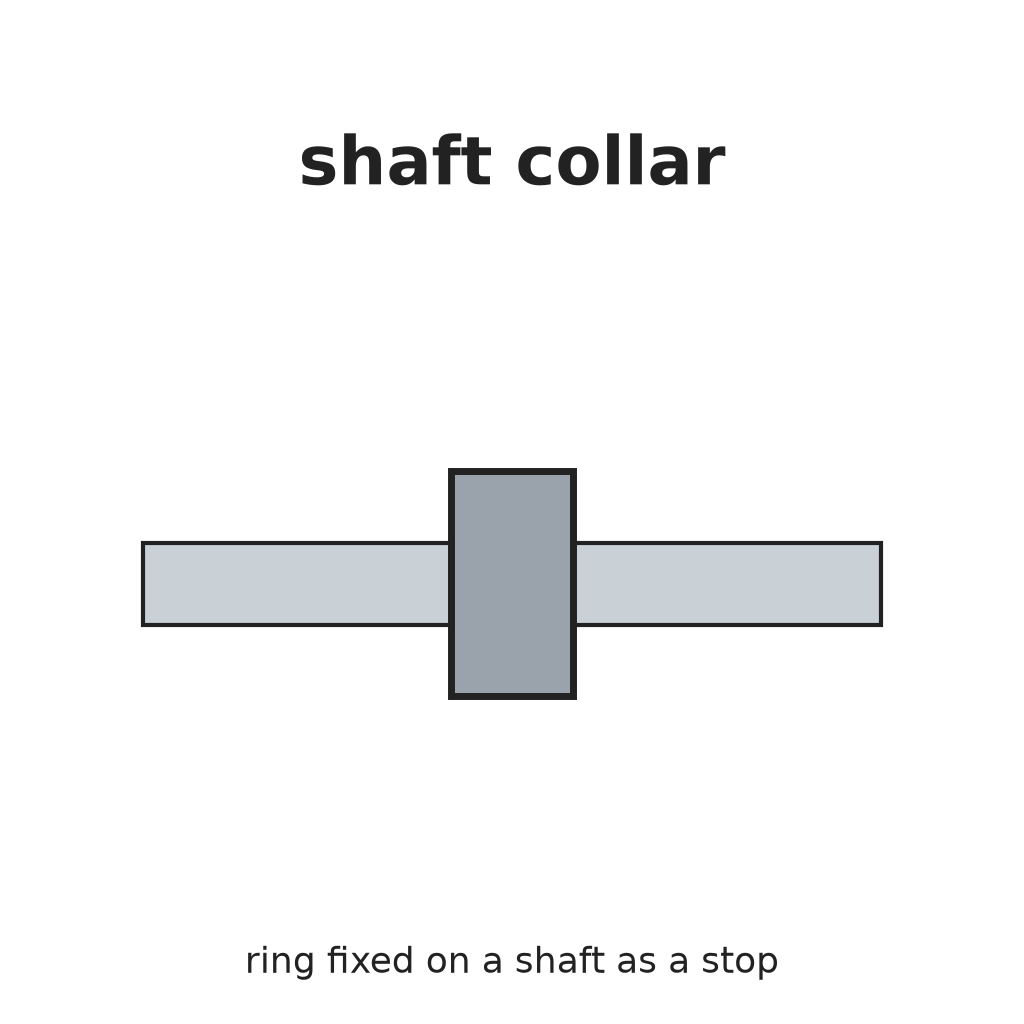
Bore the base's centre 8.4 mm and run an M8 bolt up through it with a nut each side, its head the step G, so it can be screwed up or down. Set a stainless tube F 30 mm long round it. Cut a 16 mm stainless spindle E 185 mm long; pin the cog wheel E' on it with its teeth 150 mm above the base. Screw a hardwood bearing block C' 40 x 25 x 120 mm to the base 55 to 80 mm in front of the centre, bored 16.6 mm across 97 mm up. Run a 16 mm stainless crank shaft 250 mm long through the cylinder and block, with the wheel G pinned on its inner end meshing E' from below and its end stopping clear of the spindle, a shaft collar against the block, and a crank H of mild steel flat bar, 100 mm throw, with a hardwood handle.

Efni fyrir þetta skref:

SexkantboltaúrvalSexkantboltaúrval1 stykki
SexkantróSexkantró2 stykki
Rör úr ryðfríu stáliRör úr ryðfríu stáli1 stykki
Stöng úr ryðfríu stáliStöng úr ryðfríu stáli2 stykki
HarðviðarborðHarðviðarborð1 stykki
Shaft CollarShaft Collar1 stykki
SplittiSplitti3 stykki
Flatstál úr mjúku stáliFlatstál úr mjúku stáli1 stykki
HarðviðartapparHarðviðartappar1 stykki
PETG-þráðurPETG-þráður1 stykki

Nauðsynleg verkfæri:

FDM-þrívíddarprentariFDM-þrívíddarprentari
HleðsluborHleðslubor
BorasettBorasett
JárnsögJárnsög
Þjalir (handþjöl)Þjalir (handþjöl)
SkrúfstykkiSkrúfstykki
SkiptilykillSkiptilykill
SkrúfjárnasettSkrúfjárnasett
8

Disk D, flange D', bead H and tub I

Cut an 18 mm HDPE disk D 330 mm across, bore it 16.2 mm at the centre and fix it on the spindle's top. Screw under it a bead H, an HDPE ring 230 mm across outside and 210 inside, 2 mm thick, and on top a flange ring D' 300 mm across outside and 282 inside, 15 high, that the bucket's foot just drops into. Screw the step G up until the bead just touches the posts' tops. Use a 20-litre food-grade bucket as the tub I; for the patent's set screws J, two machine screws through the flange bearing on the bucket's foot.

Efni fyrir þetta skref:

HDPE-plataHDPE-plata2 stykki
TréskrúfurTréskrúfur12 stykki
20 lítra fata20 lítra fata1 stykki
SexkantboltaúrvalSexkantboltaúrval2 stykki

Nauðsynleg verkfæri:

ÁttavitiÁttaviti
StingsögStingsög
Spaðabora-settSpaðabora-sett
HleðsluborHleðslubor
BorasettBorasett
SkiptilykillSkiptilykill
SkrúfjárnasettSkrúfjárnasett
9

Beaters L, supports M, stems N, arms O, standards P and cover K

Plane two hardwood beaters L to a triangle 40 mm a side, 330 long, and bore a 10 mm hole through each lengthwise for air. Cut two hardwood supports M 50 x 40 x 65 mm with a triangular socket below for a beater's top and a 20 mm square socket above for a stem; glue the beaters in. Cut two hardwood stems N 20 mm square, 170 long, and fit each in its support. Make two standards P 40 x 40 mm, 650 tall, each on a foot Q 60 x 80 x 20 mm with a carriage bolt down through the base's slot and a wing nut Q' under it, so the standards slide in and out; let each stand in a socket in its foot (R) so it lifts out. Fix a hardwood arm O 30 mm square across the top of each standard, reaching in to its stem, with a 20 mm square hole and a wing-nut clamp bolt so the stem can be set higher or lower. Cut an HDPE cover K 304 mm across in two halves, notched for the stems.

Efni fyrir þetta skref:

HarðviðarborðHarðviðarborð2 stykki
TrélímTrélím1 stykki
VagnboltiVagnbolti4 stykki
VængjahnetaVængjahneta4 stykki
Flöt skinnaFlöt skinna4 stykki
HDPE-plataHDPE-plata1 stykki

Nauðsynleg verkfæri:

BorðsögBorðsög
Stangajárnasett fyrir tréStangajárnasett fyrir tré
HleðsluborHleðslubor
BorasettBorasett
Spaðabora-settSpaðabora-sett
StingsögStingsög
SkiptilykillSkiptilykill
MálbandMálband
10

The build in 3D

FreeCAD model of this build, the drum, disk and tub cut open: the base with its slotted ends, the drum, posts and bearing block, the step, spindle, cog wheel and driving wheel with the crank, the disk with its bead and flange, the bucket, and the two beaters hanging from their supports, stems, arms and standards.
HönnunarskráBLENDCC0 - Free
11

Churn

Set the bucket in the flange and pour in about 8 litres of heavy cream at about 15 °C, checked with the thermometer. Set the beaters close to the wall and reaching near the bottom without touching, and lay on the cover halves. Turn the crank steadily, timing it, not so fast that the cream climbs to the rim. When the butter comes, keep turning a little so it gathers in a mass. Lift off the cover and beaters, lift the bucket off the disk, take out the butter, pour the buttermilk into a bowl, wash the butter in cold water until it runs clear, salt and weigh it.

Efni fyrir þetta skref:

RjómiRjómi8 l
Gróft sjávarsaltGróft sjávarsalt1 stykki
VatnVatn1 stykki

Nauðsynleg verkfæri:

Hitamælir með nema sem situr íHitamælir með nema sem situr í
SkeiðklukkaSkeiðklukka
Stafræn eldhúsvogStafræn eldhúsvog
Stór hrærskál úr ryðfríu stáliStór hrærskál úr ryðfríu stáli
12

Troubleshooting

Turning-tub churn troubleshooting.

Flow

Loading...
13

History and honest limits

**M. C. Longacre** of Cleveland, Cuyahoga County, Ohio, assignor to himself and R. R. Herrick, US 31,355, 5 February 1861, "Churn". He claimed "rotating the body of the churn in a vertical position by means of the disk (C) or its equivalent, when connected with the stationary dashers (L) arranged as described, for the purpose of adjusting the same both vertically and horizontally". His text uses the letters G and H each for two parts (the step and the driving wheel; the bead and the crank). His gears were bevel wheels; ours are a printed pinion and crown wheel, and our drum is stainless sheet. The patent gives no sizes; every size here is ours.

Efni

22

Nauðsynleg verkfæri

22

Hönnunarskrár

3

CC0 opinbert ríki

Þessi teikning er gefin út undir CC0. Þér er frjálst að afrita, breyta, dreifa og nota þetta verk í hvaða tilgangi sem er, án þess að biðja um leyfi.

Studdu smiðinn með því að kaupa vörur í gegnum teikningu hans þar sem hann fær þóknun smiða sem seljendur ákvarða, eða búðu til nýja endurskoðun á þessari teikningu og tengdu hana sem tengingu í þinni eigin teikningu til að deila tekjum.

Umræða

(0)

Skrá inn til að taka þátt í umræðunni

Hleður athugasemdum...