Samvinna
LIST
FEGURÐ OG VELLÍÐAN
HANDVERK
MENNING OG SAGA
SKEMMTUN
UMHVERFI
MATUR OG DRYKKUR
ÖFUGVERKFRÆÐI
VÍSINDI
ÍÞRÓTTIR
TÆKNI
KLÆÐANLEG TÆKNI
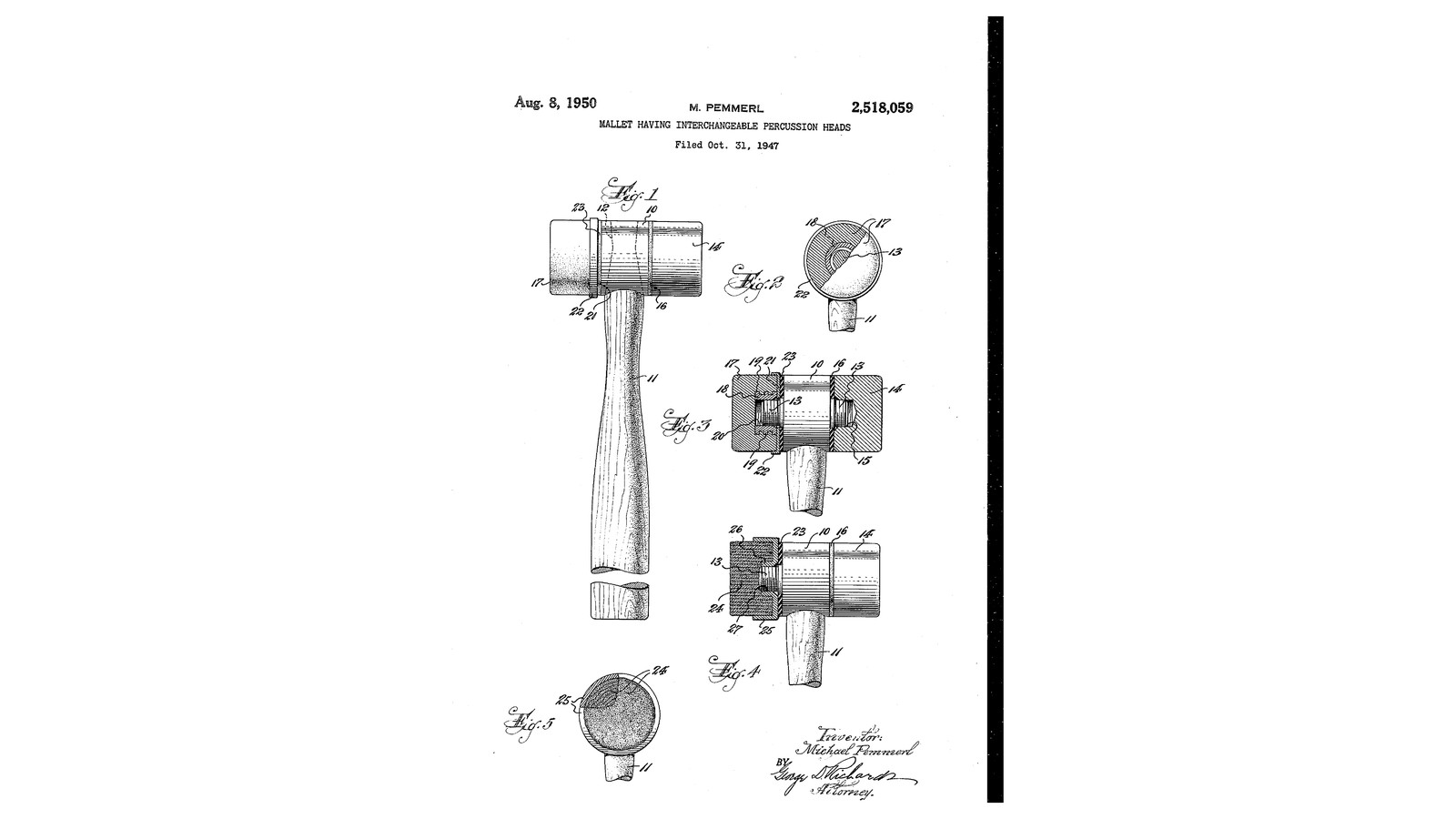


Screw-On Rubber Head Mallet: Rubber Members on Flanged Ferrules, Cupped and Cushioned on Steel Studs (Pemmerl, 1950)
Michael Pemmerl of Chatham, New Jersey, received US 2,518,059, dated 8 August 1950, for an industrial mallet with heads that change. A threaded stud stands out of each end of the steel head, and percussion members of different hardness screw on. A soft member is moulded round a hard ferrule with flanges and a threaded bore, so it cannot pull off. A steel cup holds its inner end from bulging. A thick rubber washer between cup and head stops it working loose and soaks up the shock before it reaches the hand.
We make two rubber members from rubber sheet bonded round a flanged nut. The sizes are ours.
Miðlungs
About 2 days
Leiðbeiningar
1
1
Building a rubber member round its ferrule
Building a rubber member round its ferrule
Hleð Jupyter-vinnubók…
2
2
Read US 2,518,059
Read US 2,518,059
"The frictional and cushioning washers 16 and 23, as interposed between the respective percussion members 14 and 17 and the mallet head 10, serve the two-fold purpose of setting up a strong frictional resistance against tendency of said percussion members to accidentally loosen or turn off the coupling studs 13 when the mallet is in use, while at the same time said washers act as impact shock absorbing means."
3
3
Turn the head 10
Turn the head 10
From 35 mm steel round bar turn a head 90 mm long between its end faces, and at each end a stud 13 12 mm across and 20 mm long; cut an M12 thread on each with the die. Drill a 20 mm eye through the middle, square to the axis, in a V-block, for the handle.
Efni fyrir þetta skref:
 Sívöl stöng úr mjúku stáli1 stykki
 Skurðarolía1 stykki
Nauðsynleg verkfæri:
 Málmrennibekkur
 Þríkjálka rennibekkspatróna
 Rennibekkjarstál
 Fráskurðarjárn
 Snittsett
 Snittbakkahaldari
 Skrúfstykki
 Súlubor
 V-kubbur
 Borasett
 Stafrænn skífmælir 6 tommur
 Öryggisgleraugu
4
4
Ferrules 18 and cups 21-22
Ferrules 18 and cups 21-22
For each member, saw an M12 coupling nut to 30 mm and lock a 24 mm washer on it 4 mm from each end with a nut and thread locker: the flanges 19 round the threaded bore 20. Turn two cups from 45 mm bar: a base 3 mm thick with a 13 mm hole, and a skirt 12 mm deep bored 40.5 mm to embrace the member's inner end.
Efni fyrir þetta skref:
 Sexkantró6 stykki
 Flöt skinna4 stykki
 Skrúfgengjalæsing1 stykkiSívöl stöng úr mjúku stáli1 stykki
Nauðsynleg verkfæri:
 JárnsögSkrúfstykki
 SkiptilykillMálmrennibekkurÞríkjálka rennibekkspatrónaRennibekkjarstál
 BorstöngFráskurðarjárnStafrænn skífmælir 6 tommur
5
5
Build the rubber members 17
Build the rubber members 17
Scribe and cut 4 mm rubber discs 40 mm across with the knife: for each member, seven holed to the ferrule (24 mm holes level with the two flanges and 22 mm round the nut, so the discs either side trap each flange's rim) and five solid discs for the striking face. Brush contact cement on both faces, let it go touch-dry, and build the member up over its ferrule, the ferrule's end flush with the member's inner end; press it in clamps overnight and trim it round.
Efni fyrir þetta skref:
 Náttúrugúmmíplata1 stykki
 Snertilím1 stykki
Nauðsynleg verkfæri:
 Áttaviti
 Föndurhnífur
 Stangarþvinga
6
6
Handle and assembly
Handle and assembly
Turn an ash handle 300 mm long, fit it in the eye with a glued wedge. Cut two 6 mm rubber washers 23, 40 mm across with 13 mm holes. On each stud put a rubber washer, then a cup, skirt outwards, then screw a member on until its end is in the cup and the washer is squeezed; it should take a firm twist to undo.
Efni fyrir þetta skref:
 Harðviðarborð1 stykki
 Trélím1 stykkiNáttúrugúmmíplata1 stykki
Nauðsynleg verkfæri:
 Trérennibekkur
 Rennijárnasett (HSS)Járnsög
 KúluhamarFöndurhnífur
7
7
Troubleshooting
Troubleshooting
Interchangeable-head mallet troubleshooting.
Flow
Loading...
8
8
History and honest limits
History and honest limits
**Michael Pemmerl** of Chatham, New Jersey, US 2,518,059, dated 8 August 1950, filed 31 October 1947. He claimed a mallet head with a screw-threaded coupling stud at an end, "a percussion member made of relatively soft material such as lead, an internally screw-threaded ferrule made of hard metal imbedded in said percussion member, said ferrule having external annular flanges", "a perforate cupped reenforcing member", and "a perforate rubber washer of substantial thickness" between cup and head. His soft members were moulded, and he names rubber among their materials; ours are rubber discs bonded round the ferrule. He also shows hard metal and rawhide members. He gives no sizes; every size here is ours.
Efni
9- 1 stykkiStaðgengill
- 1 stykkiStaðgengill
- 6 stykkiStaðgengill
- 4 stykkiStaðgengill
- 1 stykkiStaðgengill
- 1 stykkiStaðgengill
- 1 stykkiStaðgengill
- 1 stykkiStaðgengill
- 1 stykkiStaðgengill
Nauðsynleg verkfæri
21- Staðgengill
- Staðgengill
- Staðgengill
- Staðgengill
- Staðgengill
- Staðgengill
- Staðgengill
- Staðgengill
- Staðgengill
- Staðgengill
- Staðgengill
- Staðgengill
- Staðgengill
- Staðgengill
- Staðgengill
- Staðgengill
- Staðgengill
- Staðgengill
- Staðgengill
- Staðgengill
- Staðgengill
Þessi teikning býr til

Tengd Blueprint
Þessi blueprint deila þekkingu — tækni, efni eða meginreglur
CC0 opinbert ríki
Þessi teikning er gefin út undir CC0. Þér er frjálst að afrita, breyta, dreifa og nota þetta verk í hvaða tilgangi sem er, án þess að biðja um leyfi.
Studdu smiðinn með því að kaupa vörur í gegnum teikningu hans þar sem hann fær þóknun smiða sem seljendur ákvarða, eða búðu til nýja endurskoðun á þessari teikningu og tengdu hana sem tengingu í þinni eigin teikningu til að deila tekjum.