LIST
FEGURÐ OG VELLÍÐAN
HANDVERK
MENNING OG SAGA
SKEMMTUN
UMHVERFI
MATUR OG DRYKKUR
ÖFUGVERKFRÆÐI
VÍSINDI
ÍÞRÓTTIR
TÆKNI
KLÆÐANLEG TÆKNI


The Crossed-Bar Knife Sharpener: Two Steels Make a V
A pull-through sharpener sets the edge angle for you: two hard bars cross in a V, and the knife is drawn down through it.
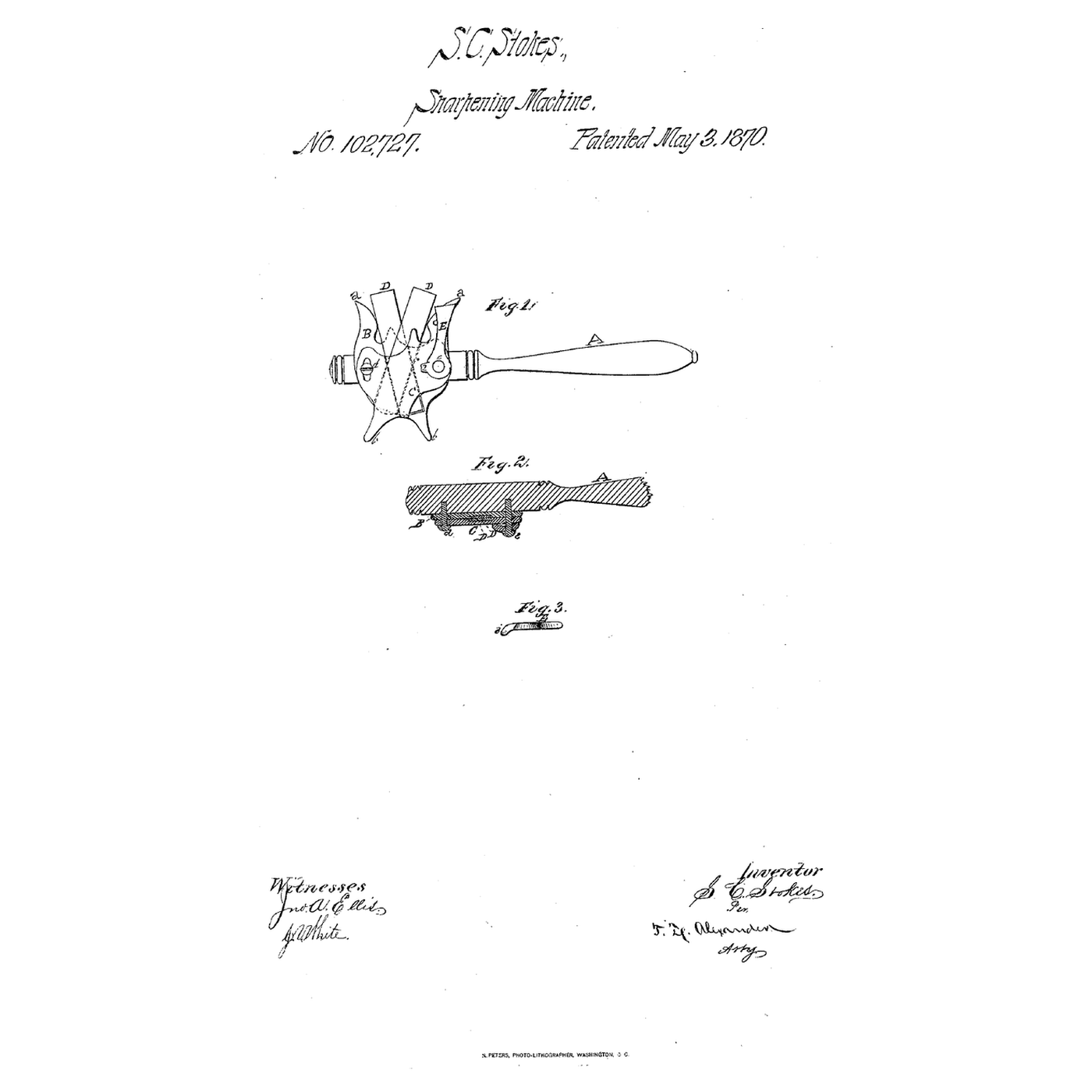
Septimus C. Stokes of Manchester, New Hampshire, received US 102,727, dated 3 May 1870, for a knife-sharpener with two plates pivoted on a handle, each carrying a steel bar in an inclined recess, so that "the bars cross each other, forming an angle in which to sharpen the knife", and a lever that locks "the plates and steel bars together" or frees them to be adjusted.
This rung works out how the V's angle trades sharpness against strength, then sets a V with two steel rods and tests the edge on paper.
Byrjandi
About 1 hour
Leiðbeiningar
1
1
Angle, thinness and push
Angle, thinness and push
Hleð Jupyter-vinnubók…
2
2
Which angle for which blade
Which angle for which blade
The embedded blueprint compares edge angles for razors, chisels, knives and axes; the sharpener fixes one of them.
3
3
Read US 102,727
Read US 102,727
"On the side of the handle A are attached two plates, B and C", "both pivoted to the handle by bolts or screws". "It will thus be seen that the two plates are pivoted in opposite edges, and that the projections or thumb-pieces a a and b b may be brought closer together or farther apart, as may be desired."
"On the outer face of the inner plate, B, and on the inner face of the outer plate, C, is an inclined recess, in which the steel bars D D are inserted. Said recesses running in opposite directions, the bars cross each other, forming an angle in which to sharpen the knife."
A lever E has a projection that, "when the lever is turned up in proper position", will "firmly lock the plates and steel bars together, while when the lever is turned down the plates are loosened, and the plates and bars may be adjusted as desired."
4
4
Set a V and test the edge
Set a V and test the edge
Clamp two round steel rods in the vise so they cross in a V, and set the angle between them with the protractor: start at 40 degrees.
Hold a kitchen knife upright and draw it down and back through the V ten times with light pressure. Slice a sheet of paper held by one corner and note how cleanly it cuts. Open the V to 60 degrees and repeat on the same knife. Look at the edge under the loupe after each and compare with the notebook: which cut better, and which edge looked more robust?
Efni fyrir þetta skref:
 Pappír2 plötur
 Hrástálsstöng2 stykki
Nauðsynleg verkfæri:
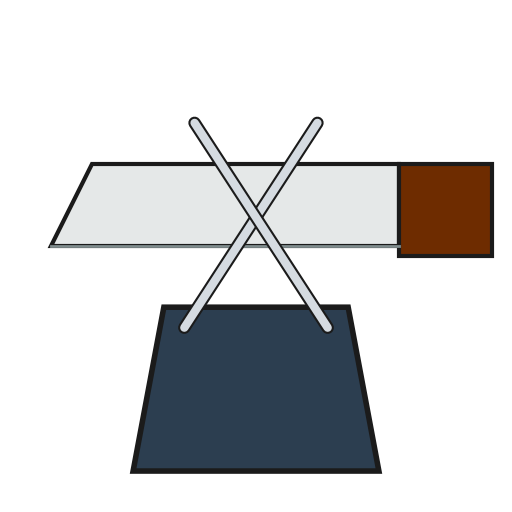 Hnífabrýni
 Eldhúshnífur
 Skrúfstykki
 Gráðubogi
 Stækkunarlúpa
5
5
An edge that stays dull, chips or goes ragged
An edge that stays dull, chips or goes ragged
Pull-through sharpener troubleshooting.
Flow
Loading...
6
6
History and honest limits
History and honest limits
**Septimus C. Stokes** of Manchester, New Hampshire, received US 102,727, dated 3 May 1870. His claims are the locking lever and the combination of handle, plates, bars and lever.
**Honest limits.** That the edge takes the V's angle is an approximation: how the knife is held and the bars' shape change it. The patent does not state the angle; the angles and the 0.1 mm distance in the notebook are examples. Your paper test is the measurement.
Nauðsynleg verkfæri
5- Staðgengill
- Staðgengill
- Staðgengill
- Staðgengill
- Staðgengill
Tengd Blueprint
Þessi blueprint deila þekkingu — tækni, efni eða meginreglur
CC0 opinbert ríki
Þessi teikning er gefin út undir CC0. Þér er frjálst að afrita, breyta, dreifa og nota þetta verk í hvaða tilgangi sem er, án þess að biðja um leyfi.
Studdu smiðinn með því að kaupa vörur í gegnum teikningu hans þar sem hann fær þóknun smiða sem seljendur ákvarða, eða búðu til nýja endurskoðun á þessari teikningu og tengdu hana sem tengingu í þinni eigin teikningu til að deila tekjum.