LIST
FEGURÐ OG VELLÍÐAN
HANDVERK
MENNING OG SAGA
SKEMMTUN
UMHVERFI
MATUR OG DRYKKUR
ÖFUGVERKFRÆÐI
VÍSINDI
ÍÞRÓTTIR
TÆKNI
KLÆÐANLEG TÆKNI
The Gramme Ring: A Continuous Winding for Steady Current
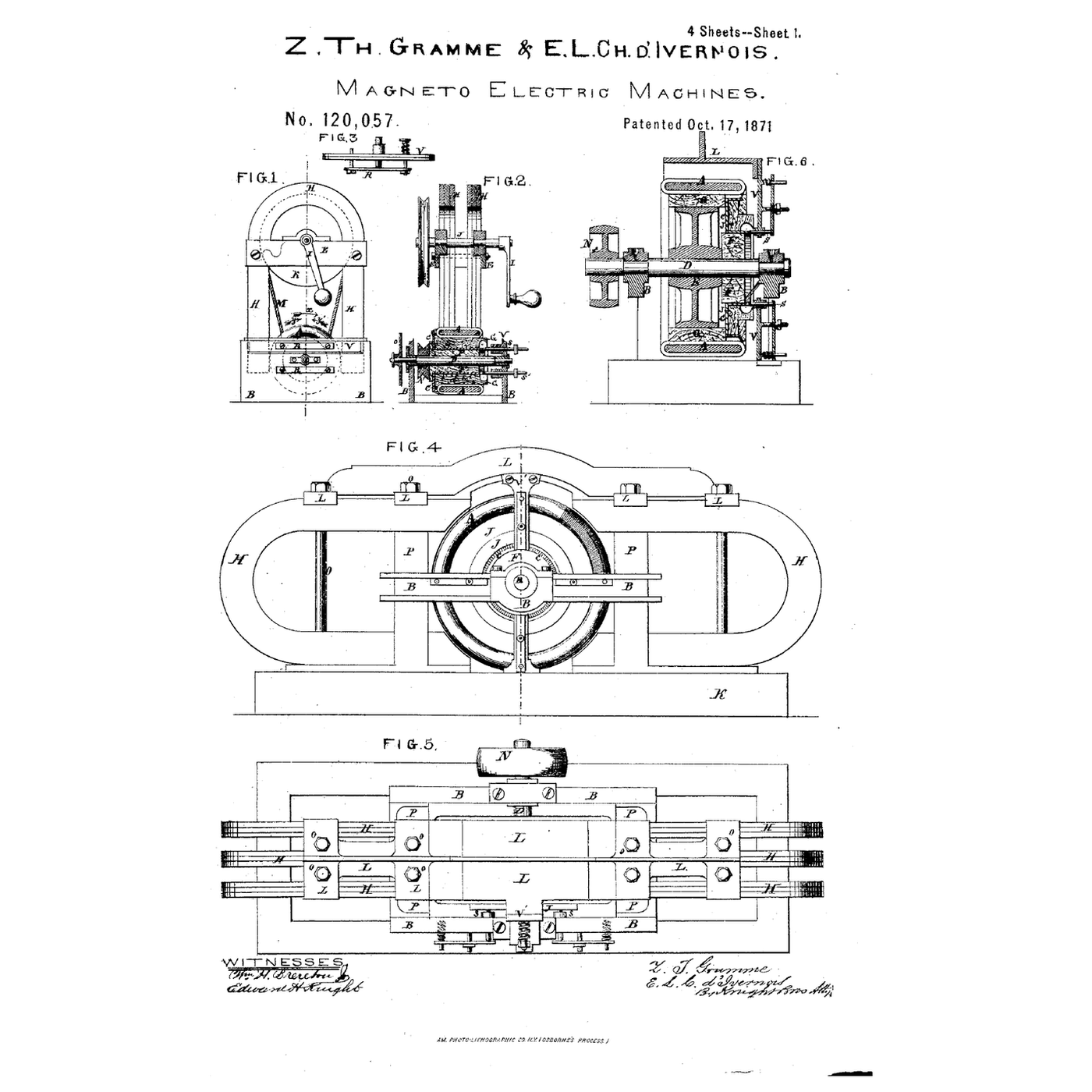
The first generators gave a current that pulsed with every half-turn. Zénobe Gramme, a Belgian working in Paris, wound his armature as a continuous coil round an iron ring, tapped at regular intervals to the segments of a commutator. At any moment many turns of the winding are cutting the field and adding together, so the current comes out nearly steady. His US patent of 1871 describes it as a 'magneto-electric machine'.
It was the first generator steady and strong enough for industry — electroplating, arc lighting — and, run backwards, it was one of the first practical electric motors.
This rung models how the ripple falls as the coils multiply, and winds a small ring armature with an eight-segment commutator.
Miðlungs
About 6 hours
Leiðbeiningar
1
1
Ripple against the number of coils
Ripple against the number of coils
Hleð Jupyter-vinnubók…
2
2
Wind a ring armature
Wind a ring armature
Print a ring 60 mm across with a 15 mm square section, on a hub that fits a steel shaft. Wind enamelled copper wire round the ring in eight equal coils of 40 turns each, all in the same direction and without cutting the wire between them: one continuous winding. At each junction between coils, pull out a loop and scrape its enamel.
Print a commutator drum on the shaft with eight strips of copper sheet glued round it, insulated from each other, and solder each junction loop to its own segment in order.
Efni fyrir þetta skref:
 PETG-þráður60 g
 Lakkeinangraður koparvír1 rúlla
 Koparplata1 plata
 Hrástálsstöng1 stykki
 Kúlulega2 stykki
Nauðsynleg verkfæri:
 FDM-þrívíddarprentari
 Sandpappírsúrval
 Stafrænn skífmælir 6 tommur
 Sexkantlyklasett
3
3
Spin it between magnets and measure
Spin it between magnets and measure
Mount the shaft in bearings in a plywood frame with neodymium magnets on either side of the ring, one north-facing and one south-facing. Bend two strips of copper as brushes to press on opposite segments, at the positions where the output is greatest (find them by turning the brushes round while measuring).
Spin the shaft with the cordless drill and read DC volts across the brushes. Switch the multimeter to AC volts: the reading is the ripple left on the DC. Now lift four adjacent junction loops off their segments, so the machine behaves as a coarser one, and read the AC ripple again — it rises.
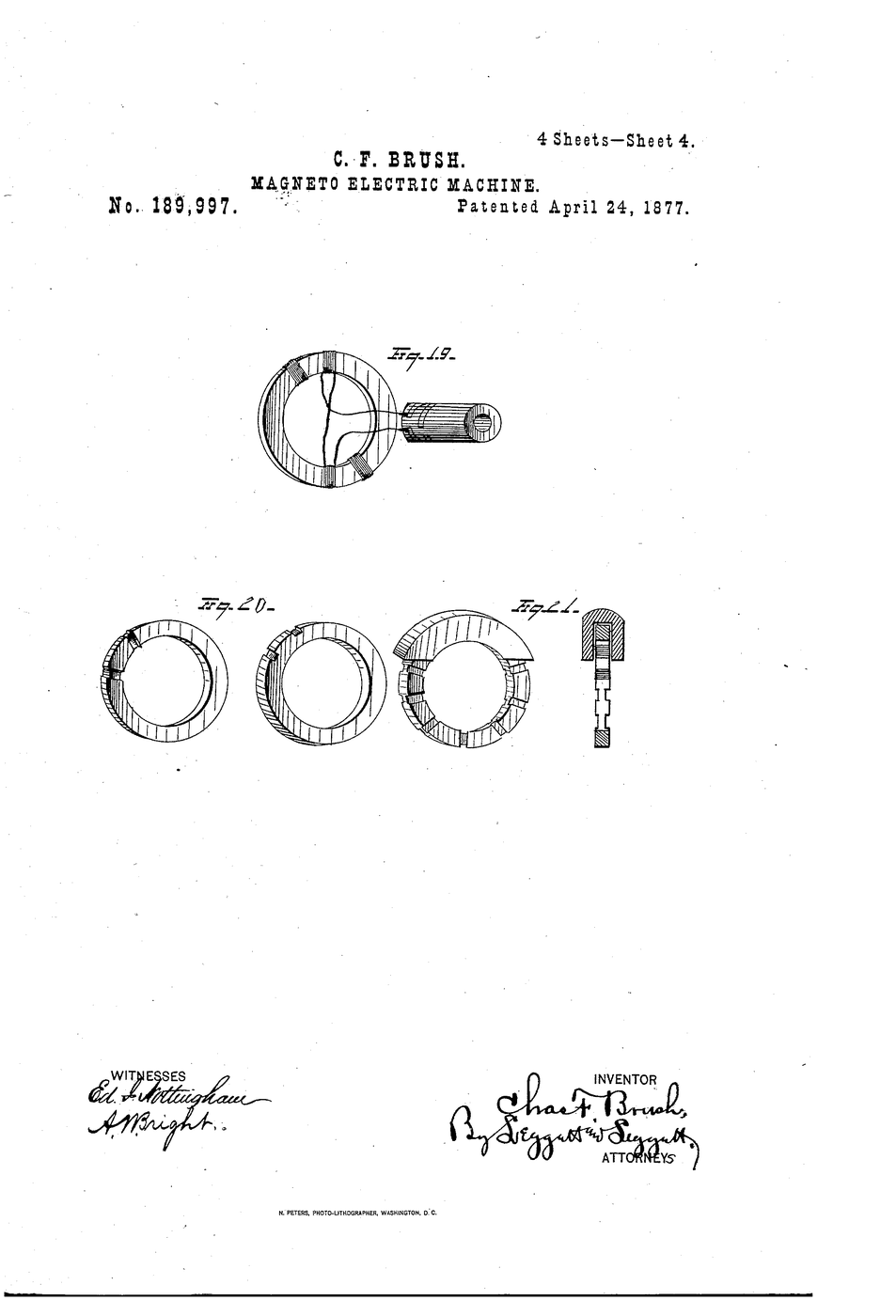
Compare with the two-segment Brush dynamo in this catalogue: same idea, fewer segments, more ripple.
Efni fyrir þetta skref:
 Neodym-seglasett1 sett
 Krossviðarplata1 plataKoparplata1 plata
Nauðsynleg verkfæri:
 Hleðslubor
 Fjölsviðsmælir
 Stafrænn snúningshraðamælir
 Tær öryggisgleraugu
4
4
History and context
History and context
**US 120,057, 'Magneto-Electric Machines', Zénobe Théophile Gramme and E. d'Ivernois, dated 17 October 1871.** Gramme's machines, built in Paris, supplied electroplating works and arc lighting in the 1870s; at the Vienna Exhibition of 1873 a Gramme machine was shown driving another as a motor.
The ring was later replaced by the drum armature, which puts all its copper in the field (on a ring, the turns inside the ring do no work), but the continuous, many-segment commutated winding is Gramme's.
**Honest limits.** The inner half of every turn on a ring is wasted copper. Commutators and brushes spark and wear. And a DC generator's voltage cannot be stepped up with a transformer, which is why alternating current won long-distance supply.
Efni
7- 60 gStaðgengill
- 1 rúllaStaðgengill
- 1 plataStaðgengill
- 1 stykkiStaðgengill
- 1 settStaðgengill
- 1 plataStaðgengill
Nauðsynleg verkfæri
8- Staðgengill
- Staðgengill
- Staðgengill
- Staðgengill
- Hleðslubor3% þóknunMagento Legacy Storeships internationallyStaðgengill
- Staðgengill
- Staðgengill
- Staðgengill
Tengd Blueprint
Þessi blueprint deila þekkingu — tækni, efni eða meginreglur
Brush Dynamo
eftir Emma
Orka
44
0
0
0
1
0

Building a Voltaic Pile — The First Battery and the Birth of Steady Electricity
eftir Gloin
Rafeindatækni
39
0
0
0
2
0
Hættulegt
Plante Lead-Acid Cell
eftir Volt
Orka
61
0
0
0
0
0
Using a Multimeter: Continuity, Volts, Ohms — and the Setting That Blows the Fuse
eftir Ed
Rafeindatækni
40
0
0
0
0
0
CC0 opinbert ríki
Þessi teikning er gefin út undir CC0. Þér er frjálst að afrita, breyta, dreifa og nota þetta verk í hvaða tilgangi sem er, án þess að biðja um leyfi.
Studdu smiðinn með því að kaupa vörur í gegnum teikningu hans þar sem hann fær þóknun smiða sem seljendur ákvarða, eða búðu til nýja endurskoðun á þessari teikningu og tengdu hana sem tengingu í þinni eigin teikningu til að deila tekjum.