LIST
FEGURÐ OG VELLÍÐAN
HANDVERK
MENNING OG SAGA
SKEMMTUN
UMHVERFI
MATUR OG DRYKKUR
ÖFUGVERKFRÆÐI
VÍSINDI
ÍÞRÓTTIR
TÆKNI
KLÆÐANLEG TÆKNI
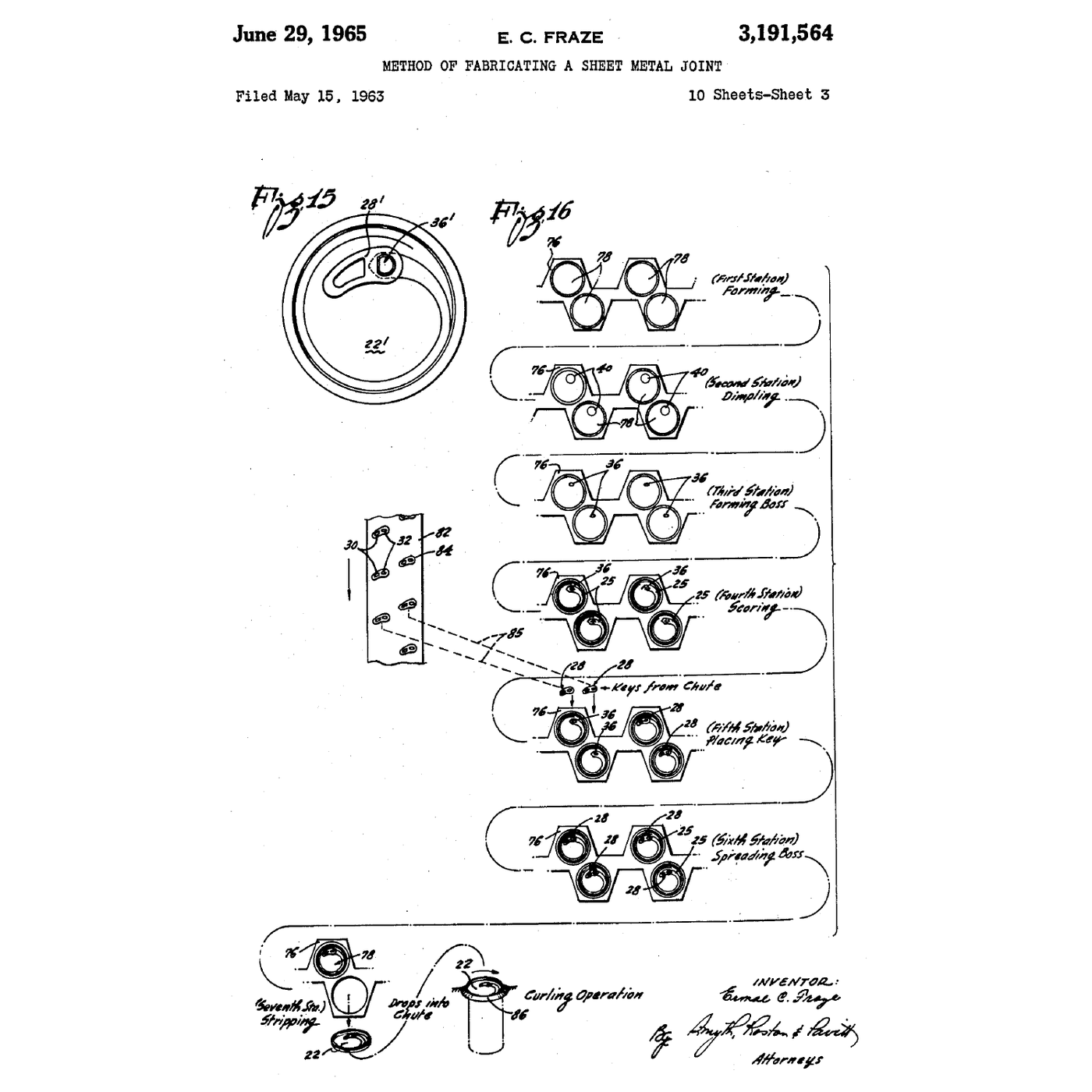


A Rivet Made of Nothing but the Sheet
To put a pull tab on a can you have to fasten it to the end. You cannot use a rivet, because a rivet is a second part with a hole under it, and a hole in a can end is a leak. You cannot spot weld it — the patent says that was tried and it failed the way spot welds have always failed. And you cannot simply punch a stud up out of the metal, because that had been tried too and the stud tore off.
Ermal Fraze's answer, patented in 1963, is to make the rivet out of the can end itself — and the real invention is not the rivet but where its metal comes from. Draw a boss from a narrow patch and the wall thins until it crushes. Draw the identical boss from a patch three times wider and it barely thins at all.
This rung is pure sheet metal: one part, no fasteners, no joint, and an argument that is entirely about conservation of volume.
Lengra kominn
About 4 hours
Leiðbeiningar
1
1
Read the claim, and the reason the prior art failed
Read the claim, and the reason the prior art failed
**US 3,191,564**, *Method of fabricating a sheet metal joint*, **Ermal C. Fraze** of 355 W. Stroop Road, Dayton, Ohio; filed **15 May 1963**, granted **29 June 1965**; 10 claims, US class 113-121. Expired. The drawing on this page is the patent's own sheet 3, showing six labelled forming stations.
The specification rules out the alternatives one by one, and each rejection is instructive:
- **A separate rivet** — *the use of a separate rivet or like fastener for securing a tab to the tear strip of a can top has been unsatisfactory*. It is a second part, and it needs a hole.
- **Spot welding** — proposed, *but [has] not been successful for reasons that have plagued spot weld connections for many years*.
- **A hollow rivet formed from the wall** — tried, and this is the interesting failure. *One cause of the failure of such a prior art hollow rivet is that in the usual fabrication procedure the total surface area of the finished rivet is so much greater than [the area from which it] is formed that the metal of the rivet is greatly [thinned]* — and then *the thin metal wall being crushed* when it is staked.
And here is the fix, in the patent's own words: the present invention *forms a hollow rivet out of* the wall while drawing *on a greater area of the container wall to form the hollow rivet and thus increase the ratio between the total area of the hollow rivet and the area of the portion of the container wall that is converted into the hollow rivet*.
Write that sentence out. It is the whole patent, it is pure conservation of volume, and step 5 turns it into a table.
2
2
Look at a real can end before you make anything
Look at a real can end before you make anything
Take the end off a drinks can — cut the double seam from rung 4 with snips and flatten the end out — and put it under the microscope. Everything in this rung is on it.
Find these, in this order:
1. **The rivet.** A small domed button near the centre. Run a fingernail round it: there is no join, no washer, no second part. It is the end's own metal.
2. **The countersink around it.** A shallow dish, considerably wider than the rivet. That is the *dimple* of station 1, and it is where the rivet's metal came from.
3. **The score line.** A groove pressed most of the way through the plate, outlining the opening. Measure what is left under it with the micrometer against the plate beside it — the residual is a fraction of the full thickness, and step 5 uses that number.
4. **The anti-fracture bead**, a second faint groove just outside the score, which stops a started tear from running away across the end.
Measure the rivet's diameter and height, and the diameter of the dished area round it. Put those three into step 5 and see what the ratio was — that is the number Fraze was fighting for, read off a can that cost nothing.
Cut ends are sharp and springy. Gloves, glasses, and flatten the end before you handle it.
Efni fyrir þetta skref:
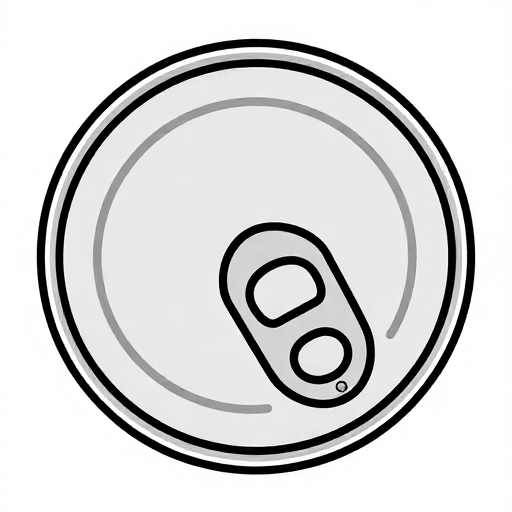 Áldós-lok á drykkjardós3 stykki
Nauðsynleg verkfæri:
 Plötuklippur
 Stafræn smásjá
 Míkrómetri
 Stafrænn skífmælir 6 tommur
 Gratáhald
 Tær öryggisgleraugu
 Vinnuhanskar úr leðri
 Rannsóknardagbók (með afriti)
3
3
Draw a boss the wrong way, and measure how thin it got
Draw a boss the wrong way, and measure how thin it got
Reproduce the prior art first, because the failure is the lesson.
Take a strip of 0.3–0.5 mm aluminium. Support it over a hole about 4 mm across in a steel plate — just larger than the boss you want — and press a round-nosed punch about 3 mm across into it with the arbor press. The metal has nowhere to draw from except the rim of that hole, which is exactly the prior art's mistake.
You will get a boss. Now section it: cut through it with a fine saw, file the face flat, polish, and measure the **wall thickness** at mid-height under the microscope. Compare with the plate beside it.
It will be dramatically thinner — step 5 predicts about a third of the original for a tight source area, and that is what the patent says happened.
Then do the part that makes the point: **stake it**. Press a flat punch down on the top of the boss to spread it into a head, as station 6 does. The thin wall will buckle, fold or split rather than spreading cleanly. That is the failure the patent is describing, reproduced on a bench in ten minutes.
Keep the sample.
Efni fyrir þetta skref:
 Álplata1 stykki
 Plata úr mjúku stáli1 stykki
Nauðsynleg verkfæri:
 Handpressa
 Vökvapressa
 Súlubor
 Körnunardorg
 Þjalir (handþjöl)Stafræn smásjáMíkrómetri
 SkrúfstykkiGratáhaldTær öryggisglerauguVinnuhanskar úr leðriRannsóknardagbók (með afriti)
 Lanólín
4
4
Now do it Fraze's way: dimple first
Now do it Fraze's way: dimple first
Same sheet, same punch, same finished boss. One extra operation in front of it.
**Station 1 — dimple.** Before anything is stood up, press a **shallow, wide dish** into the sheet with a large-radius former — 8 to 10 mm across for a 3 mm boss, and only a few tenths deep. Support the sheet on a matching wide-open die, or on a hard rubber pad using rung 7's trick. Nothing is being formed here in any obvious sense; you are moving metal inward from a wide area so it is available later.
**Station 2 — form the boss.** Now press the small punch into the centre of the dimple, over a close-fitting hole, exactly as in step 3.
**Station 3 — pierce.** Punch the top out of the boss so it is hollow.
**Stations 5 and 6 — place and spread.** Drop a small washer or a scrap tab over the boss, and press a flat punch onto it to spread the boss into a head over the tab.
Section this one too and measure the wall at mid-height. It should be markedly thicker than step 3's, and the head should have spread cleanly instead of buckling.
Put both sections side by side under the microscope and photograph them. This pair is the patent in two pictures.
Then pull the tab off. Note *where* it fails: with a decent wall it should tear the parent sheet rather than shear the rivet, which is the same 'the joint is no longer the weakest part' result that rung 5 arrived at from a completely different direction.
Efni fyrir þetta skref:
Álplata2 stykki Poppnaglar1 stykki
Nauðsynleg verkfæri:
HandpressaVökvapressa Gúmmípúði til mótunar
 GúmmíplataKörnunardorg
 HnoðhamarÞjalir (handþjöl)Stafræn smásjáMíkrómetriSkrúfstykkiGratáhaldTær öryggisglerauguVinnuhanskar úr leðriRannsóknardagbók (með afriti)Lanólín
5
5
Area ratio, wall thickness, and how deep to score
Area ratio, wall thickness, and how deep to score
Hleð Jupyter-vinnubók…
6
6
History and context
History and context
**Attribution.** US 3,191,564, *Method of fabricating a sheet metal joint*, Ermal C. Fraze of Dayton, Ohio; filed 15 May 1963, granted 29 June 1965, expired. The drawing on this page is the patent's own.
**A number that did not survive checking.** The patent usually attached to Fraze in popular accounts is **US 3,349,949**, the ring-shaped pull tab. Its own first page names the inventors as *O. L. Brown et al.*, not Fraze. It is a real patent and it is not his, and this blueprint does not assert it. Fraze's verified patent is the one above — and it is the better subject anyway, because the integral rivet is a **forming** invention while the ring tab is a shape.
**Why it mattered so much.** Before 1963 you opened a can of drink with a separate tool. Fraze's own account has him at a picnic without a church key, which may be tidied history, but the problem was real and the constraint was brutal: any fastening had to be made from the end's own metal, at thousands of cans a minute, without a hole and without a weld. Every part of the modern can end — the dimple, the score, the anti-fracture bead, the stay-on tab that came later — descends from solving it.
**The principle to keep.** *Thinning is an area ratio.* Any time you draw, spin, stretch or emboss sheet, the finished surface area divided by the area it came from tells you the thickness you will end with, and nothing else does. A part that splits in forming is almost always a part whose metal was asked to come from too small a patch — and the fix is usually to open up where it is drawn from, not to press harder.
**Honest limits.** A bench version of this will not match a production end: commercial tooling runs several stations in one press stroke with precise blank holding, and the residual under the score is held to a few hundredths of a millimetre. Do not use a hand-made scored end on anything pressurised — the whole point of a score is that it is a controlled weakness, and an uncontrolled one is a projectile. And the integral rivet suits thin ductile sheet; in steel of any real thickness a separate fastener from the fastener-choosing rung is still the right answer.
Efni
4- 3 stykkiStaðgengill
- 2 stykkiStaðgengill
- 1 stykkiStaðgengill
- 1 stykkiStaðgengill
Nauðsynleg verkfæri
18- Staðgengill
- Staðgengill
- Staðgengill
- Staðgengill
- Staðgengill
- Staðgengill
- Staðgengill
- Rannsóknardagbók (með afriti)10% þóknunStaðgengill
- Staðgengill
- Staðgengill
- Staðgengill
- Staðgengill
- Staðgengill
- Staðgengill
- Staðgengill
- Staðgengill
- Staðgengill
- Staðgengill
Tengd Blueprint
Þessi blueprint deila þekkingu — tækni, efni eða meginreglur

CC0 opinbert ríki
Þessi teikning er gefin út undir CC0. Þér er frjálst að afrita, breyta, dreifa og nota þetta verk í hvaða tilgangi sem er, án þess að biðja um leyfi.
Studdu smiðinn með því að kaupa vörur í gegnum teikningu hans þar sem hann fær þóknun smiða sem seljendur ákvarða, eða búðu til nýja endurskoðun á þessari teikningu og tengdu hana sem tengingu í þinni eigin teikningu til að deila tekjum.