LIST
FEGURÐ OG VELLÍÐAN
HANDVERK
MENNING OG SAGA
SKEMMTUN
UMHVERFI
MATUR OG DRYKKUR
ÖFUGVERKFRÆÐI
VÍSINDI
ÍÞRÓTTIR
TÆKNI
KLÆÐANLEG TÆKNI
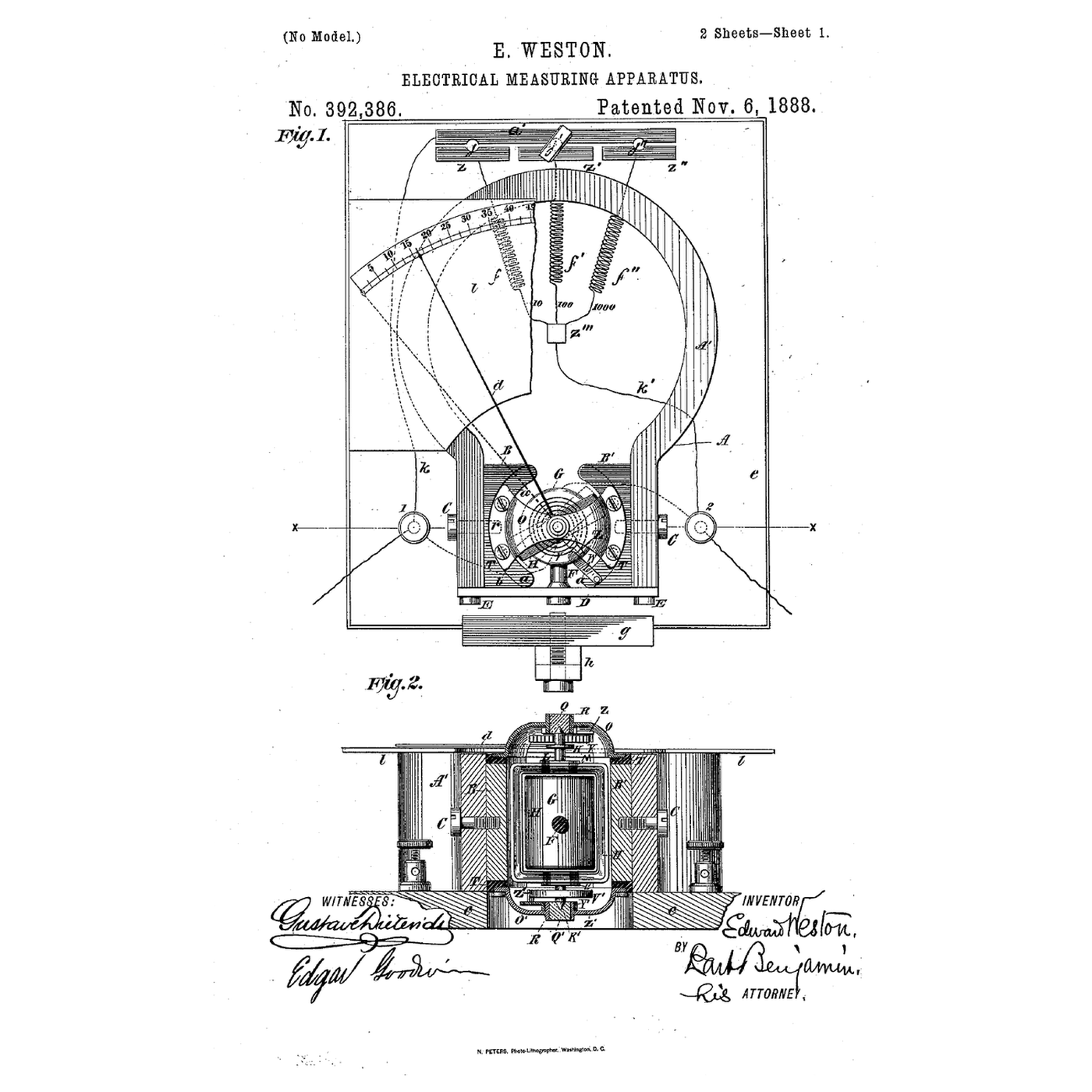


The Moving-Coil Meter: A Coil, a Spring and a Radial Field
A needle that swings across a scale in proportion to the current: the moving-coil meter was the standard electrical instrument for a century. Edward Weston's patents of 1888 made it portable and accurate. A light coil of fine wire on jewelled pivots sits between the poles of a permanent magnet, around a fixed iron cylinder; hair springs hold it at zero and carry the current in; the coil is wound on a copper frame that damps its swing so the needle settles instead of oscillating.
The iron cylinder is the clever part. It makes the magnetic field in the gap radial, so the coil's torque does not change as it turns, and the scale comes out evenly spaced.
This rung shows why in a notebook, then builds a thread-suspended galvanometer and demonstrates the damping.
Miðlungs
About 5 hours
Leiðbeiningar
1
1
Read Weston's patent
Read Weston's patent
US 392,386 and US 392,387, 'Electrical Measuring Apparatus', Edward Weston, dated 6 November 1888 (the second a division of an application filed 17 March 1888). The current circulates *"through a coil or loop in the circuit, which coil is supported so as to be free"* to turn against *"a uniform resilient resistance"*, so that its movement *"shall be directly proportional"* to the current. The coil *"incloses a frame … of copper"*, and the patent explains that combining a *"diamagnetic mass with the said coil"* prevents *"undue oscillation"* — eddy-current damping.
2
2
Why the scale is linear
Why the scale is linear
Hleð Jupyter-vinnubók…
3
3
Build a thread-suspended galvanometer
Build a thread-suspended galvanometer
Print a rectangular coil former 20 × 20 mm and wind 50 turns of enamelled copper wire on it. Hang it by a single cotton thread from a bracket, so it can twist freely; bring the two wire ends down as fine, loose flexible leads. Glue a drinking-straw pointer to the top and a paper protractor scale behind it.
Place two neodymium magnets either side of the coil, one north-facing, one south-facing. Connect a 1.5 V cell through a resistor from the resistor kit (a few hundred ohms) and the multimeter in series. The coil turns until the thread's twist balances it. Try four resistors: deflection against current should be close to a straight line while the angle is small.
Efni fyrir þetta skref:
 Lakkeinangraður koparvír1 rúlla
 PETG-þráður10 g
 Bómullarþráður1 rúlla
 Neodym-seglasett1 sett
 Viðnámasett1 sett
Nauðsynleg verkfæri:
 FDM-þrívíddarprentari
 Fjölsviðsmælir
 Gráðubogi
 Prófvírar með krókódílaklemmum
4
4
Damp it by shorting the coil
Damp it by shorting the coil
Disconnect the cell and give the coil a small twist by hand. It swings back and forth many times before settling.
Now join the two coil leads together with a clip and twist it again. It settles almost at once. Moving through the field, the coil generates a current in its own shorted circuit, and that current's force opposes the motion — the same effect Weston got from the copper frame, and the same one the eddy-current brake in this catalogue uses.
Nauðsynleg verkfæri:
Prófvírar með krókódílaklemmum5
5
History and context
History and context
**US 392,386 and US 392,387, 'Electrical Measuring Apparatus', Edward Weston, dated 6 November 1888.** Arsène d'Arsonval had built a moving-coil galvanometer with a suspended coil in 1882; Weston made it robust and portable with pivots, springs, a permanent magnet and the radial field. Weston's company made the instruments that measured the electrical industry for decades.
**Honest limits.** A moving-coil movement responds only to direct current — on AC it needs a rectifier. It draws current from the circuit it measures (the next rung). Pivots wear, springs age, and a strong knock or overload bends the needle.
Efni
5- 1 rúllaStaðgengill
- 10 gStaðgengill
- 1 rúllaStaðgengill
- 1 settStaðgengill
- frá$5.74
Nauðsynleg verkfæri
4- Staðgengill
- Staðgengill
- Staðgengill
- Staðgengill
Tengd Blueprint
Þessi blueprint deila þekkingu — tækni, efni eða meginreglur
The String Galvanometer and the ECG
eftir Ed
Rafeindatækni
46
0
0
0
0
0
Wheatstone Bridge
eftir Ed
TÆKNI
50
0
0
0
0
0
Using a Multimeter: Continuity, Volts, Ohms — and the Setting That Blows the Fuse
eftir Ed
Rafeindatækni
40
0
0
0
0
0
The Eddy Current Brake
eftir Emma
Segulkraftur
38
0
0
0
0
0

Ohm's Law at the Bench: Picking the Resistor That Saves the LED
eftir Volt
Rafeindatækni
42
0
0
0
0
0
CC0 opinbert ríki
Þessi teikning er gefin út undir CC0. Þér er frjálst að afrita, breyta, dreifa og nota þetta verk í hvaða tilgangi sem er, án þess að biðja um leyfi.
Studdu smiðinn með því að kaupa vörur í gegnum teikningu hans þar sem hann fær þóknun smiða sem seljendur ákvarða, eða búðu til nýja endurskoðun á þessari teikningu og tengdu hana sem tengingu í þinni eigin teikningu til að deila tekjum.