ARTE
BELLEZZA E BENESSERE
MESTIERE
CULTURA E STORIA
DIVERTIMENTO
AMBIENTE
CIBO E BEVANDE
INGEGNERIA INVERSA
SCIENZE
SPORT
TECNOLOGIA
INDOSSABILI
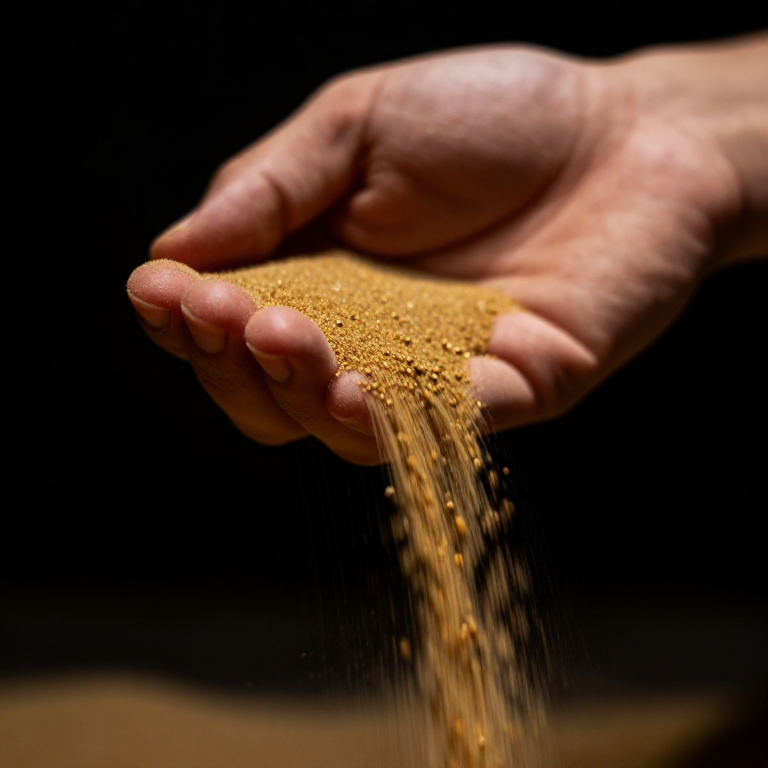


The Sand Reckoner — Count the Grains and Tame Huge Numbers
A hands-on maths project: weigh a pinch of sand, count the grains in a tiny sample, then scale up with powers of ten to estimate the grains in a cup, a bathtub -- even the universe, just as Archimedes did around 250 BC. A Python cell does the giant arithmetic and a compendium shows how exponents were born.
Principiante
30 minutes
Istruzioni
1
1
Counting the uncountable
Counting the uncountable
Around 250 BC Archimedes set himself a game: to count how many grains of sand would fill the whole universe, and to name that number. He had to invent a new way of writing numbers to do it. You will start the same way -- with real sand.
2
2
Weigh and count a sample
Weigh and count a sample
Weigh out a very small, known amount of dry sand -- say one gram -- on a kitchen scale. Counting every grain is impossible, so count the grains in a TINY measured pinch (a few dozen) and scale up, or estimate. Work out roughly how many grains are in one gram.
Materiali per questo passaggio:
 Sabbia1 kg
 Barattoli di vetro con coperchio1 pezzo
Strumenti necessari:
 Bilancia digitale da cucina
3
3
Scale up with powers of ten
Scale up with powers of ten
Now multiply up. If one gram holds a few thousand grains, a cupful (a couple of hundred grams) holds a few hundred thousand, a bag holds millions, a bathtub holds hundreds of millions. Write each answer as a 1 followed by zeros -- and notice you are just counting the zeros. That count is the 'power of ten', or exponent.
Strumenti necessari:
 Calcolatrice
4
4
Let the computer scale to the universe
Let the computer scale to the universe
Caricamento del notebook Jupyter…
Strumenti necessari:
 Computer da tavoloCalcolatrice
5
5
Compendium: no largest number
Compendium: no largest number
What the sand teaches. (1) Writing a huge number as 10-to-a-power (scientific notation) turns dozens of zeros into a single small exponent -- exactly how scientists write the sizes of atoms and galaxies today. (2) To MULTIPLY two powers of ten you just ADD their exponents (10^63 times 10^24 is 10^87) -- an idea that, centuries later, became logarithms. (3) Archimedes' real point was philosophical: numbers never run out. However vast a pile of sand, you can always name a bigger number. A game about grains quietly invented one of the most useful ideas in mathematics.
Materiali
3- 1 kgSegnaposto
- Segnaposto
- 1 foglioSegnaposto
Strumenti richiesti
4- Segnaposto
- Segnaposto
- Segnaposto
- Segnaposto
Blueprint correlati
Questi blueprint condividono conoscenze — tecniche, materiali o principi

CC0 Pubblico dominio
Questo progetto è rilasciato sotto CC0. Sei libero di copiare, modificare, distribuire e utilizzare quest'opera per qualsiasi scopo, senza chiedere permesso.
Supporta il Maker acquistando prodotti tramite il suo progetto dove guadagna una Commissione Maker stabilita dai venditori, oppure crea una nuova iterazione di questo progetto e includilo come collegamento nel tuo progetto per condividere i ricavi.