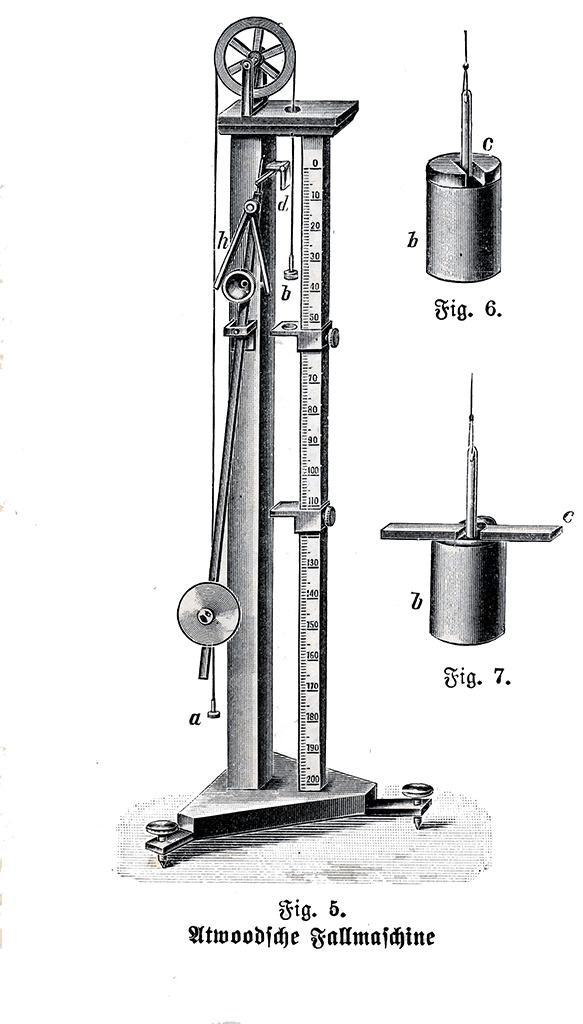


Atwood Machine
Drop a stone and it hits the ground before you can time it. That was the problem in 1784: everyone accepted that falling bodies accelerate uniformly, but nobody could easily measure the acceleration, because free fall is over too quickly for a pendulum clock.
George Atwood's answer was to hang two nearly equal masses over a pulley. The heavier side still falls, but it has to drag the lighter side up with it, so the whole system accelerates at only a small fraction of g. Make the mass difference small enough and you can slow gravity down to walking pace — and time it comfortably by hand.
It is still the cleanest way to see that acceleration depends on net force divided by total mass, because you can change either one independently and watch the prediction hold.
Istruzioni
Keep feet and fingers clear of the falling mass
Keep feet and fingers clear of the falling mass
Masses land hard. Put a book or a foam block on the floor under the descending side and keep hands off the string while it runs.
Mount the pulley high and level
Mount the pulley high and level
Clamp a low-friction pulley to a stand or a door frame so both strings hang free and vertical, with at least 1.5 m of drop below it. A ball-bearing pulley is worth using; a nail or a hook adds friction that swamps the effect.
Strumenti necessari:
 Macchina di Atwood
Hang two equal masses over the pulley
Hang two equal masses over the pulley
Tie a light, non-stretching string over the pulley with an equal mass on each end — 200 g a side is a good start. Adjust until the system stays put wherever you place it. That balance point is your zero.
Strumenti necessari:
 Bilancia digitale
Note that balanced does not mean frictionless
Note that balanced does not mean frictionless
Give one side a gentle push. If it keeps drifting at roughly constant speed, friction is low. If it stops quickly, the pulley is binding — fix that now, because friction is the main source of error in everything that follows.
Measure the drop distance
Measure the drop distance
Mark a start height and a finish point on the floor or stand, and measure the vertical distance between them in metres. Use as long a drop as you have room for — timing error matters less over a longer run.
Strumenti necessari:
 Righello
Move a small rider mass to one side
Move a small rider mass to one side
Transfer a small extra mass — 5 to 20 g — onto one hanger. This difference is the only unbalanced force acting; everything else still has to be accelerated by it.
Release from rest and time the fall
Release from rest and time the fall
Hold the heavy side at the start mark, release without pushing, and start the stopwatch at the instant of release. Stop it when the mass reaches the finish point.
Strumenti necessari:
 Cronometro
Repeat five times and average
Repeat five times and average
Human reaction time is roughly 0.2 s and scatters both ways. Five runs and a mean gets most of it out; write down every individual time, not just the average.
Calculate the measured acceleration
Calculate the measured acceleration
The system starts from rest, so s = ½at². Rearranged: a = 2s ÷ t². Use your mean time and your measured drop in metres.
Calculate the predicted acceleration
Calculate the predicted acceleration
For masses m₁ and m₂ over an ideal pulley: a = (m₁ − m₂)g ÷ (m₁ + m₂), with g = 9.81 m/s². Note that only the difference drives it while the total resists it.
Compare the two numbers
Compare the two numbers
Measured acceleration should come out slightly below predicted. A shortfall of a few per cent is friction and pulley inertia. A shortfall of thirty per cent means the pulley is bad or the string is stretching.
Change only the net force
Change only the net force
Move a second rider across from one side to the other, keeping the total mass identical. Re-time. Doubling the mass difference should double the acceleration — force up, mass constant.
Change only the total mass
Change only the total mass
Now add the same extra mass to both sides, keeping the difference fixed. Re-time. Acceleration falls, because the same net force now has more to move.
Plot acceleration against mass difference
Plot acceleration against mass difference
With total mass held constant, plot your measured a on the vertical axis against (m₁ − m₂) on the horizontal. The points should fall on a straight line through the origin — that straight line is Newton's second law, drawn by hand.
Extract a value for g
Extract a value for g
The gradient of that line is g ÷ (m₁ + m₂). Multiply the gradient by your total mass and you have measured the acceleration due to gravity — expect a value a little under 9.81 m/s², for the same reasons as step 11.
Compendium — what Atwood actually solved
Compendium — what Atwood actually solved
The instrument exists because clocks were slow. George Atwood described this machine in his 1784 Treatise on the Rectilinear Motion and Rotation of Bodies at Cambridge. Newton's Principia was a century old and uncontested, but demonstrating uniform acceleration directly needed timing to a small fraction of a second, which pendulum clocks and human observers could not deliver on a two-metre free fall. Atwood's insight was not new physics — it was that you can dilute gravity. The factor (m₁ − m₂)/(m₁ + m₂) is a dial: set it to 1/100 and a fall that took 0.6 seconds now takes six.
Where the missing acceleration goes. The ideal formula assumes a massless, frictionless pulley and an inextensible massless string. A real pulley has to be spun up, and its rotational inertia acts like extra mass bolted to the system: the honest expression is a = (m₁ − m₂)g ÷ (m₁ + m₂ + I/r²), where I is the pulley's moment of inertia and r its radius. This is why your measured value sits below prediction, and why the discrepancy grows as you make the mass difference smaller — the pulley's fixed contribution becomes a larger share of the total. The error is not sloppiness; it is a real term you left out.
The tension is not the weight. A frequent misconception is that the string tension equals the weight of the lighter mass. It does not — if it did, nothing would accelerate. For the ideal case T = 2m₁m₂g ÷ (m₁ + m₂), which lies strictly between the two weights. The heavy side is held back and the light side is pulled up by the same string, and that only works if the tension is greater than one weight and less than the other.
Why it is still in laboratories. Photogates and light gates have replaced the stopwatch, but the machine itself is unchanged, because it isolates one relationship with almost nothing else in the way. Modern variants replace the hanging mass with a magnetic or motorised drive to study driven oscillation; the geometry is Atwood's.
Strumenti richiesti
4- Segnaposto
- Segnaposto
- Segnaposto
- Segnaposto
Blueprint correlati
Questi blueprint condividono conoscenze — tecniche, materiali o principi




CC0 Pubblico dominio
Questo progetto è rilasciato sotto CC0. Sei libero di copiare, modificare, distribuire e utilizzare quest'opera per qualsiasi scopo, senza chiedere permesso.
Supporta il Maker acquistando prodotti tramite il suo progetto dove guadagna una Commissione Maker stabilita dai venditori, oppure crea una nuova iterazione di questo progetto e includilo come collegamento nel tuo progetto per condividere i ricavi.