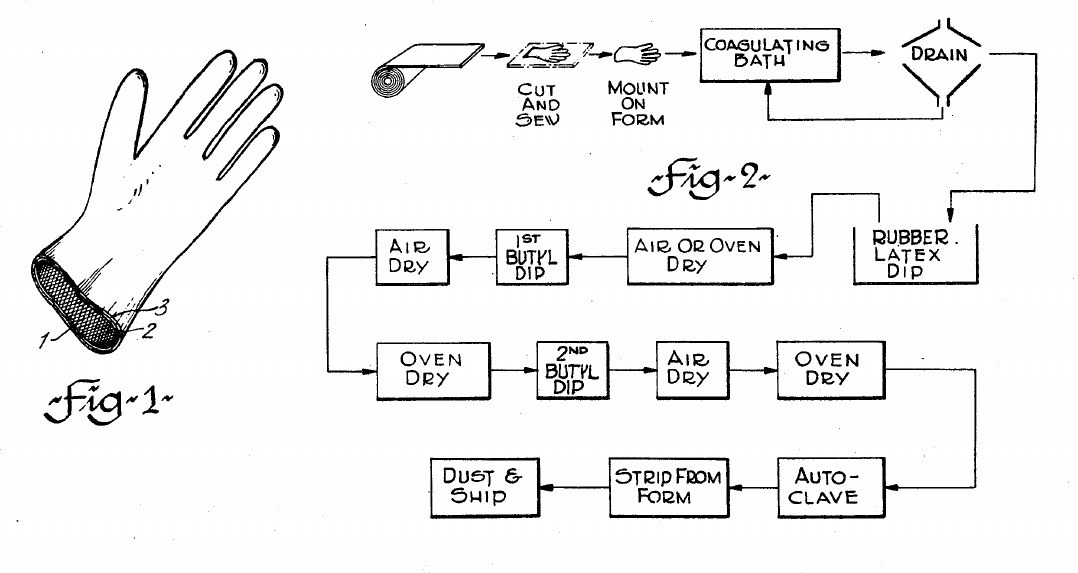


Chemical-Resistant Gloves: Butyl Latex over Natural Rubber on a Cotton Liner (Hart & Collyer, US 4,190,685, 1980)
Istruzioni
Sew the cotton liner
Sew the cotton liner
Materiali per questo passaggio:
 Maglina di cotone1 liner
Strumenti necessari:
 Forbici
 Macchina da cucire
 Dimensioni sconosciute
Dip in coagulant
Dip in coagulant
Materiali per questo passaggio:
 Acido acetico (glaciale)1 10 % in acetone
 Acetone1 solvent
Strumenti necessari:
 Forma per guanti
 Cannello a propano
Dip the natural rubber coat
Dip the natural rubber coat
Materiali per questo passaggio:
 Lattice di gomma naturale1 bath
 Detergente abrasivo1 as needed
Strumenti necessari:
Forma per guanti Spazzolone
Mix the butyl latex bath
Mix the butyl latex bath
Materiali per questo passaggio:
 Lattice di gomma butilica100 parts dry
 Zolfo3 parts
 Dibutilditiocarbammato di zinco4 parts
 Polvere di ossido di zinco5 parts
 Soluzione di formaldeide (formalina al 37 %)0.1 parts formaldehyde
 Accelerante ditiocarbammato liquido4 parts
 Materiale sconosciuto6.5 parts pigment
Strumenti necessari:
 Agitatore
Dip five butyl coats
Dip five butyl coats
Strumenti necessari:
Forma per guanti Essiccatoio
Cure and finish
Cure and finish
Materiali per questo passaggio:
 Sapone1 as needed
Strumenti necessari:
 Autoclave da bancoForbici
Materiali
13- 1 linerSegnaposto
- 1 10 % in acetoneSegnaposto
- 1 solventSegnaposto
- Segnaposto
- 1 as neededSegnaposto
- 100 parts drySegnaposto
- 3 partsSegnaposto
- Segnaposto
- 5 partsSegnaposto
- 0.1 parts formaldehydeSegnaposto
- Segnaposto
- 6.5 parts pigmentSegnaposto
- 1 as neededSegnaposto
Strumenti richiesti
9- Segnaposto
- Segnaposto
- Segnaposto
- Segnaposto
- Segnaposto
- Segnaposto
- Segnaposto
- Segnaposto
- Segnaposto
Materiali dei progetti collegati

กรีดยางพารา — การเก็บน้ำยางธรรมชาติจากต้นยางพารา
di SomchaiSang
Agricoltura

Glacial Acetic Acid from Wood Vinegar: Acetate of Soda, Oil of Vitriol and Freezing
di Charlie
Industriale
Acetone by Dry Distillation of Acetate of Lime
di Charlie
Chimica
Collecting Native Sulfur from Volcanic Deposits
di Peter
Deserto
Making Zinc White Pigment — The Non-Toxic Replacement for Lead White
di Charlie
ARTE
Questo progetto realizza

CC0 Pubblico dominio
Questo progetto è rilasciato sotto CC0. Sei libero di copiare, modificare, distribuire e utilizzare quest'opera per qualsiasi scopo, senza chiedere permesso.
Supporta il Maker acquistando prodotti tramite il suo progetto dove guadagna una Commissione Maker stabilita dai venditori, oppure crea una nuova iterazione di questo progetto e includilo come collegamento nel tuo progetto per condividere i ricavi.