Collaborazione
ARTE
BELLEZZA E BENESSERE
MESTIERE
CULTURA E STORIA
DIVERTIMENTO
AMBIENTE
CIBO E BEVANDE
INGEGNERIA INVERSA
SCIENZE
SPORT
TECNOLOGIA
INDOSSABILI
Rotating-Receiver Stationary-Break Churn: The Whole Cream Vessel Turns, a Narrow Fixed Break Churns It
Buttercup

Creato da

Buttercup

11. novembre 2026IE
1
0
0
0
0

Rotating-Receiver Stationary-Break Churn: The Whole Cream Vessel Turns, a Narrow Fixed Break Churns It

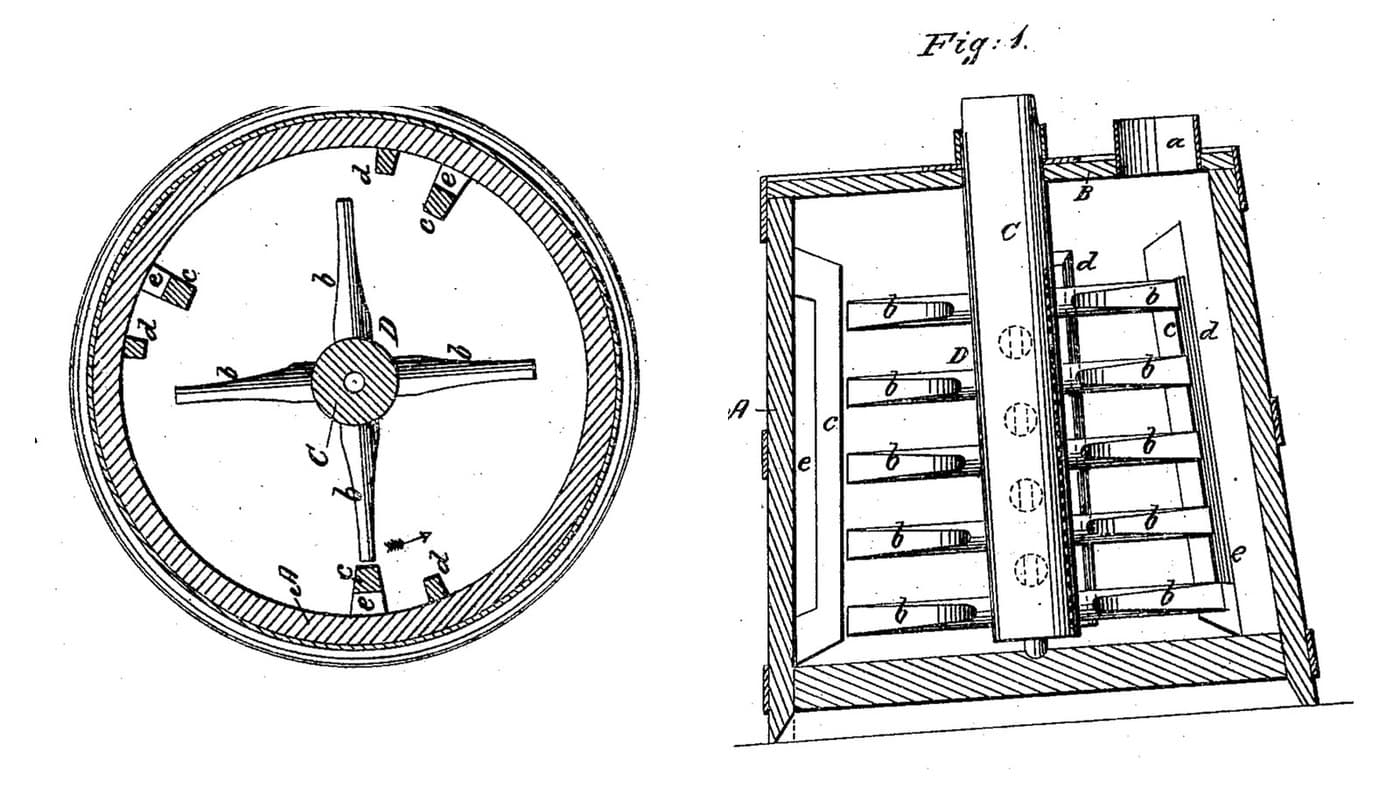
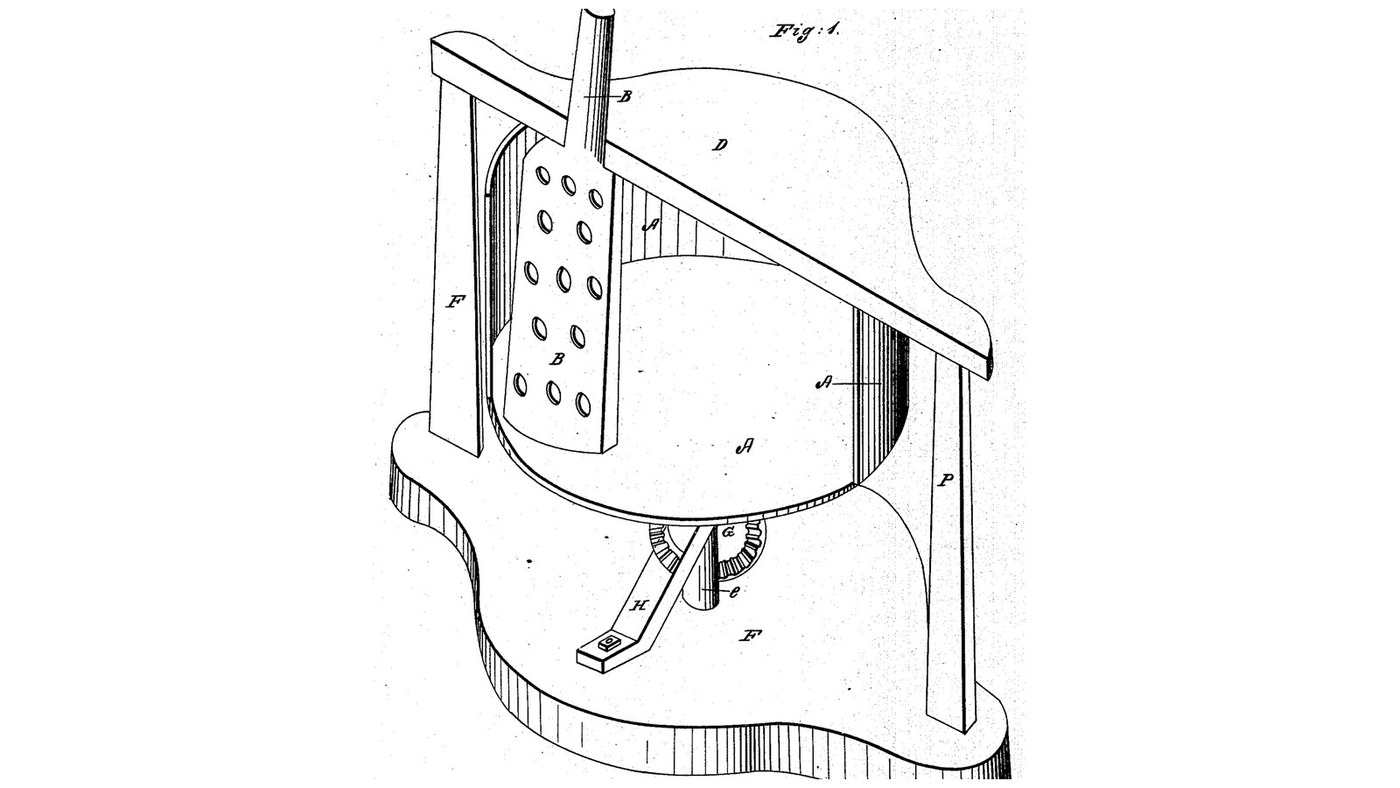
Mortimer S. Harsha of Sycamore, Illinois, received US 26,459, dated 13 December 1859, for what he called the "Vertical Rotating and Stationary Break Churn". Instead of a dasher, the whole cream vessel turns on an upright shaft with a pointed foot, driven by a gear and crank below it, while one narrow perforated break, fixed to a removable top, stands still near the vessel's side. The turning cream keeps going like a balance wheel, so little effort keeps it churning. The patent gives no sizes; every size here is ours.
Intermedio
About a day, plus printing

Istruzioni

1

The turning cream against a still break

Caricamento del notebook Jupyter…
2

Fixed brakes in turning cream, three months before

Taylor turned a dasher among fixed brakes. Harsha turns the vessel itself against a single fixed break.
3

Read US 26,459

"This is accomplished by said break presenting only a small resisting surface to the moving cream, while the cream being made to rapidly rotate on said vertical or upright shaft only against said break dash, becomes, along with its receiver, a receptacle of the power applied, similar to that of a balance wheel, and so by its own accumulative force, when power is once applied, puts it in motion"
4

Print the gear wheel G

Crown wheel, 36 teeth on its face, module 2, with a hub bored 12.4 mm and a cross hole for a pin. PETG, 0.2 mm layers, 40 % infill, 4 walls.
File di designSTLCC0 - Free
5

Print the pinion

Spur pinion, 12 teeth, module 2, with a long hub bored 16.4 mm and a cross hole for a pin. PETG, 0.2 mm layers, 40 % infill, 4 walls.
File di designSTLCC0 - Free
6

Print the socket

A cup 50 mm across and 22 mm tall with a cone recess for the shaft's point. PETG, 0.2 mm layers, 40 % infill, 4 walls.
File di designSTLCC0 - Free
7

Print the flange

A disc 200 mm across and 15 mm thick bored 16.6 mm, to carry the receiver. Print with 100 % infill. PETG, 0.2 mm layers, 40 % infill, 4 walls.
File di designSTLCC0 - Free
8

Base E, brace H, posts F and top D

Make a hardwood base 600 x 600 mm and screw the socket in its middle. Screw a brace H to it, an upright 30 x 40 mm with an arm reaching over the socket, bored 16.6 mm 25 to 55 mm up as the shaft's journal box. Tenon two posts 30 x 50 mm, 515 mm tall, into the base 490 mm apart, and make a top board 550 x 160 x 20 mm with mortises to drop onto their tenons so it lifts off. Set two chairs 44 x 30 mm, 124 mm tall, for the gear wheel's shaft.

Materiali per questo passaggio:

Tavola di legno duroTavola di legno duro3 pezzi
Colla da legnoColla da legno1 pezzo
Viti da legnoViti da legno20 pezzi
Filamento PETGFilamento PETG1 pezzo

Strumenti necessari:

Stampante 3D a filamento (FDM)Stampante 3D a filamento (FDM)
Sega circolare da bancoSega circolare da banco
Seghetto alternativoSeghetto alternativo
Scalpello da mortaseScalpello da mortase
Mazzuolo di legnoMazzuolo di legno
Trapano a batteriaTrapano a batteria
Serie di punte da trapanoSerie di punte da trapano
Morsetto a barraMorsetto a barra
Metro a nastroMetro a nastro
9

Shaft C, receiver A and gearing

File one end of a 16 mm stainless shaft 170 mm long to a point. Pin the pinion and the flange on it, stand its point in the socket through the journal box, and bolt the stockpot's bottom to the flange with stainless screws sealed with silicone. Fit the crown wheel on a 12 mm stainless shaft through the chairs, meshing under the pinion, with a crank and handle on its end.

Materiali per questo passaggio:

Barra di acciaio inossidabileBarra di acciaio inossidabile2 pezzi
PentolonePentolone1 pezzo
Viti da metalloViti da metallo4 pezzi
Dado autobloccante con inserto in nylonDado autobloccante con inserto in nylon4 pezzi

Rondella pianaRondella piana8 pezzi
Sigillante siliconicoSigillante siliconico1 pezzo
Tasselli di legno duroTasselli di legno duro1 pezzo

Strumenti necessari:

Seghetto per metalliSeghetto per metalli
Lime (lima a mano)Lime (lima a mano)
Trapano a batteriaTrapano a batteria
Serie di punte da trapanoSerie di punte da trapano
Chiave regolabile a rullinoChiave regolabile a rullino
Set di cacciavitiSet di cacciaviti
10

Break dash B

Cut a hardwood break 60 x 15 mm long enough to reach from the top board to 25 mm above the receiver's floor, bore ten 16 mm holes through it, and fix it by a tenon through the top board so it hangs 30 mm in from the receiver's side.

Materiali per questo passaggio:

Tavola di legno duroTavola di legno duro1 pezzo
Colla da legnoColla da legno1 pezzo

Strumenti necessari:

Sega circolare da bancoSega circolare da banco

Set di punte a lanciaSet di punte a lancia
Trapano a batteriaTrapano a batteria
Scalpello da mortaseScalpello da mortase
Mazzuolo di legnoMazzuolo di legno
Carta abrasivaCarta abrasiva
11

The build in 3D

FreeCAD model of this build, the receiver cut through the middle: the base with its socket, brace and posts, the shaft with pinion and flange, the crown wheel and crank, the turning receiver and the fixed perforated break hanging from the top.
File di designBLENDCC0 - Free
12

Churn

Lift the top off, pour about 9 litres of heavy cream at about 15 °C into the receiver, checked with the thermometer, and put the top back. Turn the crank steadily, timing it: once the cream is moving it keeps going with little effort. When the butter comes, lift the top and break out, take out the butter, drain the buttermilk, wash the butter in cold water until it runs clear, salt and weigh it.

Materiali per questo passaggio:

Panna da montarePanna da montare9 l
Sale marino grossoSale marino grosso1 pezzo
AcquaAcqua1 pezzo

Strumenti necessari:

Termometro a sonda permanenteTermometro a sonda permanente
CronometroCronometro
Bilancia digitale da cucinaBilancia digitale da cucina
Grande ciotola da impasto in acciaio inossidabileGrande ciotola da impasto in acciaio inossidabile
13

Troubleshooting

Rotating-receiver churn troubleshooting.

Flow

Loading...
14

History and honest limits

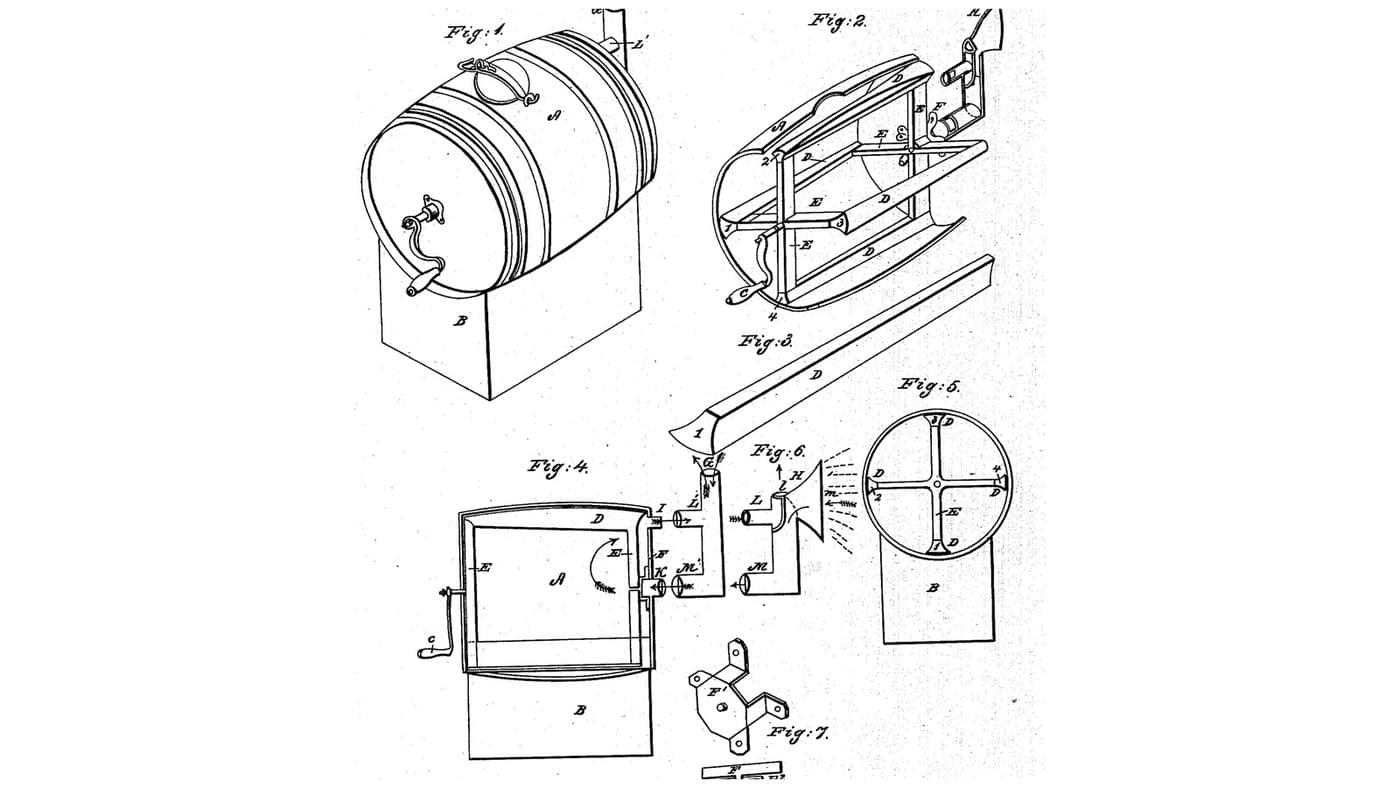
**Mortimer S. Harsha** of Sycamore, DeKalb County, Illinois, assignor to himself, Rufus S. Sanborn and H. B. Jones, US 26,459, 13 December 1859, "Churn". He claimed: "An entirely stationary break dash in combination with a cream receiver, made to rotate on a vertical or upright shaft". His break is made "of such size as the relative size of the machine requires, and of any common form or shape"; the patent gives no sizes, and every size here is ours. His receiver was tin, zinc or wood; ours is a stainless stockpot.

Materiali

14

Strumenti richiesti

19

File di progetto

5

CC0 Pubblico dominio

Questo progetto è rilasciato sotto CC0. Sei libero di copiare, modificare, distribuire e utilizzare quest'opera per qualsiasi scopo, senza chiedere permesso.

Supporta il Maker acquistando prodotti tramite il suo progetto dove guadagna una Commissione Maker stabilita dai venditori, oppure crea una nuova iterazione di questo progetto e includilo come collegamento nel tuo progetto per condividere i ricavi.

Commenti

(0)

Accedi per partecipare alla discussione

Caricamento commenti...