Collaborazione
ARTE
BELLEZZA E BENESSERE
MESTIERE
CULTURA E STORIA
DIVERTIMENTO
AMBIENTE
CIBO E BEVANDE
INGEGNERIA INVERSA
SCIENZE
SPORT
TECNOLOGIA
INDOSSABILI
Youblob · CC0


Hydroxyl-Ended Silicone Oil: D4 Opened with Potash, Then Water (Ceyzeriat 1964)
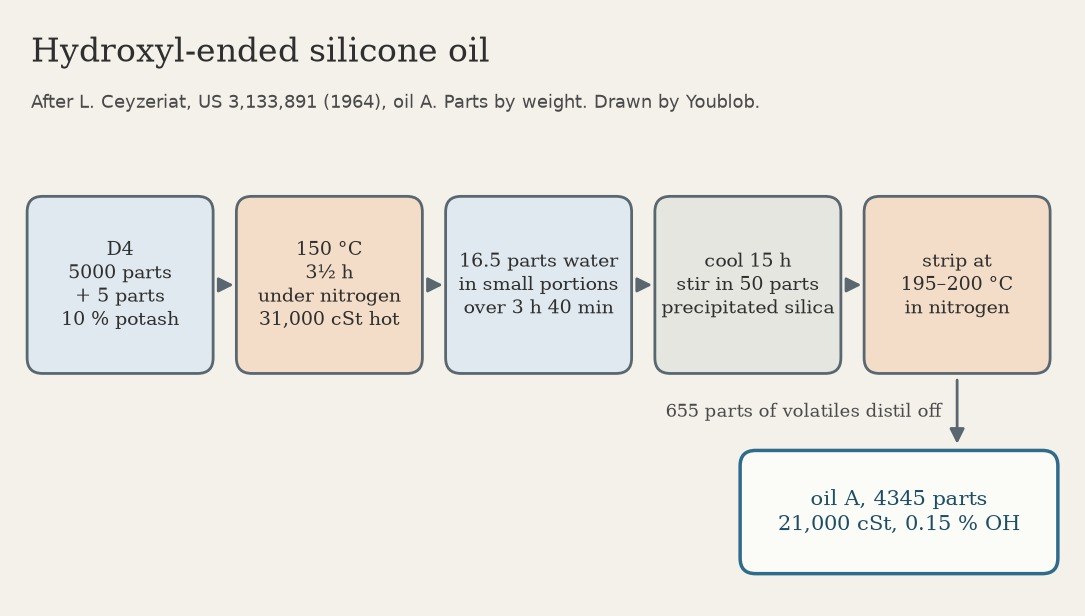
A trace of hot potash opens the ring of D4 and strings it into a long, thick chain. Water added a little at a time then cuts the chains back and leaves hydroxyl groups on their ends, which is what later lets the oil cure into rubber. This is Louis Ceyzeriat's oil A, the base of every sealant in his patent: 21,000 centistokes, 0.15 % hydroxyl.
Source: L. Ceyzeriat (Rhône-Poulenc), US 3,133,891 (1964), column 4. His neutraliser was the precipitated silica Hi-Sil X303; we use our precipitated silica in its place. The potash mix and the equipment are ours. Picture drawn by Youblob.
Avanzato
2 days
Istruzioni
1
1
Make the 10 % potash
Make the 10 % potash
Dissolve 0.5 part of potassium hydroxide in 4.5 parts of water (our arithmetic for 5 parts of a 10 % solution). All parts are by weight.
Materiali per questo passaggio:
 Idrossido di potassio0.5 parts
 Acqua4.5 parts
Strumenti necessari:
 Recipiente di vetro
 Bilancia a bracci
2
2
Heat D4 with the potash under nitrogen
Heat D4 with the potash under nitrogen
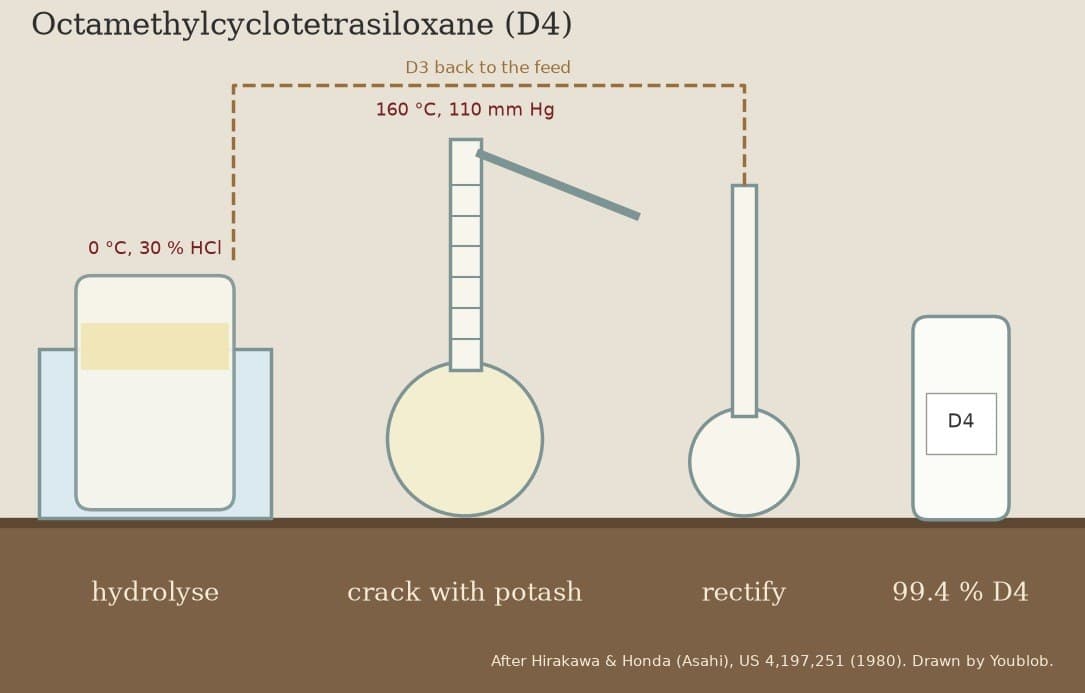
Heat 5000 parts of octamethylcyclotetrasiloxane (it melts at 17.5 °C) with the 5 parts of 10 % potash at 150 °C for 3½ hours under nitrogen. The oil thickens to 31,000 centistokes while hot.
Materiali per questo passaggio:
 Ottametilciclotetrasilossano (D4)5000 parts
Strumenti necessari:
 Pallone di distillazione in vetro
 Piastra riscaldante
 Termometro
 Agitatore
 Bombola di azoto
3
3
Add water a little at a time
Add water a little at a time
Still hot, add 16.5 parts of water in small portions over 3 hours 40 minutes. The hot oil thins to 1730 centistokes.
Materiali per questo passaggio:
Acqua16.5 partsStrumenti necessari:
Pallone di distillazione in vetroPiastra riscaldanteTermometroAgitatore4
4
Cool, then neutralise with silica
Cool, then neutralise with silica
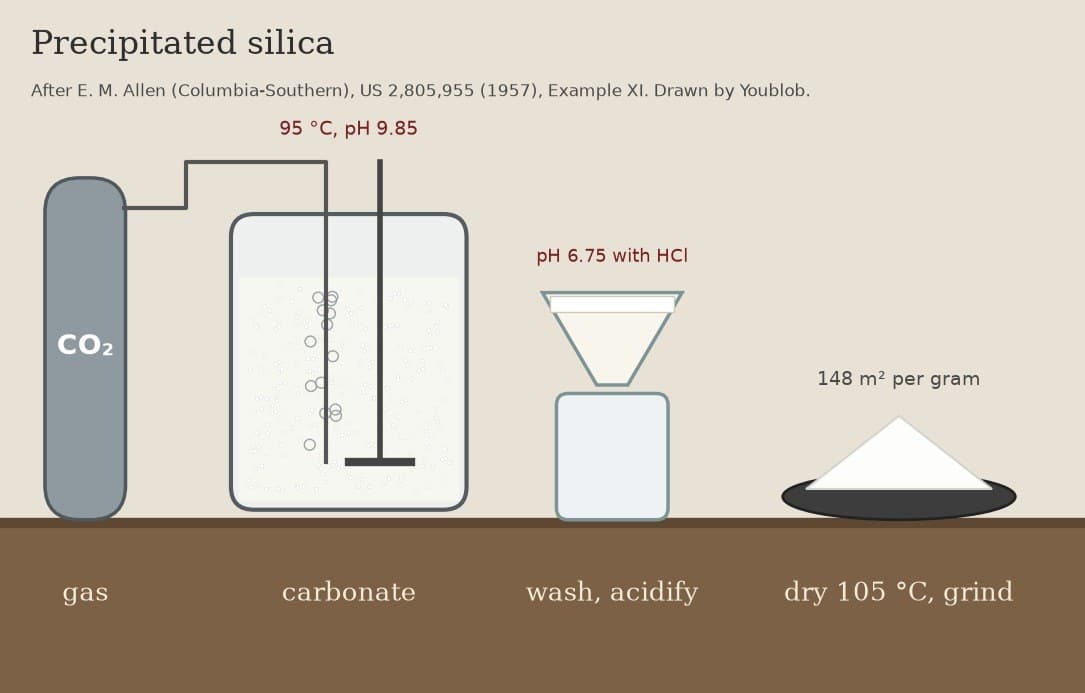
Let it cool for 15 hours. Then stir in 50 parts of precipitated silica to neutralise the potash. The liquid now measures 13,400 centistokes at 25 °C.
Materiali per questo passaggio:
 Silice precipitata50 parts
Strumenti necessari:
Pallone di distillazione in vetroAgitatore5
5
Strip the volatiles at 195–200 °C
Strip the volatiles at 195–200 °C
Heat it to about 195–200 °C in a current of nitrogen, with a water condenser on the outlet. 655 parts of liquid distil over; 4345 parts of oil A stay in the boiler, 21,000 centistokes at 25 °C with 0.15 % hydroxyl groups.
Strumenti necessari:
Pallone di distillazione in vetro Serpentina del condensatorePiastra riscaldanteTermometroBombola di azoto
 Barattoli di vetro con coperchio
Materiali
4- 0.5 partsSegnaposto
- 21 partsSegnaposto
- 5000 partsSegnaposto
- 50 partsSegnaposto
Strumenti richiesti
9- Segnaposto
- Segnaposto
- Segnaposto
- Segnaposto
- Segnaposto
- Segnaposto
- Segnaposto
- Segnaposto
- Segnaposto
Questo progetto realizza
Blueprint correlati
Questi blueprint condividono conoscenze — tecniche, materiali o principi
CC0 Pubblico dominio
Questo progetto è rilasciato sotto CC0. Sei libero di copiare, modificare, distribuire e utilizzare quest'opera per qualsiasi scopo, senza chiedere permesso.
Supporta il Maker acquistando prodotti tramite il suo progetto dove guadagna una Commissione Maker stabilita dai venditori, oppure crea una nuova iterazione di questo progetto e includilo come collegamento nel tuo progetto per condividere i ricavi.