Collaborazione
ARTE
BELLEZZA E BENESSERE
MESTIERE
CULTURA E STORIA
DIVERTIMENTO
AMBIENTE
CIBO E BEVANDE
INGEGNERIA INVERSA
SCIENZE
SPORT
TECNOLOGIA
INDOSSABILI
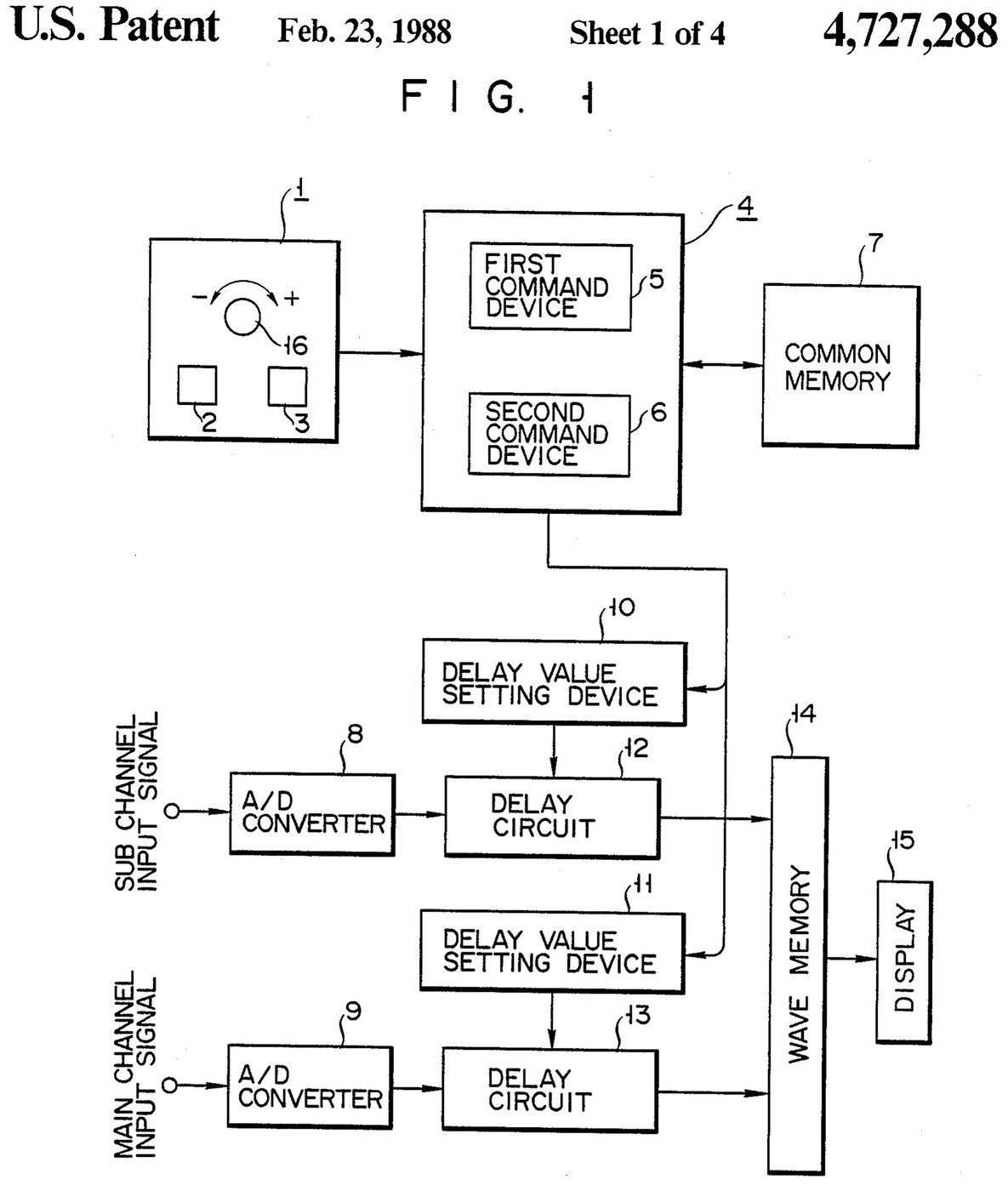

Oscilloscope: Two-Channel Digital, with a Delay per Channel and a Common Delay (Anritsu, US 4,727,288, 1988)
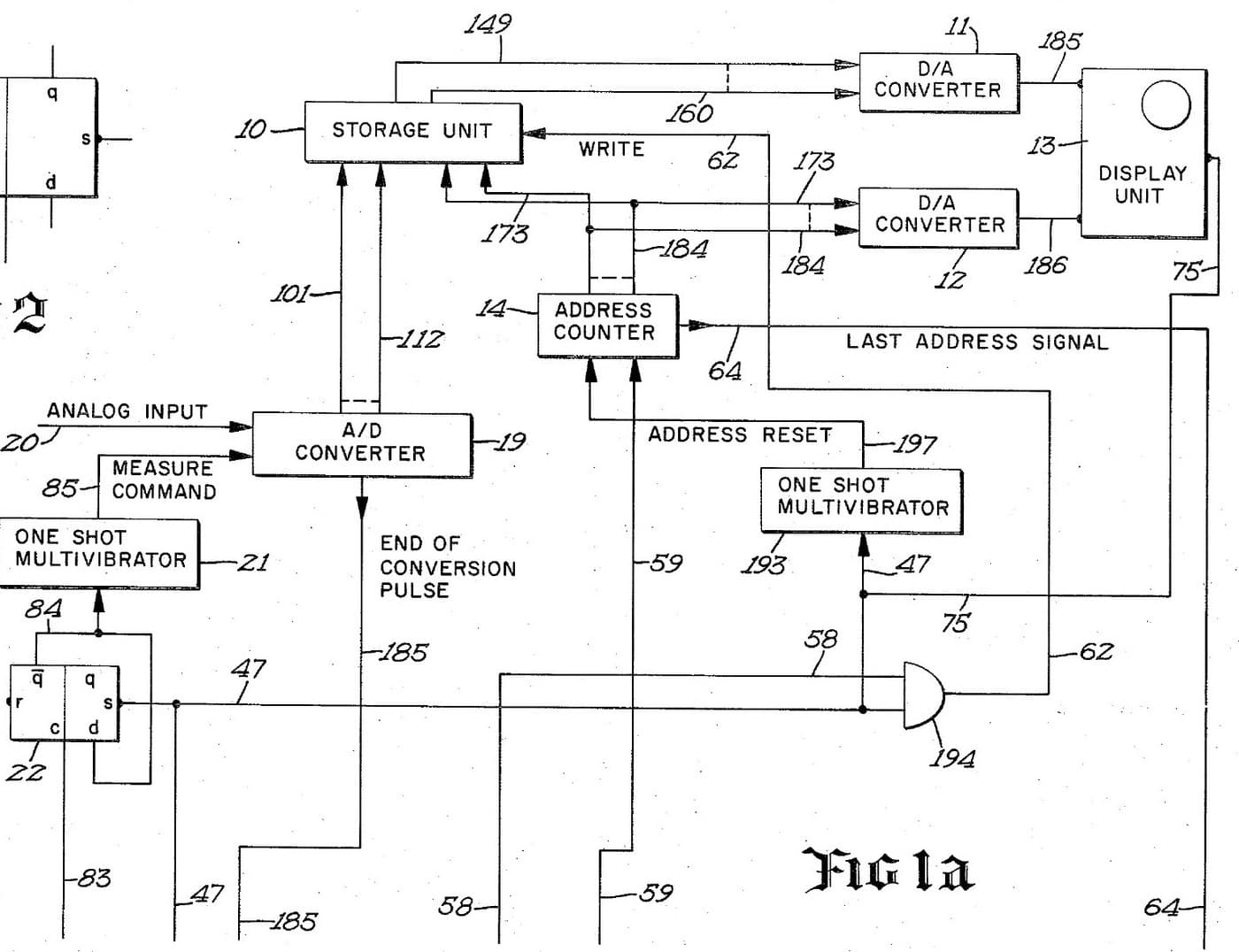
A two-channel digital oscilloscope. Each channel has its own converter and delay circuit. One knob, with a main and a sub button, sets the delays. The sub button shifts only the sub channel's wave, so you can line it up against the main one. The main button shifts both waves together and keeps the gap between them.
Result: a 2-channel digital oscilloscope that can move both traces along the time base without losing their phase difference.
Source: K. Nakatsugawa et al. (Anritsu), US 4,727,288 (1988). Unknown: sample rate, bandwidth, memory size and the display. Picture: the patent drawing.
Esperto
Unknown
Istruzioni
1
1
Convert the two channels
Convert the two channels
Bring the main channel and the sub channel each to its own analog-to-digital converter. Ours: BNC sockets. Not given: the sample rate, the bandwidth.
Materiali per questo passaggio:
 Convertitore analogico-digitale2 main and sub converters
 Set di connettori coassiali (BNC / SO-239)1 input sockets
Strumenti necessari:
 Saldatore a stagno
 Spelafili
2
2
Delay, store and display
Delay, store and display
Pass each channel's digital signal through its own delay circuit, whose delay is set by its own delay value setting device. Store both delayed signals in a wave memory and show them on the display. Ours: logic ICs for the delay circuits and setting devices, IC memory, and a CRT driven through D/A converters. Not given: how the delay circuits are built, the memory size, the display.
Materiali per questo passaggio:
 Assortimento di circuiti integrati logici1 delay circuits and setting devices
 Memoria a circuiti integrati1 wave memory
 Convertitore digitale-analogico2 display drive
 Tubo a raggi catodici1 display
Strumenti necessari:
Saldatore a stagnoSpelafili3
3
Build the delay panel and processor
Build the delay panel and processor
Make a delay operation panel with a main switch, a sub switch and one dial, with an encoder on the dial so each turn is read as a change in its output. Connect the panel to a microprocessor with a common memory that holds the sub channel's delay S in one area and the main channel's delay M in another. Mount it all in a case with its supply. Ours: push buttons, an aluminium case, a DC supply.
Materiali per questo passaggio:
 Pulsante2 main and sub switches
 Encoder rotativo1 delay dial
 Microprocessore1 command devicesMemoria a circuiti integrati1 common memory
 Contenitore in alluminio1 case
Strumenti necessari:
 Alimentatore in corrente continua
 Trapano a colonnaSaldatore a stagno
4
4
Program the two commands
Program the two commands
When the dial turns, read the encoder change e and which switch is held. Sub switch: add e to S, set the sum in the sub channel's setting device and store it back as the new S. Main switch: add e to both M and S, set M + e in the main channel's device and S + e in the sub channel's, and store both back. The main command so moves both channels by the same amount and keeps their relative delay.
Strumenti necessari:
Saldatore a stagno5
5
Compare two waves
Compare two waves
Feed two signals in. Hold the sub switch and turn the dial to slide the sub channel's wave against the main one. Then hold the main switch and turn the dial: both waves move along the time base together, with the phase difference between them unchanged. Test it with a known signal.
Strumenti necessari:
 Generatore di funzioni
Materiali
10- 2 main and sub convertersSegnaposto
- 1 input socketsSegnaposto
- 1 delay circuits and setting devicesSegnaposto
- 1 common memorySegnaposto
- 2 display driveSegnaposto
- 1 displaySegnaposto
- Segnaposto
- Segnaposto
- 1 command devicesSegnaposto
- 1 caseSegnaposto
Questo progetto realizza

Blueprint correlati
Questi blueprint condividono conoscenze — tecniche, materiali o principi
CC0 Pubblico dominio
Questo progetto è rilasciato sotto CC0. Sei libero di copiare, modificare, distribuire e utilizzare quest'opera per qualsiasi scopo, senza chiedere permesso.
Supporta il Maker acquistando prodotti tramite il suo progetto dove guadagna una Commissione Maker stabilita dai venditori, oppure crea una nuova iterazione di questo progetto e includilo come collegamento nel tuo progetto per condividere i ricavi.