
Collaborazione
ARTE
BELLEZZA E BENESSERE
MESTIERE
CULTURA E STORIA
DIVERTIMENTO
AMBIENTE
CIBO E BEVANDE
INGEGNERIA INVERSA
SCIENZE
SPORT
TECNOLOGIA
INDOSSABILI
Pump Egg Beater: A Piston Draws the Eggs In and Out Through a Grate
TheChef

Creato da

TheChef

10. novembre 2026DK
0
0
0
0
0

Pump Egg Beater: A Piston Draws the Eggs In and Out Through a Grate

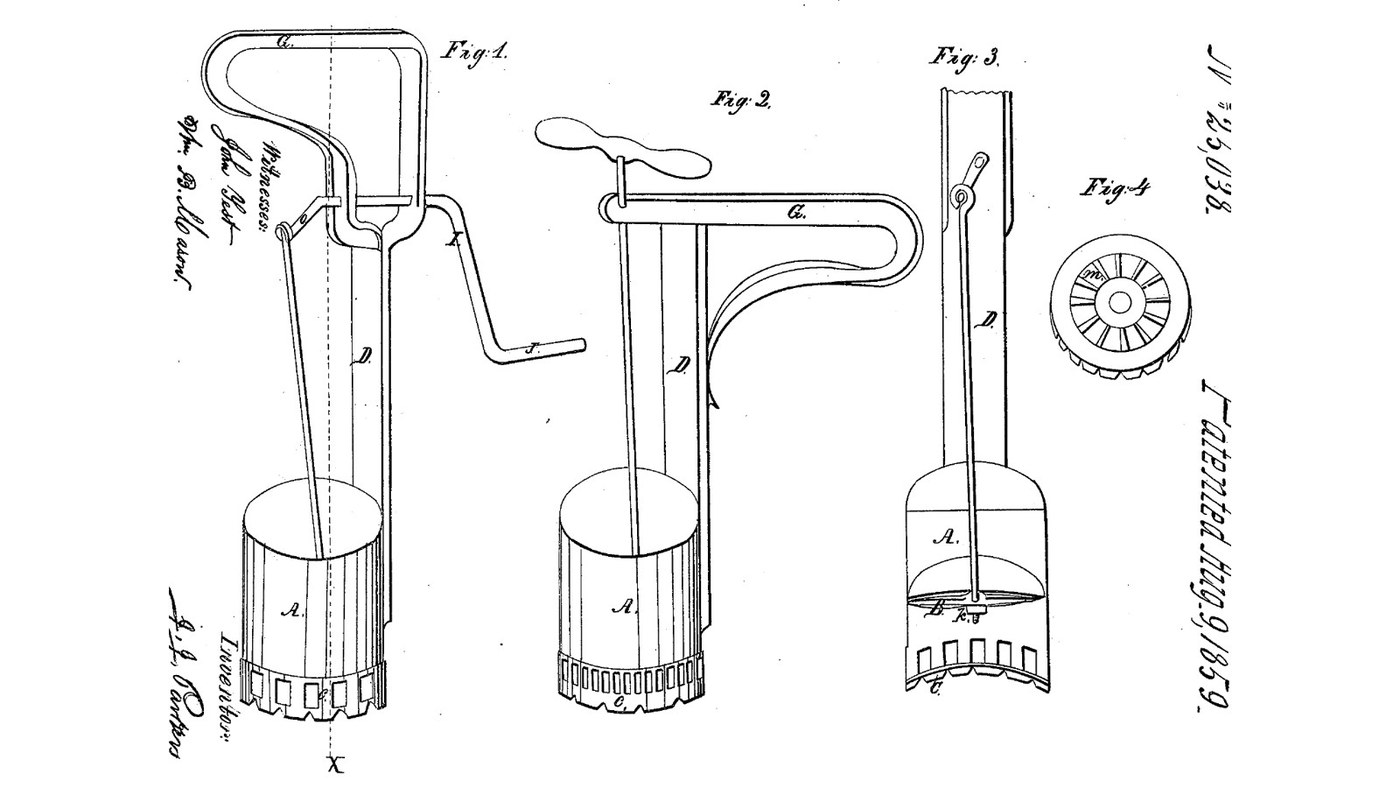
J. J. Parker of Marietta, Ohio, received US 25,038, dated 9 August 1859, for an egg-beater and churn combined. A small tube stands in the eggs. A crank on a post above it works a piston up and down "in the manner of a pump", drawing the eggs in and out through square openings and a grated bottom until they are fine and frothy. A loose band turned over the openings closes them or opens them. This rung builds his "smaller sized machine" at his own sizes: a tube 1 1/2 inches across and 1 5/8 inches deep, openings 1/4 inch square, a band 1/2 inch wide, bearings 4 inches above the tube, and a crank shaft of No. 7 wire.
Intermedio
About 4 hours, plus printing

Istruzioni

1

Parker's sizes, worked through

Caricamento del notebook Jupyter…
2

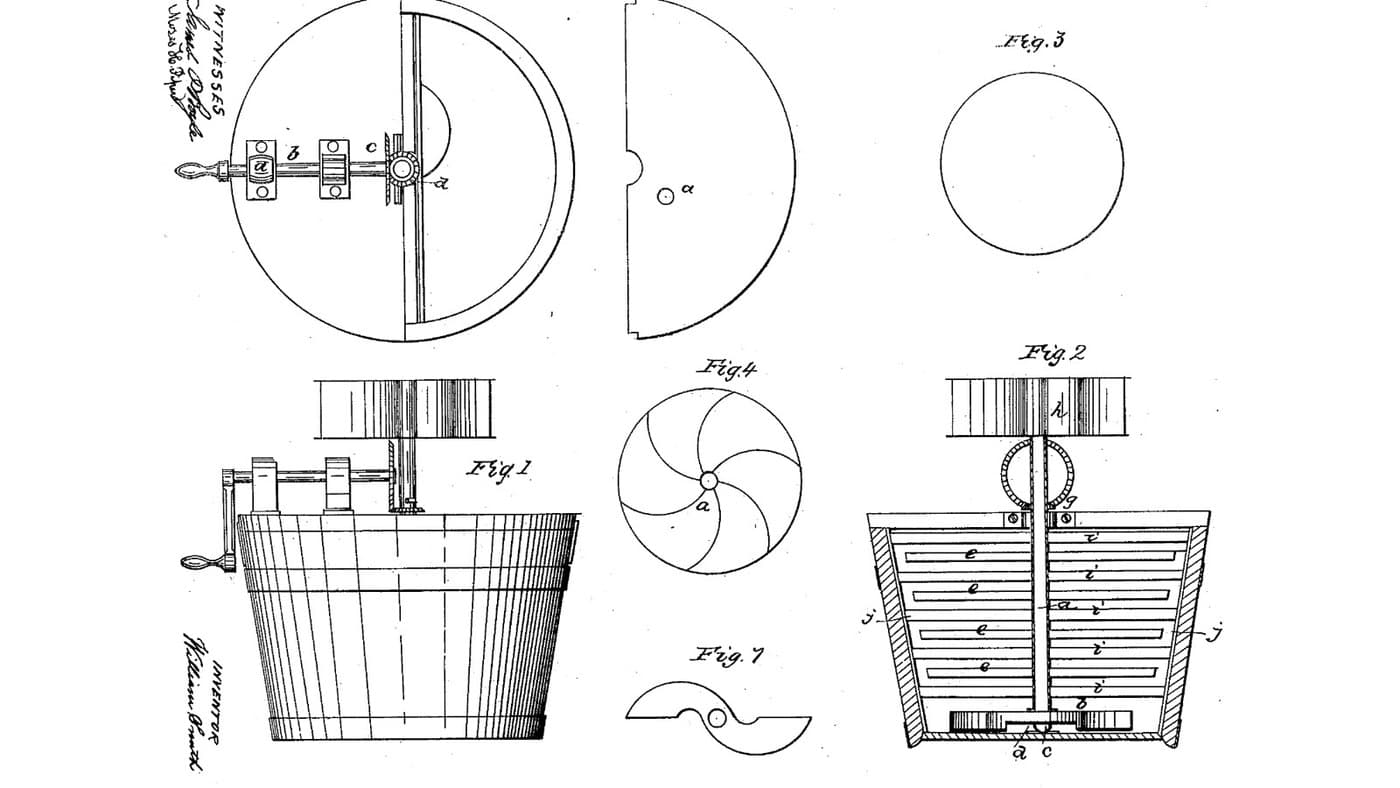
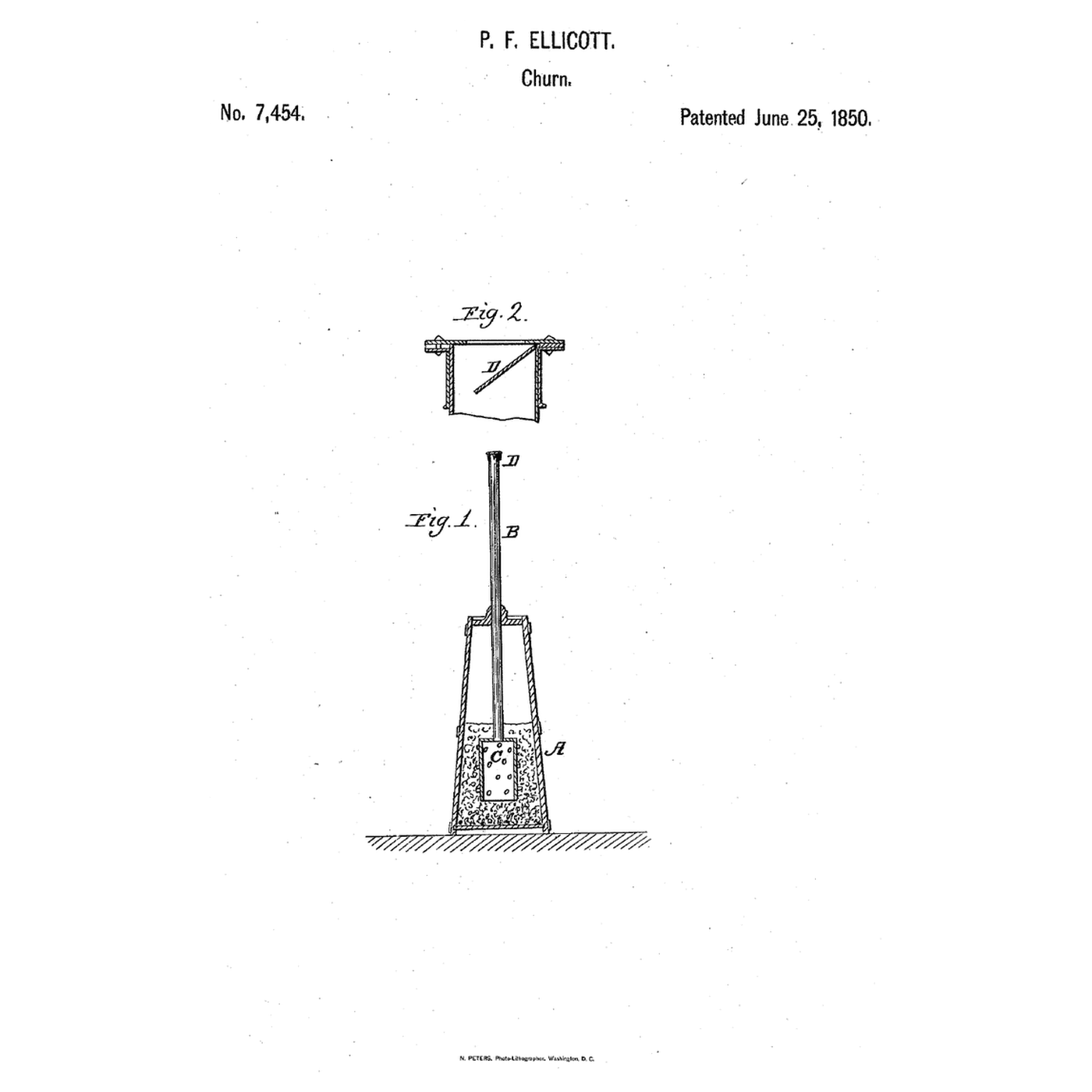
A plunger in the cream, before it

That churn was worked up and down by hand. Parker's piston is worked by a crank.
3

Read US 25,038

"The eggs are broken into a vessel, the beater set into them. The piston being moved up and down by means of the crank draws the eggs in and out through the grate bars until they are completely torn in pieces or made perfectly fine and frothy."
4

Print the tube A with post D and holder G

The tube, 38.1 mm across and 41.3 mm deep, with twelve 6.35 mm square openings at its lower end, the post up its side, the bearing 101.6 mm above the tube's top and the loop handle G. Print it standing, tube down, with supports under the bearing and the handle's top bar. PETG, 0.16 mm layers, 30 % infill, 4 walls.
File di designSTLCC0 - Free
5

Print the band C with its grated bottom M

The 12.7 mm band that slips loosely over the tube's lower end, with twelve matching openings, notches in its lower edge and the grate of twelve bars round a hub (Fig. 4). Print it grate down. PETG, 0.16 mm layers, 30 % infill, 4 walls.
File di designSTLCC0 - Free
6

Print the piston halves B

One dished half, 33.7 mm across with a 4 mm crown and a 3.4 mm hole. Print two, crown up. PETG, 0.16 mm layers, 30 % infill, 4 walls.
File di designSTLCC0 - Free
7

Crank shaft from No. 7 wire

Cut about 180 mm of 4.6 mm stainless wire. In the vice bend the wrist and the 7/8 inch crank at one end: a 6.4 mm wrist, then a 22.2 mm arm at right angles, measured centre to centre. Slide the straight end through the bearing from the tube's side, and 25.4 mm on bend the 2 inch crank, 50.8 mm centre to centre, opposite the first, then a 38 mm handle. Push a hardwood dowel, drilled 4.8 mm, on the handle as a grip.

Materiali per questo passaggio:

Filo di acciaio inoxFilo di acciaio inox1 pezzo
Tasselli di legno duroTasselli di legno duro1 pezzo

Strumenti necessari:

Morsa da bancoMorsa da banco
Pinze a becchi tondiPinze a becchi tondi
TronchesineTronchesine
Lime (lima a mano)Lime (lima a mano)
Trapano a batteriaTrapano a batteria
Serie di punte da trapanoSerie di punte da trapano
Calibro a corsoioCalibro a corsoio
8

Piston B on the rod E

Cut a 35.6 mm disc of 1.5 mm food-grade silicone sheet with a 3 mm hole, for Parker's leather. Cut a 3 mm stainless threaded rod 145 mm long and bend a 5 mm eye at one end with the round-nose pliers. Run two nuts up the other end, locked against each other 109 mm below the eye's middle, then a piston half crown up, the silicone disc, the other half crown down, and nut K. Tighten K until the disc's edge just stands proud of the halves: it should slide in the tube with a light drag.

Materiali per questo passaggio:

Barra filettataBarra filettata1 pezzo
Dado esagonaleDado esagonale3 pezzi
Foglio di gomma siliconicaFoglio di gomma siliconica1 pezzo

Strumenti necessari:

ForbiciForbici
Pinze a becchi tondiPinze a becchi tondi
Seghetto per metalliSeghetto per metalli
Chiave regolabile a rullinoChiave regolabile a rullino
Calibro a corsoioCalibro a corsoio
9

Assemble

Drop the piston into the tube from the top, hook the rod's eye over the wrist and squeeze the eye closed. Slip the band over the tube's lower end. Turn the handle: the piston runs down to just above the grate, and at the top of the stroke it rises out of the tube and drops back in. Turn the band so its openings line up with the tube's for the most stir, or part over them for less.

Materiali per questo passaggio:

Filamento PETGFilamento PETG1 pezzo

Strumenti necessari:

Stampante 3D a filamento (FDM)Stampante 3D a filamento (FDM)
Chiave regolabile a rullinoChiave regolabile a rullino
10

The build in 3D

FreeCAD model of this build, cut open: the tube with its post, bearing and loop handle, the band and grate, the bent crank shaft and handle, the rod and the piston at the bottom of its stroke. Checked at 24 crank angles.
File di designBLENDCC0 - Free
11

Beat eggs

Break four eggs into a glass bowl. Stand the beater in them on its notched band, hold the loop handle and turn the crank about two turns a second, timing it. Lift it out when the eggs are smooth and frothy. Wash every part in warm soapy water; the piston comes apart at nut K.

Materiali per questo passaggio:

UovoUovo4 pezzi

Strumenti necessari:

Ciotola di vetroCiotola di vetro
CronometroCronometro
12

Troubleshooting

Pump egg beater troubleshooting.

Flow

Loading...
13

History and honest limits

**J. J. Parker** of Marietta, Ohio, US 25,038, 9 August 1859, "Egg-Beater or Churn". He claimed the tube A in combination with the band C and the grated bottom M. His sizes are kept: the tube, the openings, the band, the bearing height and the crank shaft. We read his "crank seven eighths of an inch long" as centre to centre, so its 1 3/4 inch stroke is longer than his 1 5/8 inch tube is deep and the piston leaves the tube at the top of each stroke. He does not name the wire gauge; 4.6 mm is No. 7 on the Birmingham gauge. Printed PETG stands in for his tin, and silicone for his leather; the rod, the piston's shape and the handle G's outline are ours.

Materiali

7

Strumenti richiesti

13

File di progetto

4

Questo progetto realizza

CC0 Pubblico dominio

Questo progetto è rilasciato sotto CC0. Sei libero di copiare, modificare, distribuire e utilizzare quest'opera per qualsiasi scopo, senza chiedere permesso.

Supporta il Maker acquistando prodotti tramite il suo progetto dove guadagna una Commissione Maker stabilita dai venditori, oppure crea una nuova iterazione di questo progetto e includilo come collegamento nel tuo progetto per condividere i ricavi.

Commenti

(0)

Accedi per partecipare alla discussione

Caricamento commenti...